A penny for your prions: Researchers study link between copper, mad cow disease
June 25, 2009 A penny for your prions: Researchers study link between copper, mad cow disease

Enlarge

(PhysOrg.com) -- North Carolina State University researchers have discovered a link between copper and the normal functioning of prion proteins, which are associated with transmissible spongiform encephalopathy diseases such as Cruetzfeldt-Jakob in humans or "mad cow" disease in cattle.

Their work could have implications for patients suffering from these diseases, as well as from other prion-related diseases such as Alzheimers or Parkinson's.

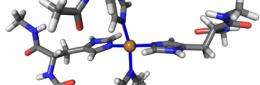
proteins, or PrPs, are commonly found in and throughout the . In humans or animals with prion diseases, these proteins deform and aggregate, creating clumps of PrPs that interfere with the nervous system's ability to function normally. A team of NC State physicists, led by Miroslav Hodak and Jerry Bernholc, has found that when PrPs bind with copper in the human body, their structure becomes more stable and less likely to misfold or aggregate.

"We believe that a prion protein's normal function is to serve as a copper buffer in the human body, binding with copper ions and keeping those ions from damaging human tissue," Hodak says. "We wanted to determine whether this was the normal function of the prion, and then look at how that binding affected the prion's structure."

The researchers created a 3-D model of the PrP using supercomputers at Oak Ridge National Laboratories. With the model, they determined that PrPs can bind up to four copper ions apiece, depending on the concentration of copper present. They also found that when the PrPs bind to the copper ions, the structure of the protein changes, becoming more stable.

Their results are published online this week in Proceedings of the National Academy of Sciences.

"Prion proteins are unusual in that half of the protein has a well-defined structure, but the other half of it - where the binding occurs - is a flexible, random tangle," Hodak says. "When we looked at the so-called 'random' portion of the PrP where that binding occurs, we found that the lend stability to the overall protein. This stability may play a role in preventing PrPs from misfolding or aggregating - which indicates that with prion diseases, copper binding may be beneficial."

More information: "Cu2+ Binding to the Prion : Functional Implications and the Role of Copper"
Authors: Miroslav Hodak, and Robin Chisnell, North Carolina State University; Wenchang Lu and Jerry Bernholc, North Carolina State University and Oak Ridge National Laboratories; Published: Online the week of June 22, 2009, in

Source: North Carolina State University (news : web)


print this article email this article download pdf blog this article bookmark this article     Stumble it Digg this share on Facebook retweet share on Reddit add to delicious
Rate this story - 4.8 /5 (4 votes)


June 25, 2009 all stories

Comments: 0

4.8 /5 (4 votes)
  • Stumble this up

  • Digg this

  • share this

  • hide
  • Related Stories

  • Study points to disruption of copper regulation as key to prion diseases
    created Apr 17, 2009 | popularity not rated yet | comments 0
  • Mutant proteins result in infectious prion disease in mice
    created Dec 05, 2008 | popularity not rated yet | comments 0
  • New prion protein may offer insight into mad cow disease
    created Aug 16, 2007 | popularity not rated yet | comments 0
  • Is there more to prion protein than mad cow disease?
    created Sep 30, 2008 | popularity not rated yet | comments 0
  • Study: Amino acid helps in copper binding
    created Dec 24, 2007 | popularity not rated yet | comments 0


  • hide
  • Relevant PhysicsForums posts

  • Goddard
    created 11 hours ago
  • Rate Laws
    created 13 hours ago
  • why oxygen, cannot act as a pi-donor while NO can?
    created Nov 20, 2009
  • Aspirin
    created Nov 19, 2009
  • More from Physics Forums - Chemistry

Other News

Accidental discovery produces durable new blue pigment for multiple applications

Accidental discovery produces durable new blue pigment for multiple applications

Chemistry / Biochemistry

created Nov 16, 2009 | popularity 4.5 / 5 (30) | comments 6

An accidental discovery in a laboratory at Oregon State University has apparently solved a quest that over thousands of years has absorbed the energies of ancient Egyptians, the Han dynasty in China, Mayan ...


One word: bioplastics

One word: bioplastics

Chemistry / Materials Science

created Nov 17, 2009 | popularity 4.6 / 5 (12) | comments 4

(PhysOrg.com) -- Every year, more than 250 billion pounds of plastic are produced worldwide. Much of it ends up in the world's oceans, a fact that troubles MIT biology professor Anthony Sinskey.


New on-off 'switch' triggers and reverses paralysis in animals with a beam of light

New on-off 'switch' triggers and reverses paralysis in animals with a beam of light (w/ Video)

Chemistry / Biochemistry

created Nov 18, 2009 | popularity 4.8 / 5 (5) | comments 3

In an advance with overtones of Star Trek phasers and other sci-fi ray guns, scientists in Canada are reporting development of an internal on-off "switch" that paralyzes animals when exposed to a beam of ultraviolet ...


New research provides blueprint for molecular basis of global warming

New research provides blueprint for molecular basis of global warming

Chemistry / Materials Science

created Nov 17, 2009 | popularity 4 / 5 (4) | comments 3

A new study indicates that major chemicals most often cited as leading causes of climate change, such as carbon dioxide and methane, are outclassed in their warming potential by compounds receiving less attention.


Ethanol

Microbes to Take Over Ethanol Production?

Chemistry / Biochemistry

created Nov 20, 2009 | popularity 3.5 / 5 (6) | comments 0

(PhysOrg.com) -- Not too long ago, it seemed that ethanol production was the wave of the future. The use of trash, wood chips or different types of plants -- usually grass or corn -- to make ethanol was considered ...