New fossil tells how piranhas got their teeth
June 25, 2009
New fossil tells how piranhas got their teeth

Enlarge

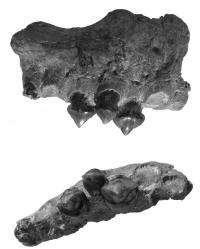
This photograph of the fossilized teeth and upper jaw of Megapiranha paranensis shows intermediate tooth arrangement between single-rowed piranhas and their double-rowed relatives. The fossil measures about 3 inches in length. Credit: Photo courtesy of Mark Sabaj-Pérez

How did piranhas -- the legendary freshwater fish with the razor bite -- get their telltale teeth? Researchers from Argentina, the United States and Venezuela have uncovered the jawbone of a striking transitional fossil that sheds light on this question. Named Megapiranha paranensis, this previously unknown fossil fish bridges the evolutionary gap between flesh-eating piranhas and their plant-eating cousins.

Present-day piranhas have a single row of triangular teeth, like the blade on a saw, explained the researchers. But their closest relatives — a group of fishes commonly known as pacus — have two rows of square teeth, presumably for crushing fruits and seeds. "In modern piranhas the teeth are arranged in a single file," said Wasila Dahdul, a visiting scientist at the National Evolutionary Synthesis Center in North Carolina. "But in the relatives of piranhas — which tend to be herbivorous fishes —the teeth are in two rows," said Dahdul.

Megapiranha shows an intermediate pattern: it's teeth are arranged in a zig-zag row. This suggests that the two rows in pacus were compressed to form a single row in piranhas. "It almost looks like the teeth are migrating from the second row into the first row," said John Lundberg, curator at the Academy of Natural Sciences in Philadelphia and a co-author of the study.
New fossil tells how piranhas got their teeth
Enlarge

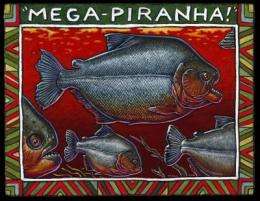
This is an artist's rendering of Megapiranha paranensis. Credit: Artwork © Ray Troll, 2005

If this is so, Megapiranha may be an intermediate step in the long process that produced the piranha's distinctive bite. To find out where Megapiranha falls in the for these fishes, Dahdul examined hundreds of specimens of modern piranhas and their relatives. "What's cool about this group of fish is their teeth have really distinctive features. A single tooth can tell you a lot about what species it is and what other fishes they're related to," said Dahdul. Her phylogenetic analysis confirms their hunch -- Megapiranha seems to fit between piranhas and pacus in the fish family tree.

The Megapiranha fossil was originally collected in a riverside cliff in northeastern Argentina in the early 1900s, but remained unstudied until paleontologist Alberto Cione of Argentina's La Plata Museum rediscovered the startling specimen —an upper jaw with three unusually large and pointed teeth — in the 1980s in a museum drawer.

Cione's find suggests that Megapiranha lived between 8-10 million years ago in a South American river system known as the Paraná. But you wouldn't want to meet one today. If the jawbone of this is any indication, Megapiranha was a big . By comparing the teeth and jaw to the same bones in present-day species, the researchers estimate that Megapiranha was up to 1 meter (3 feet) in length. That's at least four times as long as modern piranhas. Although no one is sure what Megapiranha ate, it probably had a diverse diet, said Cione.

Other riddles remain, however. "Piranhas have six teeth, but Megapiranha had seven," said Dahdul. "So what happened to the seventh tooth?"

"One of the teeth may have been lost," said Lundberg. "Or two of the original seven may have fused together over evolutionary time. It's an unanswered question. Maybe someday we'll find out."

The team's findings were published in the June 2009 issue of the Journal of Vertebrate Paleontology.

More information: Cione, A., W. Dahdul, J. Lundberg, and A. Machado-Allison. (2009). "Megapiranha paranensis, a new genus and species of Serrasalmidae (Characiformes, Teleostei) from the upper Miocene of Argentina." Journal of Vertebrate Paleontology 29(2): 350-358.

Source: National Evolutionary Synthesis Center

4.6 /5 (5 votes)  

Rank 4.6 /5 (5 votes)
Related Stories
Relevant PhysicsForums posts
  • Pertubance in a model
    created1 hour ago
  • Cancer drugs and Alzheimer's, Oh my!
    created9 hours ago
  • Squishing cells
    created10 hours ago
  • Any books/articles for evolutionary stable strategy models in humans?
    created21 hours ago
  • Science behind the bore feeling?
    createdFeb 09, 2012
  • Homo Sapien vs. Chimpanzee - Divergence Timeline
    createdFeb 09, 2012
  • More from Physics Forums - Biology

More news stories

Chilean miners' rescue capsule on show in London

The capsule used to rescue Chilean miners trapped underground for two months goes on display Saturday at the Science Museum in London -- the first time it has been seen in Europe.

Other Sciences / Other

created 17 minutes ago | popularity not rated yet | comments 0

A frank discussion of the power law and linking correlation to causation

(PhysOrg.com) -- Michael Stumpf a mathematics professor at Imperial College in London, and Mason Porter a lecturer at Oxford have teamed together to write and publish a perspective piece in Science regarding the in ...

Other Sciences / Mathematics

created 1 hour ago | popularity not rated yet | comments 0 | with audio podcast report

The question of life in the ancient world

There’s a general feeling that we don’t get the Greeks – ancient or modern. Many, including heads of state like Angela Merkel, visibly shake their head in exasperation, rightly or wrongly, at ...

Other Sciences / Archaeology & Fossils

created 1 hour ago | popularity not rated yet | comments 2

Soccer -- the link between managers and captains

Soccer managers regard their captains as an extension of themselves, according to new research from Northumbria University, which could explain why Fabio Capello quit as England manager following the FA row ...

Other Sciences / Other

created 1 hour ago | popularity not rated yet | comments 0

US workers are 'giving away the store,' costing firms billions

Nearly 70 percent of the nation's service employees give away free goods and services – from hamburgers to cable TV – costing companies billions of dollars a year, according to a groundbreaking study.

Other Sciences / Economics & Business

created 19 hours ago | popularity 4.5 / 5 (2) | comments 8


The power of estrogen -- male snakes attract other males

A new study has shown that boosting the estrogen levels of male garter snakes causes them to secrete the same pheromones that females use to attract suitors, and turned the males into just about the sexiest ...

Clam fields found at deep, low-temperature Mariana vents

(PhysOrg.com) -- Scientists have marveled at the unusual life forms thriving at high temperature hydrothermal vents of the deep ocean.

Seeing colors in music, tasting flavors in shapes may happen in life's early months

Famed violinist Itzhak Perlman sees a deep forest green whenever he plays a B-flat on his Stradivarius' G string. The A on the E string is red.

Could Venus be shifting gear?

(PhysOrg.com) -- ESA’s Venus Express spacecraft has discovered that our cloud-covered neighbour spins a little slower than previously measured. Peering through the dense atmosphere in the infrared, the ...

Team isolates nerve cells involved in storing long term memory and gene proteins associated with them

(Medical Xpress) -- A research team in Taiwan has succeeded in isolating two nerve cells in fruit fly brains that are believed to be the major players in allowing for the formation of long term memories. Furthermore, ...

Is that sleepiness during pregnancy normal or a sign of sleep apnea?

(Medical Xpress) -- Most pregnant women complain of being tired. Some of them however, could be suffering more than normal fatigue associated with their pregnancy; they may have developed obstructive sleep apnea (OSA), a ...