More gene mutations linked to autism risk
(PhysOrg.com) -- More pieces in the complex autism inheritance puzzle are emerging in the latest study from a research team including geneticists from The Children's Hospital of Philadelphia, the University of Pennsylvania School of Medicine and several collaborating institutions. This study identified 27 different genetic regions where rare copy number variations - missing or extra copies of DNA segments - were found in the genes of children with autism spectrum disorders (ASDs), but not in the healthy controls. The complex combination of multiple genetic duplications and deletions is thought to interfere with gene function, which can disrupt the production of proteins necessary for normal neurological development.
"We focused on changes in the exons of DNA--protein-coding areas in which deletions or duplications are more likely to directly disrupt biological functions," said study leader Hakon Hakonarson, M.D., Ph.D., director of the Center for Applied Genomics at The Children's Hospital of Philadelphia and associate professor of Pediatrics at the University of Pennsylvania School of Medicine.
"We identified additional autism susceptibility genes, many of which, as we previously found, belong to the neuronal cell adhesion molecule family involved in the development of brain circuitry in early childhood." He added that the team discovered many "private" gene mutations, those found only in one or a few individuals or families—an indication of genetic complexity, in which many different gene changes may contribute to an autism spectrum disorder.
"We are finding that both inherited and new, or de novo, genetic mutations are scattered throughout the genome and we suspect that different combinations of these variations contribute to autism susceptibility," said Maja Bucan, Ph.D., professor of Genetics at the University of Pennsylvania School of Medicine and Chair of the Steering committee for Autism Speaks' Autism Genetic Resource Exchange (AGRE). "We are grateful to families of children with autism spectrum disorders for their willingness to participate in genetic studies because family-based studies have many advantages. We have learned a lot both from genetic analyses of children with autism as well as analyses of their patents and their unaffected siblings."
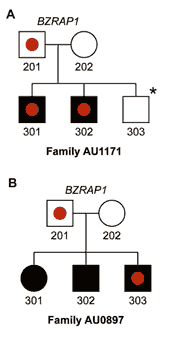
The researchers compared genetic samples of 3,832 individuals from 912 families with multiple children with ASDs from the AGRE cohort against genetic samples of 1,070 disease-free children from The Children's Hospital of Philadelphia. This study also uncovered two novel genes in which variations were found, BZRAP1 and MDGA2 - thought to be important in synaptic function and neurological development, respectively. Interestingly, key variants of these genes were transmitted in some, but not all, of the affected individuals in families.
The findings were published in the June 26 edition of the journal PloS Genetics.
By further refining the genetic landscape of ASDs, the current study expands the findings of two large autism gene studies published in April, led by Hakonarson and co-authored by Gerard Schellenberg, Ph.D., professor of Pathology and Laboratory Medicine at the University of Pennsylvania School of Medicine, Bucan and others. One study was the first to report common gene variants in ASDs. The other identified copy number variants that raise the risk of having an ASD. Both studies found gene changes on two biological pathways with crucial roles in early central nervous system development. Hakonarson and Bucan said the latest findings reinforce the view that multiple gene variants, both common and rare, may be interacting to cause the heterogeneous group of disorders included under autism spectrum disorders.
Source: University of Pennsylvania School of Medicine


