Iowa State researchers contribute climate model to study that finds some winds decreasing
June 25, 2009
Iowa State researchers contribute climate model to study that finds some winds decreasing

Enlarge

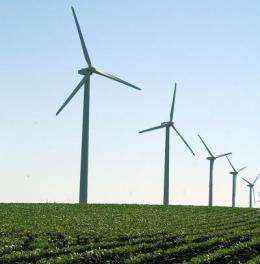
Iowa State University researchers contributed their regional climate modeling expertise to a study that found surface wind speeds are decreasing across the country. That could have implications for the wind power industry, agriculture and city air pollution. Credit: Photo by Iowa Energy Center.

Declining wind speeds in parts of the United States could impact more than the wind power industry, say Iowa State University climate researchers.

Three Iowa State researchers contributed their expertise in modeling North America's climate to a study to be published in the Journal of Geophysical Research - Atmospheres. The study - led by Sara C. Pryor, a professor of at Indiana University Bloomington - found that wind speeds across the country have decreased by an average of .5 percent to 1 percent per year since 1973.

"The study found that across the country wind speeds were decreasing - more in the East than in the West, and more in the Northeast and the Great Lakes," said Gene Takle, an Iowa State professor of geological and atmospheric sciences and agronomy.

In Iowa, a state that ranks second in the country for installed wind power capacity, Takle said the study found annual declines that matched the average for the rest of the country.

The study's findings made headlines across the country. Most of those stories focused on the potential implications for the wind power industry.

But Iowa State's team of climate researchers - Takle; Ray Arritt, a professor of agronomy; and Bill Gutowski, a professor of geological and atmospheric sciences - say the study raised other issues and questions, too.

The study looked at eight sets of wind data going back to 1973 and up to 2005: actual wind speed measurements from anemometers; a hybrid of measurements and computerized climate models; and two different regional climate models. Iowa State researchers contributed a regional model of North America's climate they've worked with since the early 1990s. It's a community model that researchers across the globe share and use. The Iowa State researchers have used the model to run long-term climate simulations.

Takle said there wasn't a lot of agreement between the measurements and the various models. The model that most closely matched the measurements was the one used by the Iowa State researchers.

Gutowski said the differences aren't surprising because the study was an initial examination of surface wind trends. He also said those differences tell climate researchers they have more work to do.

"We see this trend toward slower wind speeds and our unanswered question is whether this is part of global warming or something else," Gutowski said. "What we're poking into here is not something that's commonly explored. Most studies look at temperature and precipitation, not surface winds."

But the researchers said slower surface winds can have significant impacts beyond the wind power industry.

Crops, for example, depend on the wind for ventilation and cooling. Slower winds could mean higher field temperatures and less productive crops.

Slower winds could also mean more dew covering crops for longer periods, Takle said. That could mean problems with fungus and plant disease. That could also lead to lower yields at harvest time.

In cities, slower winds can mean more pollution and heat, the Iowa State researchers said.

"Air pollution episodes in major cities happen when there's high pressure and stagnant air,"
Takle said. "Less wind means less ventilation and less sweeping away of pollutants."

Slower winds can also be a problem when heat waves hit a city, he said. The winds wouldn't dissipate as much heat, allowing heat to linger and build.

All of those potential impacts need further study, the researchers said. And so does the cause of the apparent decline in the country's speeds.

Takle suggested three possibilities for the trend: changes in instrumentation produced flawed measurements (though Takle said researchers made corrections to account for the changes); the study didn't account for land-use changes such as development and tree planting that slowed winds near instruments; or the climate is changing and one consequence is slower winds.

Arritt said the study appears to support theories that climate change could affect surface winds.

"There are some good theoretical reasons to think that global warming will cause lighter winds in regions between the tropics and the Arctic," Arritt said. "But we like to confirm our theory with data, and our results make us think the theory is on track."

Source: Iowa State University (news : web)

Filter


Move the slider to adjust rank threshold, so that you can hide some of the comments.


Display comments: newest first

Doug_Huffman
Jun 26, 2009

Rank: not rated yet
"Less wind means less ventilation and less sweeping away of pollutants."

Affirming that dilution is the solution to pollution - or is there a carpet somewhere under which to sweep the dirty little secret?
mongander
Jun 26, 2009

Rank: not rated yet
Never fear. Even though PhysOrg reports at least one 'sky is falling' story per week, they amply compensate with at least 3 earthshaking energy technology breakthroughs per week.
GrayMouser
Jun 26, 2009

Rank: not rated yet
Takle said there wasn't a lot of agreement between the measurements and the various models. The model that most closely matched the measurements was the one used by the Iowa State researchers.

Measurements trump computer models every time. Measurements are actual facts while computer models are guesses on top of guesses.

the study didn't account for land-use changes such as development and tree planting that slowed winds near instruments; or the climate is changing and one consequence is slower winds.

What? This is bad methodology. Oh well, at least they admitted it.
Rank 5 /5 (2 votes)
Related Stories
Relevant PhysicsForums posts
  • Do some geologists actually act a lot like Randy Marsh?
    createdFeb 11, 2012
  • Discrepancy between oxygen and carbon-dioxide levels
    createdFeb 09, 2012
  • where gems are found in the world
    createdFeb 09, 2012
  • Wind Waves in Reservoir ~ Wind run-up and Wind set-up
    createdFeb 08, 2012
  • Balance of oxygen in the atmosphere
    createdFeb 01, 2012
  • The case for a methanol-based economy
    createdJan 30, 2012
  • More from Physics Forums - Earth

More news stories

With climate change, today's '100-year floods' may happen every three to 20 years: research

Last August, Hurricane Irene spun through the Caribbean and parts of the eastern United States, leaving widespread wreckage in its wake. The Category 3 storm whipped up water levels, generating storm surges ...

Space & Earth / Environment

created 1 hour ago | popularity 1.8 / 5 (5) | comments 0 | with audio podcast

Alien matter in the solar system: A galactic mismatch

This just in: The Solar System is different from the space just outside it.

Space & Earth / Space Exploration

created 22 minutes ago | popularity 5 / 5 (1) | comments 0 | with audio podcast

China's pollution puts a dent in its economy

Although China has made substantial progress in cleaning up its air pollution,a new MIT study shows that the economic impact from ozone and particulates in its air has increased dramatically. ...

Space & Earth / Environment

created 41 minutes ago | popularity not rated yet | comments 0

Solastalgia's growing influence is 'bittersweet' success

If you enter ‘solastalgia’ into a Google search, the staggering number and range of results illustrates just how widely the influence of Professor Glenn Albrecht’s concept has spread. ...

Space & Earth / Environment

created 21 minutes ago | popularity not rated yet | comments 0

Earth-facing sunspot doubles in size

The latest sunspot region to traverse the face of the Sun has nearly doubled in size as it aims Earthward, as seen in the animation above from NASA’s Solar Dynamics Observatory. (Click image to play the ...

Space & Earth / Space Exploration

created 4 minutes ago | popularity not rated yet | comments 0


Researchers make better heat sensor based on butterfly wings

(PhysOrg.com) -- Scientists have long known that butterfly wings produce their iridescent colors by bouncing light around and between tiny ridges in structures made of chitin. More recently they’ve discovered ...

Manipulating genes with hidden TALENs

(PhysOrg.com) -- A better understanding of gene function in model plant and animal systems could be used to develop useful traits in livestock and crop plants, and might someday lead to developments in stem ...

Can Viagra treat childhood lymphatic disorder?

(Medical Xpress) -- A surprising potential therapy for severe, hard-to-treat malformations of the lymphatic system is now being studied at the Stanford School of Medicine and Lucile Packard Children’s Hospital: researchers ...

Don't ignore kids' snores

(Medical Xpress) -- Your ears aren’t playing tricks on you – that is the sound of snoring you hear from the bedroom of your preschooler. Snoring is common in children, but in some cases it can be a symptom of a ...

NDSU nano research could impact flexible electronic devices

A discovery by a research team at NDSU and the National Institute of Standards and Technology shows the flexibility and durability of carbon nanotube films and coatings are intimately linked to their electronic properties. ...

Thomas Edison inspires the oscar awards you don't see

Thomas Edison's invention of the first motion picture camera in 1891 inspired scientific and technological advances that he never could have imagined.