Implant bacteria, beware: Researchers create nano-sized assassins
June 26, 2009 Implant bacteria, beware: Researchers create nano-sized assassins

Enlarge

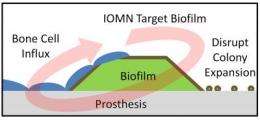
Iron-oxide nanoparticles developed at Brown University target an infected prosthesis, penetrate a bacterial film on the implant’s surface and thwart the colony by killing the bacteria. The nanoparticles also are believed to help natural bone cell growth. Credit: Erik Taylor, Brown University

Staphylococcus epidermidis is quite an opportunist. Commonly found on human skin, the bacteria pose little danger. But S. epidermidis is a leading cause of infections in hospitals. From catheters to prosthetics, the bacteria are known to hitch a ride on a range of medical devices implanted into patients.

Inside the body, the multiply on the implant's surface and then build a slimy, protective film to shield the colony from antibiotics. According to a study in the journal Clinical Infectious Diseases, up to 2.5 percent of hip and knee implants alone in the United States become infected, affecting thousands of patients, sometimes fatally.

More ominously, there is no effective antidote for infected implants. The only way to get rid of the bacteria is to remove the implant. "There is no [easy] solution," said Thomas Webster, a biomedical engineer at Brown University.

Now, Webster and Brown graduate student Erik Taylor have created a nano-sized headhunter that zeroes in on the implant, penetrates S. epidermidis's defensive wall and kills the bacteria. The finding, published in the International Journal of , is the first time iron-oxide nanoparticles have been shown to eliminate a bacterial infection on an implanted prosthetic device.

In lab tests, Taylor, the lead author, and Webster, associate professor of engineering and orthopaedics, noted that up to 28 percent of the bacteria on an implant had been eliminated after 48 hours by injecting 10 micrograms of the nanoparticle agents. The same dosage repeated three times over six days destroyed essentially all the bacteria, the experiments showed.

The tests show "there will be a continual killing of the bacteria until the film is gone," said Webster, who is editor-in-chief of the peer-reviewed journal in which the paper appears.

A surprising added benefit, the scientists learned, is the nanoparticles' magnetic properties appear to promote natural bone cell growth on the implant's surface, although this observation needs to be tested further.

To carry out the study, the researchers created iron-oxide particles (they call them "superparamagnetic") with an average diameter of eight nanometers. They chose because the metallic properties mean the particles can be guided by a magnetic field to the implant, while its journey can be tracked using a simple magnetic technique, such as magnetic resonance imaging (MRI). Moreover, previous experiments showed that iron seemed to cause S. epidermidis to die, although researchers are unsure why. (Webster said it may be due to iron overload in the bacteria's cell.)

Once the nanoparticles arrive at the implant, they begin to penetrate the bacterial shield. The researchers are studying why this happens, but they believe it's due to magnetic horsepower. In the tests, the researchers positioned a magnet below the implant, producing a strong enough field to force the nanoparticles above to filter through the film and proceed to the implant, Webster explained.

The particles then penetrate the bacterial cells because of their super-small size. A micron-sized particle, a thousand times larger than a nanoparticle, would be too large to penetrate the bacterial cell wall.

Source: Brown University (news : web)


print this article email this article download pdf blog this article bookmark this article     Stumble it Digg this share on Facebook retweet share on Reddit add to delicious
Rate this story - 4.9 /5 (8 votes)


June 26, 2009 all stories

Comments: 0

4.9 /5 (8 votes)
  • Stumble this up

  • Digg this

  • share this

  • hide
  • Related Stories

  • Problem: implant infection, solution: nanotech surfaces
    created Jul 07, 2006 | popularity not rated yet | comments 0
  • New Nanoparticle Structure Boosts Magnetic Properties
    created Dec 19, 2005 | popularity not rated yet | comments 0
  • Bone-growing nanomaterial could improve orthopaedic implants
    created Sep 17, 2007 | popularity not rated yet | comments 0
  • Making Better Magnetic Nanoparticles
    created Dec 18, 2006 | popularity not rated yet | comments 0
  • Magnetic nanoparticles detect and remove harmful bacteria
    created Nov 19, 2007 | popularity not rated yet | comments 0


  • hide
  • Relevant PhysicsForums posts

Other News

New Digital 'Electronics' Concept May Continue Moore's Law

New Digital 'Electronics' Concept May Continue Moore's Law

Nanotechnology / Nanophysics

created Nov 05, 2009 | popularity 4.6 / 5 (50) | comments 8

(PhysOrg.com) -- Computers of the future could be operating not on electrons, but on tiny waves traveling through an electron "fluid," if a new proposal is successful. The new circuit design, recently introduced ...


Nanoparticles for gene therapy improve

Nanoparticles for gene therapy improve

Nanotechnology / Bio & Medicine

created Nov 06, 2009 | popularity 5 / 5 (4) | comments 3

(PhysOrg.com) -- About five years ago, Professor Janet Sawicki at the Lankenau Institute in Pennsylvania read an article about nanoparticles developed by MIT's Robert Langer for gene therapy, the insertion ...


Breakthrough in industrial-scale nanotube processing

Breakthrough in industrial-scale nanotube processing

Nanotechnology / Nanomaterials

created Nov 02, 2009 | popularity 4.9 / 5 (20) | comments 3

(PhysOrg.com) -- Rice University scientists today unveiled a method for the industrial-scale processing of pure carbon-nanotube fibers that could lead to revolutionary advances in materials science, power ...


Scientists witness nature's complexity unfold in self-assembling quasicrystals

Scientists witness nature's complexity unfold in self-assembling quasicrystals

Nanotechnology / Nanomaterials

created Oct 31, 2009 | popularity 4.9 / 5 (16) | comments 3

(PhysOrg.com) -- Just a few decades ago, scientists believed that all ordered matter consists of self-repeating building blocks -- atoms, ions or molecules. In this view, the ordinary solids of everyday life ...


Nanoparticles may cause DNA damage across a cellular barrier

Nanoparticles may cause DNA damage across a cellular barrier

Nanotechnology / Bio & Medicine

created Nov 05, 2009 | popularity 4.3 / 5 (9) | comments 1

(PhysOrg.com) -- Scientists have shown in the laboratory that metal nanoparticles damaged the DNA in cells on the other side of a cellular barrier. The research, by the University of Bristol, is published ...