Trio of signals converge to induce liver and pancreas cell development in the embryo
June 26, 2009
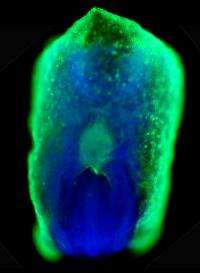
Distribution of the genetic regulatory protein, Smad4, in a mouse embryo at 8.5 days gestation. The green stain in the center is Smad4 expressed in the liver and pancreas progenitor cells. The green on the periphery is Smad4 in the extraembryonic yolk sac tissue. Credit: Ken Zaret, PhD; Ewa Wandzioch, PhD, University of Pennsylvania School of Medicine
(PhysOrg.com) -- Understanding the molecular signals that guide early cells in the embryo to develop into different organs provides insight into ways that tissues regenerate and how stem cells can be used for new therapies. With regenerated cells, researchers hope to one day fill the acute shortage in pancreatic and liver tissue available for transplantation in cases of type I diabetes and acute liver failure.
Previous studies on pancreas and liver development have focused on individual molecular signals that induce these tissues to mature from a common precursor cell population. In a new study, published this week in Science, researchers investigated a trio of cell-signaling pathways that work simultaneously, converging to direct pancreas and liver progenitor cells to mature into their final state. They looked at how BMP, TGF-beta, and FGF signaling pathways turn on genes that guide cells to ultimately become pancreas or liver tissue.
The structure of the cell-signaling network provides insight into the basis of tissue development and how it can be manipulated to facilitate pancreas and liver-cell regeneration and development from embryonic stem cells.
"For my entire scientific life, I've been intrigued by how cells early in development make 'decisions' to turn on one genetic program and exclude others," says Kenneth S. Zaret, PhD, Professor of Cell and Developmental Biology and Associate Director, Institute for Regenerative Medicine at the University of Pennsylvania School of Medicine.
The work was conducted while Zaret and co-author Ewa Wandzioch, PhD, Research Associate in the Department of Cell and Developmental Biology, were at the Fox Chase Cancer Center in Philadelphia.
How the developing embryo starts to apportion different functions to different cell types is a key question for developmental biology and regenerative medicine.
Guidance along the correct path is provided by genetic regulatory proteins that attach to chromosomes, marking part of the genome to be turned on or off. But first the two meters of tightly coiled DNA inside the nucleus of every cell must be loosened a bit. The regulatory proteins help with this, exposing a small domain near the target gene. They then act as a landing pad on which other proteins assemble to continue the gene activation process.
The Science paper addresses how chemical signals from neighboring cells in the embryo tell early progenitor cells to activate genes encoding the regulatory proteins. The regulatory proteins, in turn, guide the cells to become a liver cell or a pancreas cell. "In the current study we mapped the signaling pathways being turned on before they connected with the target genes," explains Zaret. "We monitored these cues before the cell displayed any overt signs of differentiation. While my lab and others had previously looked at individual signals that influence development, in this paper we simultaneously mapped three signal paths that converge to induce liver and pancreas cells. We're starting to construct a network of the common signals that govern development of these specific cell types. The complexity of this system is somewhat like our 26-letter alphabet being able to encode Shakespeare or a menu at a restaurant."
Many investigators are now trying to broadly reprogram cells into desired cell fates for potential therapeutic uses. "By better understanding how a cell is normally programmed we will eventually be able to directly reprogram other cells," notes Zaret. "An analogy I use here is if a watch is broken and you want to know how to reassemble it, the best thing is to go the factory and see how it is assembled in the first place. That may not be the solution to fixing it, but it's a good place to start."
In the near term, the team also aims to generate liver and pancreas cells for research and to screen drugs that repair defects or facilitate cell growth.
Source: University of Pennsylvania School of Medicine
-
Frog provides insight into making specialised cells from stem cells
Aug 27, 2006 |
not rated yet |
0
-
Stem cells with potential to regenerate injured liver tissue identified
Nov 12, 2008 |
not rated yet |
0
-
Scientists uncover the key to controlling how stem cells develop
Aug 08, 2008 |
not rated yet |
0
-
Researchers find key developmental pathway activates lung stem cells
Jun 17, 2008 |
not rated yet |
0
-
Scientists reveal mechanism that triggers differentiation of embryo cells
Dec 22, 2008 |
not rated yet |
0
-
Engineers build first sub-10-nm carbon nanotube transistor
Feb 01, 2012 |
4.9 / 5 (33) |
30
-
Something old, something new: Evolution and the structural divergence of duplicate genes
Jan 31, 2012 |
4.6 / 5 (7) |
1
-
The hidden nanoworld of ice crystals: Revealing the dynamic behavior of quasi-liquid layers
Jan 30, 2012 |
5 / 5 (5) |
1
-
Stock market network reveals investor clustering
Jan 27, 2012 |
3.9 / 5 (23) |
8
-
Of microchemistry and molecules: Electronic microfluidic device synthesizes biocompatible probes
Jan 26, 2012 |
5 / 5 (2) |
0
-
Factors affecting beet root cell membrane
20 hours ago
-
Stem cell question.
Feb 10, 2012
-
Protease cleavage
Feb 10, 2012
-
Pertubance in a model
Feb 10, 2012
-
Cancer drugs and Alzheimer's, Oh my!
Feb 09, 2012
-
Squishing cells
Feb 09, 2012
- More from Physics Forums - Biology
More news stories
A mitosis mystery solved: How chromosomes align perfectly in a dividing cell
Although the process of mitotic cell division has been studied intensely for more than 50 years, Whitehead Institute researchers have only now solved the mystery of how cells correctly align their chromosomes during symmetric ...
17 hours ago |
4.5 / 5 (22) |
0
|
Integrated pest management recommendations for the southern pine beetle
The southern pine beetle, Dendroctonus frontalis Zimmermann, is a chronic insect pest within pine forests in the southeastern United States. Under favorable environmental and host conditions, it is an agg ...
2 hours ago |
not rated yet |
0
Researchers find extensive RNA editing in human transcriptome
In a new study published online in Nature Biotechnology, researchers from BGI, the world's largest genomics organization, reported the evidence of extensive RNA editing in a human cell line by analysis of RNA-seq data, demons ...
17 hours ago |
5 / 5 (4) |
0
|
The proteins ensuring genome protection
Researchers from the University of Geneva (UNIGE), Switzerland, have discovered the crucial role of two proteins in developing a cell 'anti-enzyme shield'. This protection system, which operates at the level of molecular ...
17 hours ago |
5 / 5 (3) |
0
|
Entire genome of extinct human decoded from fossil
(PhysOrg.com) -- In 2010, Svante Pääbo and his colleagues presented a draft version of the genome from a small fragment of a human finger bone discovered in Denisova Cave in southern Siberia. The ...
Feb 07, 2012 |
4.7 / 5 (60) |
51
|
Ordered planar polymers created for the first time
(PhysOrg.com) -- Scientists under the direction of ETH Zurich have created a minor sensation in synthetic chemistry. They succeeded for the first time in producing regularly ordered planar polymers that form ...
New European rocket lifts off on maiden flight
A new lightweight rocket, Vega, lifted off from Europe's space base Monday carrying nine satellites on its inaugural flight, mission control said.
Chinese city seizes Apple iPads in name dispute
(AP) -- Authorities have seized Apple iPads from retailers in a city in northern China due to a dispute with a domestic company that says it owns the iPad name, an official said Monday. The Chinese company said it is asking ...
Microsoft India retail site down after 'cyber attack'
Microsoft India's retail website was down on Monday after reportedly being hacked by a Chinese group calling itself Evil Shadow Team.
Researchers find rate of follow-up surgeries after partial mastectomy varies greatly
(Medical Xpress) -- A study conducted at the University of Vermont/Fletcher Allen Health Care and three other sites and published in the February 1 issue of the Journal of the American Medical Association found significant ...
Rapunzel, Leonardo and the physics of the ponytail
(PhysOrg.com) -- New research provides the first mathematical understanding of the shape of a ponytail and could have implications for the textile industry, computer animation and personal care products.