One-stop shop for grid computing (w/ Video)
From searching for cures for disease to monitoring the Earth’s atmosphere, grid computing has become essential to data-intensive research. But accessing limited grid resources is not always a simple task. European researchers are making it easier.
Grid computing harnesses the processing and storage power of many different computers to analyse and store huge amounts of data. But just as grid-connected computers - often numbering in the thousands - are usually geographically dispersed and heterogeneous, with different processing speeds and operating systems, different grids and networks typically bear little likeness to one another. That can make finding and accessing grid and network resources a costly and time-consuming challenge for the researchers, research institutes and businesses that need them.
“Large grids with enormous processing power connected via high-bandwidth optical networks are essential to many scientific applications today, but establishing dedicated connections to those resources on demand can be a costly process in terms of both time and effort,” explains Artur Binczewski, the head of the Networking Department at Poznan Supercomputing and Networking Centre in Poland.
The solution, in the view of a team of European and North American researchers coordinated by Binczewski, is to make grid users and applications dynamically aware of the grid (computer processing power, storage, etc.) and network (bandwidth) resources available as and when they need them.
Bridging the grid and networking worlds
Working in the EU-funded Phosphorus project, the team sought to bridge the networking and grid worlds by developing protocols and software that allow users to obtain a scheduled or immediate high-performance grid connection with a simple, quick and low-cost process.
Their approach relies on the deployment of a Network Service Plane that ensures interoperability between existing Network Resource Provisioning Systems, such as ARGON, DRAC, UCLP-ARGIA and GMPLS, in order to access the local resources of autonomous network domains located in several countries. In addition, the team developed Grid-enabled GMPLS (G2MPLS), an evolution of the ASON/GMPLS connection management architecture and protocols. Their approach makes it easier and faster to find, allocate and provide network and grid resources, whether scheduled in advance or required immediately.
“It is an entirely new model in which network and grid resources make users aware of their availability, whether for five minutes or several days,” Binczewski says.
The technology has been proven in four trials in which four data-intensive applications, which utilise grid resources in different ways, were run via the Phosphorus architecture.
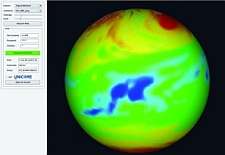
“The EU WISDOM project, for example, is using grid computing to search for drugs to treat malaria. It sends a huge number of small files to multiple grid nodes for analysis. On the other hand, the KoDaVis project, which is simulating the Earth’s atmosphere, sends large amounts of data in only a few transfers,” Binczewski notes.
A third trial was run with the Distributed Data Storage System (DDSS), a high-performance data transfer protocol optimised for high-bandwidth, wide-area networks, while another test involved the TOPS (Technology for Optical Pixel Streaming) project to stream ultra-high resolution images.
“The trials proved what can be achieved and served to showcase the technology. The response from other researchers and institutes when we have presented the results at conferences has been overwhelmingly positive… They view it as a much-needed solution to some of the big challenges they face when trying to access grid and networking infrastructure,” Binczewski says.
Commercial deployment ahead
The project coordinator notes that the team has already been approached about commercial deployments of the technology within academia, which could take place in the next two to five years. An international group of radio astronomers, for example, are interested in using the Phosphorus technology to distribute and analyse data from radio telescopes in Europe and the Americas linked together to form an extremely high-resolution virtual telescope.
Further down the line, the Phosphorus technology could also be adopted for business by industrial partners involved in the project, such as Germany’s ADVA Optical Networking, and by international companies, such as optical transmission equipment maker Infinera, that have expressed an interest in the project results.
One application Binczewski suggests is for the distribution of next-generation television and films, which, at resolutions many times greater than current high-definition video, will require huge amounts of bandwidth and storage capacity.
“With on-demand grid and networking technology, a film company in Hollywood or Bollywood could distribute an ultra-high definition film to all cinemas in the world on the same day,” Binczewski notes.
The Phosphorus project, which received funding under the EU’s Sixth Framework Programme for research, is showcasing this month the results of its work at the Terena Networking Conference in Malaga, Spain.
More information: www.ist-phosphorus.eu/
Provided by ICT Results


