Sequencing effort to chart ants and their ecosystem
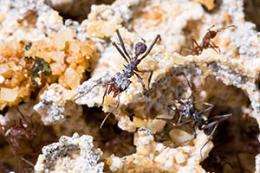
(PhysOrg.com) -- Nestled within the twisting fungus gardens of leaf-cutter ants exists a complex symbiotic web that has evolved over millions of years. Now, with the help of a major genomic sequencing grant from Roche Applied Science, scientists at the University of Wisconsin-Madison will be able to analyze these interactions at the molecular scale.
"By sequencing genomes of all the major players, we can study the evolution of the system," says Cameron Currie, a UW-Madison bacteriology professor and one of the project's lead researchers. "It would be one of the first, if not the first, genomic level study of a community of organisms over evolutionary time."
As winners of Roche Applied Science's 10 Gigabase Grant Program, UW-Madison and Great Lakes Bioenergy Research Center (GLBRC) scientists Currie, Steven Slater and Garret Suen will be part of a team that will use Roche technology to sequence the known members of the ant-fungus symbiosis, which includes three ant genomes and 14 ant-associated fungal and bacterial genomes.
"Three sequenced ant genomes will be truly spectacular," says Ted Schultz, a research entomologist at the Smithsonian Institution National Museum of Natural History. "This is going to advance the field a quantum level beyond what is done now.
"The fungus-growing ant system is already a model system for studying symbiosis and coevolution," says Schultz. "This project will solidify its status as the premier model system for those kinds of studies."
Most of the DNA samples to be sequenced will come from Currie's UW-Madison lab, which is also investigating how the leaf-cutter ants break down large amounts of cellulose as part of their work with the GLBRC.
Sequencing data will be generated by the end of the summer, but finalizing the genome sequences and annotation will be an ongoing project that will span a number of years, says Slater, GLBRC scientific programs manager and an investigator on the project.
To tackle a project of this size and scope, the research team is looking for extra help in a very interesting place: high school and undergraduate classrooms. By recruiting university faculty and training high school teachers, then providing well-stocked research kits and the support of a dedicated Ph.D.-level scientist, students will have the opportunity to perform novel research and make a contribution to functional gene analysis.
"Any kid who contributes some DNA sequence or functionally tests a gene prediction has truly added to the scientific effort. For example, closing [sequence] gaps is expensive and time-consuming, but it's an important part of genomics and can be a wonderful education tool," says Slater. "Kids learn basic molecular biology and learn to understand genome sequencing and genome assembly if they're tasked with closing those gaps. Our hope is that this becomes a nucleus for a much larger national program — a way of teaching science that's participatory."
The Joint Genome Institute, another Department of Energy laboratory, will be assisting with both sequence analysis and educational efforts.
As genomic data is collected and annotated, researchers will have unprecedented potential to study ecology, evolution, behavior and development in a 50-million-year association.
"This provides us a unique look under the hood of some very important ecosystems," says Tim Donohue, GLBRC director and UW-Madison bacteriology professor. "These ants and their partner microbes have evolved over millions of years to digest plant material, including the cellulose in plant cell walls."
Some of these ant communities have a picky appetite and only eat certain types of plant leaves; others are omnivores and digest the cellulose in a wide variety of leaves. GLBRC is studying the fungi and bacteria from these communities to identify microbial enzymes that can help generate fuels from the cellulose, or non-edible, part of the leaf.
"The Roche support leverages the expertise that GLBRC has brought to the table and provides us with a unique look at the ant part of this food chain," says Donohue. "This information will ultimately allow evolutionary biologists to understand how the ants and microbes have adjusted their genetic blueprints to become effective partners in this food chain."
The human genome is composed of 3 billion base pairs of DNA, and it took more than a decade to completely sequence. But technology improvements have made DNA sequencing much faster and cheaper. "In terms of total base pairs," Currie says, "this project is roughly half the scale of the human genome project."
With Currie, Nicole Gerardo of Emory University, who works on insect-microbe interactions, will co-lead the research team. The group also includes her Emory colleague James Taylor, a computational biologist focused on analyzing genomic data. George Weinstock, a veteran of insect genome sequencing, and Sandra Clifton, an expert on analyzing microbial genomes, from The Genome Center at Washington University will round out the research team.
Roche Applied Science's 10 Gigabase Grant Program for DNA sequencing and transcriptome analysis studies awards up to 10 gigabases of DNA or cDNA sequencing data to an individual, institution or corporation.
Roche Applied Science will perform all sequencing, primary data generation and analysis using the Genome Sequencer FLX System, developed by 454 Life Sciences. The 10 gigabases of data will be generated using the new Genome Sequencer FLX reagents that produce an average of 400-base-pair read lengths. In total, up to 25 million sequencing reads will be generated, resulting in 10 gigabases of information.
The Great Lakes Bioenergy Research Center is one of three Department of Energy Bioenergy Research Centers funded to make transformational breakthroughs that will form the foundation of new cellulosic biofuels technology.
Provided by University of Wisconsin-Madison (news : web)


