Sophisticated weather satellite rockets into orbit
June 28, 2009 Sophisticated weather satellite rockets into orbit

Enlarge

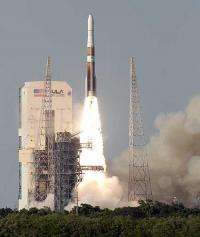
Rising above the two lightning towers around the pad, a Delta IV rocket races into the sky with the GOES-O satellite aboard. Photo credit: NASA/Kim Shiflett

(PhysOrg.com) -- The latest Geostationary Operational Environmental Satellite, GOES-O, soared into space today after a successful launch from Space Launch Complex 37 at the Cape Canaveral Air Force Station in Florida.

The GOES-O spacecraft lifted off at 6:51 p.m. EDT on a Delta IV rocket. The National Oceanic and Atmospheric Administration's GOES-O satellite will improve weather forecasting and monitor environmental events around the world. The satellite is the second to be launched in the GOES N series of geostationary environmental weather satellites.

"All indications are that GOES-O is in a normal orbit, with all spacecraft systems functioning properly," stated Andre Dress, GOES deputy project manager at NASA's Goddard Space Flight Center in Greenbelt, Md. "We are proud of our support teams and pleased with the performance of the Delta IV launch vehicle."

Approximately 4 hours and 21 minutes after launch, the spacecraft separated from the launch vehicle. The Universal Space Network Western Australia tracking site in Dongara monitored the spacecraft separation.

On July 7, GOES-O will be placed in its final orbit and renamed GOES-14. Approximately 24 days after launch, Boeing Space and Intelligence Systems will turn engineering control over to NASA. About five months later, NASA will transfer operational control of GOES-14 to NOAA. The satellite will be checked out, stored in orbit and available for activation should one of the operational GOES satellites degrade or exhaust its fuel.

NASA contracted with Boeing to build and launch the GOES-O spacecraft. NASA's Launch Services Program at NASA's Kennedy Space Center in Florida supported the launch in an advisory role. NOAA manages the GOES program, establishes requirements, provides all funding and distributes environmental satellite data for the United States. Goddard procures and manages the design, development and launch of the satellites for NOAA on a cost-reimbursable basis.

For more information about the GOES-O mission and program, visit: http://www.nasa.gov/goes-o

Provided by NASA


Rate this story - 5 /5 (1 vote)


June 28, 2009 all stories

Comments: 0

5 /5 (1 vote)

  • hide
  • Related Stories

  • NASA's Goes-N Satellite Ready for Launch
    created Jul 27, 2005 | popularity not rated yet | comments 0
  • NASA, NOAA set to launch new environmental satellite
    created May 04, 2005 | popularity not rated yet | comments 0
  • New Environmental Satellite Successfully Launched
    created Feb 06, 2009 | popularity not rated yet | comments 0
  • NASA, NOAA set to launch NOAA-N Prime satellite
    created Jan 22, 2009 | popularity not rated yet | comments 0
  • GOES-N Set For Launch
    created Jun 20, 2005 | popularity not rated yet | comments 0


  • hide
  • Relevant PhysicsForums posts

  • Carbon Dioxide emissions question
    created Feb 08, 2010
  • Photosynthesis vs. carbonization
    created Feb 07, 2010
  • Sheep's footprints
    created Feb 05, 2010
  • How did Victorians estimate the ages of fossils?
    created Feb 03, 2010
  • More from Physics Forums - Earth

Other News

Climate 'Tipping Points' May Arrive Without Warning, Says Top Forecaster

Space & Earth / Environment

created 6 hours ago | popularity 3 / 5 (4) | comments 5 | with audio podcast

(PhysOrg.com) -- A new University of California, Davis, study by a top ecological forecaster says it is harder than experts thought to predict when sudden shifts in Earth's natural systems will occur -- a worrisome finding ...


Rho Ophiuchus cloud

Professor: We have a 'moral obligation' to seed universe with life

Space & Earth / Astronomy

created 17 hours ago | popularity 3.3 / 5 (22) | comments 47 | with audio podcast report

(PhysOrg.com) -- Eventually, the day will come when life on Earth ends. Whether that’s tomorrow or five billion years from now, whether by nuclear war, climate change, or the Sun burning up its fuel, the last ...


38 percent of world's surface in danger of desertification

38 percent of world's surface in danger of desertification

Space & Earth / Environment

created 3 hours ago | popularity 2.3 / 5 (3) | comments 4

A team of Spanish researchers has measured the degradation of the planet's soil using the Life Cycle Assessment (LCA), a scientific methodology that analyses the environmental impact of human activities, and ...


A new 3-D map of the interstellar gas within 300 parsecs from the sun

A new 3D map of the interstellar gas within 300 parsecs from the Sun

Space & Earth / Astronomy

created 9 hours ago | popularity 5 / 5 (4) | comments 0 | with audio podcast

(PhysOrg.com) -- Astronomy & Astrophysics is publishing new 3D maps of the interstellar gas in the local area around our Sun. A French-American team of astronomers presents new absorption measurements toward ...


URI researcher calls for global effort to monitor marine pollutants

Space & Earth / Environment

created 7 hours ago | popularity 3 / 5 (2) | comments 1

A University of Rhode Island researcher who studies chemical pollutants in the marine environment has called on colleagues around the world to establish a global monitoring network to verify that the chemicals banned by the ...