Litter of lynx kittens heartens Colo. biologists
June 28, 2009 By JUDITH KOHLER , Associated Press Writer Litter of lynx kittens heartens Colo. biologists (AP)

Enlarge

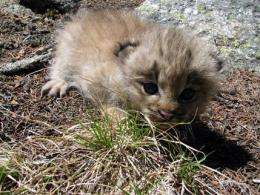
This is an undated photograph taken in May 2009 at an undisclosed located and supplied by the Colorado Division of Wildlife that shows a lynx kitten, which is one of 10 born this spring in Colorado, according to researchers. The discovery of the kittens after finding none the last two years and the location of some of the newborns outside what is considered the cats' core area have buoyed the hopes of biologists overseeing the restoration of the long-haired mountain feline to the Centennial State. (AP Photo/Colorado Division of Wildlife)

(AP) -- The discovery of 10 lynx kittens this spring marks the first newborns documented in Colorado since 2006, heartening biologists overseeing restoration of the mountain feline.

The tuft-eared cats with big, padded feet were native to Colorado, but were wiped out by the early 1970s by logging, trapping, poisoning and development. They are listed as threatened on the endangered species list.

found no kittens the past two years, possibly partly because of a drop in the number of snowshoe hares, the cats' main .

This year, seven male and three female kittens were found in five dens.

More than 200 from Alaska and Canada have been released in Colorado since 1999. Biologists don't know how many lynx are currently in the state.

©2009 The Associated Press. All rights reserved. This material may not be published, broadcast, rewritten or redistributed.


print this article email this article download pdf blog this article bookmark this article     Stumble it Digg this share on Facebook retweet share on Reddit add to delicious
Rate this story - 5 /5 (2 votes)


June 28, 2009 all stories

Comments: 0

5 /5 (2 votes)
  • Stumble this up

  • Digg this

  • share this

  • hide
  • Related Stories

  • New population of Iberian lynx raises hope, says World Wildlife Fund
    created Oct 23, 2007 | popularity not rated yet | comments 0
  • Britain may reintroduce wolf and lynx
    created Dec 01, 2007 | popularity not rated yet | comments 0
  • New study shows greenback cutthroat trout involved in recovery effort misidentified
    created Sep 05, 2007 | popularity not rated yet | comments 0
  • Climate change and species distributions
    created Aug 04, 2008 | popularity not rated yet | comments 0
  • Thin Colorado snowpack reported again
    created May 22, 2006 | popularity not rated yet | comments 0


  • hide
  • Relevant PhysicsForums posts

  • What is transpulmonary pressure?
    created Nov 24, 2009
  • Is there a gay gene?
    created Nov 23, 2009
  • Super quick question about Starling forces?
    created Nov 22, 2009
  • Questions about diffusion
    created Nov 22, 2009
  • More from Physics Forums - Biology

Other News

Variable Temperatures Leave Insects wtih a Frosty Reception

Biology / Plants & Animals

created 1hour ago | popularity not rated yet | comments 0

(PhysOrg.com) -- For the first time, scientists at The University of Western Ontario have shown that insects exposed to repeated periods of cold will trade reproduction for immediate survival.


Experts think toxic algae harming endangered fish

Biology / Ecology

created 1hour ago | popularity not rated yet | comments 0

(AP) -- Scientists say they think toxins from a blue-green algae plaguing lakes and rivers around the West are harming an endangered fish in the Klamath Basin, adding another obstacle to restoring species that have forced ...


When camouflage is a plant's best protection

Rare woodland plant uses 'cryptic coloration' to hide from predators

Biology / Plants & Animals

created 3 hours ago | popularity not rated yet | comments 0

It is well known that some animal species use camouflage to hide from predators. Individuals that are able to blend in to their surroundings and avoid being eaten are able to survive longer, reproduce, and ...


Destruction spreads 'like a disease'

Biology / Ecology

created 2 hours ago | popularity not rated yet | comments 0

(PhysOrg.com) -- People have cleared more than a quarter of the world’s forests and half of its grasslands, according to a paper published today in the Proceedings of the Royal Society by researchers from The University of Que ...


'Safety valve' protects photosynthesis from too much light

Biology / Cell & Microbiology

created 5 hours ago | popularity not rated yet | comments 0

Photosynthetic organisms need to cope with a wide range of light intensities, which can change over timescales of seconds to minutes. Too much light can damage the photosynthetic machinery and cause cell death. Scientists ...