Daimler launches first German hybrid car
June 28, 2009 by Lenaig Bredoux
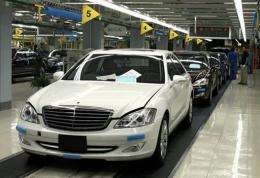
Mercedes Benz S Class cars move on an assembly line at the Mercedes plant in Sindelfingen, southern Germany. The world's best-selling limousine, a favourite of world leaders, the Mercedes Benz S Class, is now available in Europe with two motors, one electric and the other petrol (gasoline), to save fuel and cut pollution.
German luxury car maker Daimler launched its first hybrid model last week, almost 10 years after the market leader, Toyota.
The world's best-selling limousine, a favourite of world leaders, the Mercedes Benz S Class, is now available in Europe with two motors, one electric and the other petrol (gasoline), to save fuel and cut pollution.
The "CO2 champion of luxury cars," as Mercedes bills it, nonetheless cranks out 186-189 grams of carbon dioxide per kilometre, remaining one of the biggest polluters on the road, well above the European average of around 160 grams.
A comparable S model with a normal engine can spew out as much as 234 grams, Daimler counters.
A spokesman added that "we want to launch at least one hybrid model per year."
It is by all accounts a mini revolution in the German auto sector, which generally produces big, powerful cars by brands including Mercedes, Porsche, BMW and Audi.
Porsche plans to roll out a hybrid version of its Cayenne sports utility vehicle in late 2010, and BMW is preparing a saloon (sedan) from its Series 7 line this year, even though it is "too early to speak of full distribution," according to a BMW spokeswoman.
Auto expert Gerd Lottspiesen from the environmental association VCD told AFP that the German car industry "has been asleep for several years."
"It repeatedly dismissed hybrids. If it is finally waking up, it's pretty late" compared with Toyota, which sold its first hybrid Prius model in Europe nine years ago.
Lexus, the luxury line from Toyota, has offered a hybrid system for four years.
"For years, the German automobile sector did not believe hybrids had a chance ... but at a certain point, under market pressure, the industry changed its mind," said Stefan Bratzel, professor at a specialised auto centre in the western city of Bergisch Gladbach.
German companies mainly focused on diesel engines, the specialists noted.
As a result, the German market is dominated by diesels, while hybrids represented only 0.2 percent of the market last year with the sale of 6,500 Toyota, Lexus or Honda hybrids, according to national registration figures.
Since its launch, Toyota has sold 22,000 Prius in France and around 17,000 in Germany, which has a market three times bigger, according to Toyota data.
"The Prius has never been a best-seller here," a spokeswoman for the Japanese group acknowledged.
Germans, who are strongly attached to their national brands, could begin to switch over if domestic hybrid models are available however.
"The environmental trend is becoming dominant," said Frank Schwope, an auto analyst at the NordLB bank.
Daimler is a good example.
Until now it has been considered one of the most resistant to environmental trends.
But in the past few months, Daimler has begun to highlight its determination in the area.
It recently acquired a battery company and a 10 percent stake in the US electric car maker Tesla.
A sign for auto specialists that Germans could be at the leading edge of the next big step, fully electric automobiles.
(c) 2009 AFP
-
Toyota Not Too Keen On Plug-In Hybrids
May 22, 2009 |
not rated yet |
0
-
Toyota Annouces R&D for Standard Current Prius
Nov 12, 2007 |
not rated yet |
0
-
Defying recession, Japan's green cars surge in popularity
Jun 04, 2009 |
not rated yet |
0
-
2007 vehicle fuel economy list released
Oct 17, 2006 |
not rated yet |
0
-
Toyota rolls out new Prius to fend off rivals
May 18, 2009 |
not rated yet |
0
-
Engineers build first sub-10-nm carbon nanotube transistor
Feb 01, 2012 |
4.9 / 5 (31) |
30
-
Something old, something new: Evolution and the structural divergence of duplicate genes
Jan 31, 2012 |
4.6 / 5 (7) |
1
-
The hidden nanoworld of ice crystals: Revealing the dynamic behavior of quasi-liquid layers
Jan 30, 2012 |
5 / 5 (3) |
1
-
Stock market network reveals investor clustering
Jan 27, 2012 |
3.9 / 5 (23) |
8
-
Of microchemistry and molecules: Electronic microfluidic device synthesizes biocompatible probes
Jan 26, 2012 |
5 / 5 (1) |
0
-
Need help reading 3-D
11 hours ago
-
A way to send and receive wireless data
17 hours ago
-
Tabletop Cold Fusion Reactor
19 hours ago
-
Calling function with no input argument
Feb 10, 2012
-
Force free body diagram problem on gym equipment
Feb 10, 2012
-
Empirical data regarding shower heads and water
Feb 10, 2012
- More from Physics Forums - General Engineering
More news stories
Google might launch Drive for cloud storage soon
(PhysOrg.com) -- Google's next big move, according to the Wall Street Journal, is a cloud storage service called Drive. Hardly first to the plate, Google is simply catching up to introducing its cloud reposi ...
Love a click away in Indonesia's Twitter Republic
He was a geeky kid from Yogyakarta, she a glamorous city girl in Jakarta. In a country with one of the world's most vibrant social networking scenes they fell in love on Twitter.
1 hour ago |
not rated yet |
0
Walney offshore wind farm is world's biggest (for now)
(PhysOrg.com) -- The Walney wind farm on the Irish Sea--characterized by high tides, waves and windy weather--officially opened this week. The farm is treated in the press as a very big deal as the Walney ...
GPS court ruling leaves US phone tracking unclear
A US Supreme Court decision requiring a warrant to place a GPS device on the car of a criminal suspect leaves unresolved the bigger issue of police tracking using mobile phones, legal experts say.
20 hours ago |
4 / 5 (2) |
0
Europeans protest controversial Internet pact
Tens of thousands of people marched in protests in more than a dozen European cities Saturday against a controversial anti-online piracy pact that critics say could curtail Internet freedom.
16 hours ago |
4.6 / 5 (9) |
0
Latin America mining boom clashes with conservation
Latin America is experiencing a mining boom as prices rise fuelled by a hike in global demand, but the region is also being hit by a wave of violent protests, strikes and rallies by environmentalists.
Europe stakes billion-dollar bet on new rocket
A pencil-slim rocket is scheduled to lift into space from South America on Monday, carrying a billion-dollar bet that Europe can grab a juicy slice of the market to place satellites in low orbit.
Study finds that anti-diabetic medication can prevent the long-term effects of maternal obesity
In a study to be presented today at the Society for Maternal-Fetal Medicine's annual meeting, The Pregnancy Meeting, in Dallas, Texas, researchers will report findings that show that short therapy with the anti-diabetic medication ...
Netflix settlement trims 14 pct off 4Q earnings
(AP) -- Netflix pressed the rewind button on its fourth-quarter earnings after settling allegations that the video subscription service violated a consumer-privacy law.
Navy to begin tests on electromagnetic railgun prototype launcher
The Office of Naval Research (ONR)'s Electromagnetic (EM) Railgun program will take an important step forward in the coming weeks when the first industry railgun prototype launcher is tested at a facility ...
Explained: Sigma
It's a question that arises with virtually every major new finding in science or medicine: What makes a result reliable enough to be taken seriously? The answer has to do with statistical significance -- but ...
Jun 29, 2009
Rank: 2.3 / 5 (3)
European automakers do have a chance to catch up, though. Skip the hybrid step and go straight to PHEV's. Toyota would freak.
Jun 29, 2009
Rank: 1 / 5 (1)
No need for wars to get oil then.
Jul 01, 2009
Rank: 2.5 / 5 (2)
Free the people, and the people will erect their own technocracy.
Jul 03, 2009
Rank: not rated yet
We could get gigawatts of solar for a mere fraction of the military spending. We have the real estate (home roofs) we have the infrastructure (people using power where its created, no need for transmission)
The worst case scenario is that some of the excess solar power is wasted when it's not needed. There are plenty of ways to use intermittant power if you know it needs to be used....
like.... How about everyone turn on your air conditioners full blast when the solar power is creating too much electricity. Most people would love a free 2 degree cooling of their houses. A cloud comes by and everyone AC goes back to normal settings. Intermittant power, intermittant use. No needed extra infrastructure. Controll everyones AC through a phone line that already exists.
People always complain you need all these extra lines to every house to make solar useful. Why? For what purpose? You need less energy into your house. You need less energy into your neighborhood. You need less energy into your city. If anything you put a ***LITTLE*** energy back to the main grid. If the grid can supply a neighborhood with 200 MW, it can certianly handle taking back 10MW of power with just a minimal switching circuit at the relay station.
I'm listening. Where is the extra infrastructure needed to make use of solar energy? Keep in mind peak load is always during the day when the sun is shining the brightest.
Even if you don't send back power, if you take many peoples houses off the grid so they don't use power during the day, you release a lot of need for peak energy use. Even if the house simply turns off the solar panels and wastes the energy when it doesn't want it, that is a big savings to the electric bill for you and the city.
If nothing else it's a start. A step in the direction of powering yourselves instead of killing people to steal their power, and it is cheaper powering the war machine.