Trying to spot differences in the sun
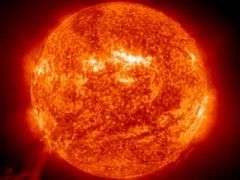
June 28, 2009 By Anthony R. Wood The Sun

The sun is the focus of a deepening mystery. Solar scientists want to know: Why is the sun so quiet?

So-called sunspots, intense solar storms that eject mass amounts of energy and darken the solar surface, have been all but missing the last two years. Typically, the more spots, the more energy the gives off.

What effect this might have on is unclear. Earth's atmosphere and the sun have had a long and complex relationship, and scientists acknowledge they still are not sure precisely what goes on between them.

But changes in the deceptively volatile star evidently do have some impact on the planet's weather.

Sunspots have been tied to everything from droughts to wine vintages to the sinking of the Titanic. A sunspot lull correlated with the Little Ice Age -- from the 14th through 19th centuries -- when "Greenland" became a misnomer.

Recently, the sun has been ever-so-subtly weaker than usual. Last year, 266 days were spot-free, and not a single spot was detected in August, said David Hathaway, a NASA expert in Huntsville, Ala. And while 2008 was one of the warmest years on record worldwide, it was the coolest since 2000.

"The current minimum is now the longest we have seen," said Ken Tapping, a scientist with the Penticton, Canada, Herzberg Institute of Astrophysics, which has been tracking sunspots since 1947.

NASA is forecasting the sun's activity will pick up before the end of the year. "However, we are now getting into new territory," Tapping said. The solar lull was supposed to have ended months ago.

Sunspots typically follow 11-year cycles of lull, crescendo, lull. But, like EPA gas-mileage estimates, 11 years represents a rough range. Cycles can vary from nine to 14 years.

Tapping cautions against reading too much into recent observations, or even those that date to Galileo, who first noticed them. In the old days, observers tracked them by projecting solar images onto paper, and the technology has improved tremendously since World War II.

But the period of sun-spotting by earthlings, he notes, is "very small compared with the 4.5 billion-year life of the sun."

What's more, no one yet has quite figured how to isolate the effects of solar variations from other forces that drive the climate system, such as volcanic ash, seesawing temperatures in the tropical Pacific Ocean, and human activity.

"How much the sun affects short-term weather is really not known," said Caspar Ammann, a climate specialist at the National Center for Atmospheric Research in Boulder, Colo. "A lot of speculation exists, but I would caution and doubt any conclusions."

Although the sun is by no means a steady star, the range of change in solar output is only on the order of 0.2 percent, the experts say.

Fred House, a solar-energy specialist at Drexel University, says the total wattage beamed at the top of the atmosphere over a square meter is equivalent to about 13 100-watt light bulbs directed at a card table. Remove 0.2 percent of that wattage, and you'd probably still be able to see the cards.

How these tiny changes work their way into the climate system is "the million-dollar question," Tapping says. "The first step -- what the sun does at the top of the atmosphere -- is a relatively simple thing, but what the atmosphere does with it is very complicated."

The U.N. Intergovernmental Panel on Climate Change estimates that solar fluctuations have about one-fifth the climate impact of human greenhouse gases but cautions that that is based on a "low level of understanding."

That said, the current lull could have some effect on Earth's temperatures for the next two years or so, according to NASA's Goddard Institute for Space Studies in New York City. Don't expect another ice age, though, according to the agency.

To put the last two years in perspective, Hathaway says that sunspots were absent in 31 of the 70 years from 1645 to 1715, in the cold heart of the Little , with none sighted from 1661 to 1671.

The infamous "year without a summer," 1816, coincided with another lull from 1798 to 1825. But that chilly summer followed the cataclysmic eruption of Tambora in Indonesia, which cast a sun-screening veil across the atmosphere.

More recently, 1911 to 1913 all had more than 200 spotless days each, with 1913 having 314. One British researcher has suggested that the lack of sunspots may have contributed to the formation of the iceberg that sunk the Titanic in 1912, but Hathaway says the lull does not show up in temperature records.

Given the long career of the sun and the relatively short period of observation, Tapping said it was unrealistic for anyone to expect the sun to give up its secrets.

"It's like walking into town, taking a photograph, and trying to deduce what's going on," he said.

___

(c) 2009, The Philadelphia Inquirer.
Visit Philadelphia Online, the Inquirer's World Wide Web site, at http://www.philly.com/
Distributed by McClatchy-Tribune Information Services.


print this article email this article download pdf blog this article bookmark this article     Stumble it Digg this share on Facebook retweet share on Reddit add to delicious
Rate this story - 4.1 /5 (14 votes)

Rank Filter

Move the slider to adjust rank threshold, so that you can hide some of the comments.


Display comments: newest first

  • deatopmg - Jun 28, 2009
    • Rank: 3.8 / 5 (5)
    Apparently these "experts" are not. They are just consensus scientists w/ excellent PR.
  • ChiRaven - Jun 28, 2009
    • Rank: 3.9 / 5 (7)
    The IPCC models deliberately ignore the impact of solar radiation on screening the earth's upper atmosphere from incident cosmic radiation. Cosmic radiation, in turn, has been shown by other models to have a significant impact on high-level cloud formation. Thus these second-order effects of incident solar radiation are being ignored in the IPCC estimates.
  • PinkElephant - Jun 28, 2009
    • Rank: 3 / 5 (6)
    @ChiRaven,

    Cosmic radiation, in turn, has been shown by other models to have a significant impact on high-level cloud formation.


    This cosmic ray hypothesis has already been empirically disproven with considerable authority. There is no statistically significant correlation between atmospheric cosmic ray flux and cloud cover. For more details, see this half-year-old news item:

    http://www.scienc...5138.htm
  • Jeffhans1 - Jun 28, 2009
    • Rank: 3.8 / 5 (8)
    The study you link is a straw man arguement. It "proves" that there is not a statisically signifigant change in cloud formations during "Sudden outbreaks of intense solar activity that lead to a strong reduction of cosmic rays, lasting for a couple of days. The researchers have identified 22 such events between 2000 and 2005." This entire study was around specific types of increases in solar radiation and all occurred during a Solar Maximum. The entire Heliosphere was already being shielded from a large percentage of Cosmic Rays. That is like me holding a small but strong umbrella over my head while standing inside a tent and concluding that umbrellas do not effect the amount of rain hitting me. I'm sorry but your study does not empirically prove anything.
  • PinkElephant - Jun 28, 2009
    • Rank: 3 / 5 (6)
    Really, Jeffhans1.

    that lead to a strong reduction of cosmic rays, lasting for a couple of days


    That means there's a certain flux of cosmic rays, yes even during a solar maximum. Then an outburst of solar activity leads to a "strong reduction" in that flux. So first you have cosmic rays, then you have a lot fewer cosmic rays, then you again have a lot more cosmic rays. If there were any dependency of cloud cover at all, _some_ statistically significant effect should have been seen. But there was no such effect. AND, this is not the only such study. Indeed,

    This result is in line with most other research in the field. As far as Kristjansson knows, no studies have proved a correlation between reduced cosmic rays and reduced cloud formation.


    and

    Kristjansson also points out that most research shows no reduction in cosmic rays during the last decades...


    This "strawman" just broke the back of the camel you rode in on.
  • mikiwud - Jun 29, 2009
    • Rank: 3.4 / 5 (5)
    The sun is the focus of a deepening mystery. Solar scientists want to know: Why is the sun so quiet?

    ?,this article spends most of the time saying that solar variations are not the cause of Global Warming, not "why is the Sun so quiet?"
    The U.N. Intergovernmental Panel on Climate Change estimates that solar fluctuations have about one-fifth the climate impact of human greenhouse gases but cautions that that is based on a "low level of understanding."

    I thought the IPCC believed Man was 100% at fault.
  • DGBEACH - Jun 29, 2009
    • Rank: 3 / 5 (6)
    A sunspot lull correlated with the Little Ice Age -- from the 14th through 19th centuries -- when "Greenland" became a misnomer.

    ...so NOW the Earth is cooling (?)...can they please make up their minds!
  • Modernmystic - Jun 29, 2009
    • Rank: 2.7 / 5 (7)
    Yes of course pink elephant...the sun has nothing whatsoever to do with how warm the Earth is......
  • lengould100 - Jun 29, 2009
    • Rank: 3 / 5 (8)
    You anti-AGW trolls should find a girlfriend an stop clogging up science websites.
  • Velanarris - Jun 29, 2009
    • Rank: 3 / 5 (2)
    You anti-AGW trolls should find a girlfriend an stop clogging up science websites.

    We could just go clog up yours if you prefer.
  • Quantum_Conundrum - Jul 01, 2009
    • Rank: 3 / 5 (2)
    This article states that "world wide" the temperatures are actually cooler than in 2000,a nd that 2008 was one of the hottest on record, yet cooler than 2000.

    Well, that may be true on the world average, but ironically, where I live (Hammond/Ponchatoula are, Louisiana, just north of lakes Maurepas and Ponchartrain), we have had some of the hottest summers on record actually in the past 4 years. This June has had the record high temperature and the record high heat index broken by several degrees almost every day of the month. In some cases, we broke previous record highs before noon, when the hottest part of the day is, on average, about 2pm to 4pm. Just yesterday, the heat index was 118 degrees, which I have NEVER seen in this area in my life. I think there were only a couple days in June which did not break previous record highs, and those records were set in 2003-2006.


    Ironically, this past december, we got BY FAR the heaviest snow accumulation in my entire life. NOrmally, It only snows w/ accumulation about once every 10 years here, and even then only half an inch to one inch. But this past december we got 8-9 inches of accumulation, which hasn't happened in this area in at least 80 years. However, other than this snow, which survived on the ground for about 3 days, maybe 4 in the shade (also longest I'd ever seen,) but other than this, it was actually a ridiculously hot winter, with very few days getting below freezing, or even close to freezing temperatures.

    This past month, according to the weather channel, it rained 2.93 inches in Hammond. yet we live within about 5 miles or so of that station, and according to our THREE rain gauages, we have only gotten about 0.25 inches for the entire month of june. (and the grass shows it because even though we have watered it, a lot of it is turning brown.)

    The point I'm making is that "global averages" based on point measurements at cities and buoys are misleading. It can rain two or three inches at point A, and yet not rain at all at point B a few minles away. Similarly, the record high or humidity at Point B can be broken by several degrees, and just a few miles away you may even end up setting a record low(because of cloud cover and rain, fontal boundaries, etc). It happens.

    The global data don't take into account for all the spaces where there are no measurements, i.e. wilderness, and miles and miles of open oceans, and small towns that aren't really given much attention by the NWS.


    ANYWAY, I still do not believe in AGW as any more than a minor, almost insignificant factor in all of this, in the greater scheme of things. It is my belief that we are still experiencing recovery from the events of the Little Ice Age. After all, the coldest day on record, and the coldest winter on record for this area (since the NWS was formed,) also happened in my lifetime (I'm 29 years old). Looks like normal fluctuations to me.

June 28, 2009 all stories

Comments: 11

4.1 /5 (14 votes)
  • Stumble this up

  • Digg this

  • share this

  • hide
  • Related Stories

  • What's Wrong with the Sun? (Nothing)
    created Jul 11, 2008 | popularity not rated yet | comments 0
  • Spotless Sun: Blankest Year of the Space Age
    created Oct 01, 2008 | popularity not rated yet | comments 0
  • The Sun Shows Signs of Life
    created Nov 10, 2008 | popularity not rated yet | comments 0
  • The Sun Loses its Spots
    created Jul 24, 2007 | popularity not rated yet | comments 0
  • Solar Variability: Striking a Balance with Climate Change
    created May 08, 2008 | popularity not rated yet | comments 0


  • hide
  • Relevant PhysicsForums posts

  • Semi-major axis from cartesian co-ordinates
    created 11 hours ago
  • Primary Mirror grinding
    created 13 hours ago
  • dark energy can escape black holes.
    created 22 hours ago
  • Are there green, purple and pink stars?
    created Nov 22, 2009
  • Sideral question
    created Nov 21, 2009
  • Doppler shifted blackbody spectrum
    created Nov 21, 2009
  • More from Physics Forums - General Astronomy

Other News

'Cosmic fruit machine' matches collisions

'Cosmic fruit machine' matches collisions

Space & Earth / Astronomy

created 15 minutes ago | popularity not rated yet | comments 0

(PhysOrg.com) -- A new website will give everyone the chance to contribute to science by playing a 'cosmic fruit machine' and compare images of colliding galaxies with millions of simulated images of galactic ...


New computer-developed map shows more extensive valley network on Mars

New computer-developed map shows more extensive valley network on Mars

Space & Earth / Space Exploration

created 13 hours ago | popularity 4.5 / 5 (8) | comments 0

New research adds to the growing body of evidence suggesting the Red Planet once had an ocean.


Supervolcano eruption -- in Sumatra -- deforested India 73,000 years ago

Supervolcano eruption -- in Sumatra -- deforested India 73,000 years ago

Space & Earth / Earth Sciences

created 15 hours ago | popularity 4.3 / 5 (10) | comments 2

A new study provides "incontrovertible evidence" that the volcanic super-eruption of Toba on the island of Sumatra about 73,000 years ago deforested much of central India, some 3,000 miles from the epicenter, ...


Spitzer Telescope Observes Baby Brown Dwarf

Spitzer Telescope Observes Baby Brown Dwarf

Space & Earth / Astronomy

created 12 hours ago | popularity 4.7 / 5 (9) | comments 0

(PhysOrg.com) -- NASA's Spitzer Space Telescope has contributed to the discovery of the youngest brown dwarf ever observed -- a finding that, if confirmed, may solve an astronomical mystery about how these ...


Scientist: Leak of climate e-mails appalling

Space & Earth / Environment

created 18 hours ago | popularity 3.2 / 5 (10) | comments 8

(AP) -- A leading climate change scientist whose private e-mails are included in thousands of documents that were stolen by hackers and posted online said Sunday the leaks may have been aimed at undermining next month's ...