Forgotten evolutionist lives in Darwin's shadow
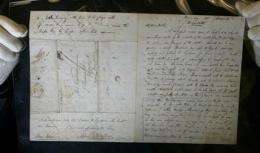
(AP) -- As he trudges past chest-high ferns and butterflies the size of saucers, George Beccaloni scours a jungle hilltop overlooking the South China Sea for signs of a long-forgotten Victorian-era scientist.
He finds what he's looking for: an abandoned, two-story guest house, its doors missing and ceiling caved in.
"Excellent. This is the actual spot," he yells.
It is on this site, in a long-gone thatched hut, that Alfred Russel Wallace is believed to have spent weeks in 1855 writing a seminal paper on the theory of evolution. Yet he is largely unknown outside scientific circles today, overshadowed by Charles Darwin, whom most people credit as the father of a theory that explains the origins of life through how plants and animals evolve.
Now, in the 200th anniversary of Darwin's birth, a growing number of academics and amateur historians are rediscovering Wallace. Their efforts are raising debate over exactly what Wallace contributed to the theory of evolution, and what role, if any, the spiritual world plays in certain aspects of natural selection.
Beccaloni, a 41-year-old British evolutionary biologist with London's Natural History Museum, is on a quest to return Wallace to what he sees as his rightful place in history. He and Fred Langford Edwards, a British artist making an audiovisual project about Wallace, are retracing the scientist's eight-year trip around Southeast Asia.
Unlike Wallace, Darwin spent two decades developing his theory of natural selection and had far more evidence to back it up, as presented in his defining work, "The Origin of Species," published 150 years ago. But Wallace reached the same conclusion before Darwin published his findings, and Beccaloni contends that Wallace deserves equal billing.
"The Darwin industry is what has distorted the whole of history," Beccaloni said. "People have just concentrated on Darwin and his life and work but they fail to see Darwin wasn't alone and he fits into a wider picture."
Wallace, a British beetle and bird collector, set off for Singapore in 1854. Eight years and 14,000 miles (23,000 kilometers) later, he returned to England as one of the most celebrated biologists after Darwin.
Often traveling with a lone assistant and enduring monsoons and malaria, Wallace collected more than 125,000 birds, beetles and other animals. Thousands were new to the West, including one he named Wallace's golden bird wing butterfly. He shot 17 orangutans and shipped their skins back to Britain, became a fan of the durian - a fruit known for its thorns and powerful odor - and admired the moral character and mental capacity of the Dyak people of Borneo.
But his biggest contribution to science was his writings in the Malay archipelago on evolution and natural selection, building on an earlier four-year trek to the Amazon.
In 1855, he laid out the Sarawak law - named after the place he wrote the paper, now a state in modern-day Malaysia - in which he described evolution as a branching tree. His forceful argument in support of evolution came at a time when creationism, or the idea that God created man, was the popular school of thought.
A year later, he proposed what became known as the Wallace Line after traveling to the islands of Bali and Lombok, in what is now Indonesia. He noticed that bird species were different on each island and concluded that a deep water trench created a boundary that separated the animal species of Southeast Asia and Australasia.
Two years after that, Wallace came up with the theory of natural selection - or survival of the fittest - while bedridden with malaria on another nearby island.
His theory was presented together with Darwin's by the Linnean Society of London on July 1, 1858. Upon his return to England in 1862, Wallace found himself welcomed into a select club of scientists that included Darwin, Sir Charles Lyell, Joseph Hooker and Thomas Henry Huxley.
Wallace became one of the most prominent scientists of his day, publishing more than 800 articles and 22 books over the next 50 years. He was a leading voice in an anti-vaccination movement, a proponent of land reform and the father of biogeography, or the study of the geographic distribution of plants and animals.
"He was a person with a remarkable open mind," said Charles H. Smith, a professor and Western Kentucky University librarian who runs a Web site on Wallace. "He had more concern with science as it related to humankind than practically anyone in his time. That is why he was so interested in social issues."
Wallace died in 1913 at the age of 90. Over the years, he slipped into obscurity, joining a long list - British scientist Patrick Matthews and French scientist Jean Baptist LeMarc among them - whose contributions to evolution theory have largely become footnotes.
The soft-spoken, baby-faced Beccaloni became enamored of Wallace as a graduate student studying the evolution of mimicry in butterflies. He took up Wallace's cause in 1999 after stumbling upon his poorly maintained gravestone in Dorset, England.
Calling himself Wallace's Rottweiler, Beccaloni has barnstormed across England to preserve Wallace homes and other sites. He convinced the Natural History Museum in London to buy the scientist's insect collection, correspondence and books from Wallace's two grandsons.
He also runs a Wallace Web site and is helping British standup comedian Bill Bailey plan a routine based on the scientist. Beccaloni's biggest job by far, however, is defending Wallace's legacy.
He and other scholars claim Darwin conspired to ensure his paper was presented with Wallace's to prevent Wallace from getting sole credit. Roy Davies, the author of the "The Darwin Conspiracy," even accuses Darwin of stealing his ideas from Wallace - an allegation dismissed by other Wallace supporters as unsubstantiated.
But Peter Bowler, a Queen's University of Belfast professor who has spent his career studying evolution theory, contends Wallace's achievements have been exaggerated by his supporters.
Wallace did not have the complete theory and nowhere near the evidence Darwin had compiled - and that was needed to win over a skeptical public, Bowler said. Darwin's evidence included fossil records, animal breeding and heredity, while Wallace relied almost exclusively on biogeography.
"How many years would it have taken Wallace to put together the sort of comprehensive account that would have grabbed people's attention the way 'The Origin of Species' did?" Bowler asked. "Without Darwin, I don't think there would have been a great debate about natural selection in the 1860s and 1870s."
Also controversial is Wallace's support of spiritualism, a popular movement that held seances and believed spirits of the dead can communicate with the living. He upset Darwin and damaged his scientific reputation by arguing that the development of the human mind and some bodily attributes were guided by spiritual beings rather than natural selection, Beccaloni acknowledged.
That has turned Wallace into an unlikely hero among some Christian conservatives opposed to the teaching of evolution. He is also used to support intelligent design, the theory that certain features of life forms are so complex that they must have originated from a higher power.
Michael Flannery, the author of the new book "Alfred Russel Wallace's Theory of Intelligent Evolution," argues that Wallace was in many ways "the seminal figure in what we consider the intelligent design movement." The Seattle-based Discovery Institute, the main supporter of the theory, cites Wallace in its promotional material.
Beccaloni groans when the talk turns to Wallace's spiritualism, noting that he wasn't even a Christian. Christian groups are "grasping at straws," he said, and other academics are using spiritualism to diminish his scientific importance. Beccaloni is trying to keep the focus on his earlier scientific discoveries.
In the Malaysian riverside town of Simunjan, Beccaloni was again on the trail of Wallace. Using Wallace's famous travelogue "The Malay Archipelago" as a map of sorts, he followed a rusted railroad track featured in the book, past paddy fields and palm oil plantations, until the road ended in a peat bog.
That's when Beccaloni began noticing chunks of coal sticking out of the dark soil, a telltale sign of coal works that Wallace described in his book. It was here, Beccaloni surmised, that Wallace spent nine months collecting insects, discovering a strange tree-frog and shooting orangutans.
But nobody would know. The site was unmarked.
---
On the Net:
The Alfred Russel Wallace Memorial Fund: http://wallacefund.info/
The Alfred Russel Wallace Page: http://www.wku.edu/
The Discovery Institute: http://www.discovery.org/
Natural History's Wallace Collection: http://www.nhm.ac.uk/nature-online/collections-at-the-museum/wallace-collection/index.jsp
Fred Langford Edwards Page: http://www.fredlangfordedwards.com
©2009 The Associated Press. All rights reserved. This material may not be published, broadcast, rewritten or redistributed.


