Super-sleepers could help super-sizers!
June 29, 2009 Super-sleepers could help super-sizers!

Enlarge

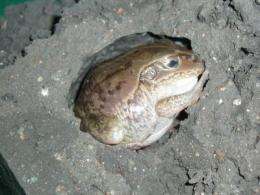
This is the burrowing frog (Cyclorana alboguttata) used as model organism in the study. Credit: Sara M. Kayes

Burrowing frogs can survive buried for several years without food or water. Scientists have discovered that the metabolism of their cells changes radically during the dormancy period allowing the frogs to maximize the use of their limited energy resources. This discovery could prove to have important applications in the long term for treating energy-related disorders such as obesity. The results will be presented at the Society for Experimental Biology meeting on Monday, June 29.

Many species of animals go through a period of torpor to conserve energy when resources are scarce. But when it comes to switching to energy-saving mode, the champion by far among vertebrates is the burrowing frog (Cyclorana alboguttata), which can survive for several years buried in the mud in the absence of any food or water. How do they accomplish this feat?

A team of scientists at the University of Queensland have discovered that the of their cells changes radically during the dormancy period allowing the to maximise the use of their limited energy resources without ever running on empty. This discovery could prove to have important medical applications in the long term. "It could potentially be useful in the treatment of energy-related disorders such as ", explains Ms. Sara Kayes who will present her findings at the Society of Annual Meeting in Glasgow on Monday 29th June 2009.

When the operation efficiency of the , the tiny "power plants" of the cell, was measured during the dormancy period, it was found to be significantly higher compared to that observed in active animals. This trick , known as mitochondrial coupling, allows these frogs to be extremely efficient in the use of the limited energy stores they have by increasing the total amount of energy obtained per unit consumed, allowing them to easily outperform other species whose efficiency remains essentially the same even when they happen to be inactive for extended periods.

If this is such an efficient way to use energy resources during dormancy, how come that it is not more widespread in the animal kingdom? The researchers speculate that a potential drawback may be the increased production of reactive oxygen species, which may in turn lead to oxidative stress. Since these small molecules are believed to cause most of the damage during periods of re-awakening, increasing mitochondrial coupling does not seem to be a particularly good idea for animals that tend to exhibit short periods of spontaneous arousal during the dormancy period, in some cases even daily. Burrowing frogs, on the other hand, are believed to remain deeply asleep during the entire period of dormancy. Furthermore, being cold-blooded, they don't have the need to maintain a basal level of heat production, minimizing their energy needs.

Source: Society for Experimental Biology


print this article email this article download pdf blog this article bookmark this article     Stumble it Digg this share on Facebook retweet share on Reddit add to delicious
Rate this story - 5 /5 (2 votes)

Rank Filter

Move the slider to adjust rank threshold, so that you can hide some of the comments.


Display comments: newest first

  • DGBEACH - Jun 29, 2009
    • Rank: 5 / 5 (1)
    Finally a possible way to induce true long-term hibernation in a living being. This would allow us to travel much further in space, n'est ce pas?
  • david_42 - Jun 29, 2009
    • Rank: not rated yet
    An interesting article, but really?

    "energy-related disorders such as obesity"

    Stuff in minus stuff out equals accumulation. All of my siblings are obese. I eat much less than they do and I'm not.
  • Megadeth312 - Jun 29, 2009
    • Rank: not rated yet
    An interesting article, but really?


    "energy-related disorders such as obesity"


    Stuff in minus stuff out equals accumulation. All of my siblings are obese. I eat much less than they do and I'm not.


    beautiful
  • Birger - Jun 30, 2009
    • Rank: not rated yet
    Since cancer cells shut down the mitochondria to avoid apoptosis, can this research help finding ways to turning them back on?
    For instance, work in Canada shows dichloracetate in some occasions can turn the mitochondria back on, killing the cancer cells, but since cancers are very diverse, more approaches would be welcome.

June 29, 2009 all stories

Comments: 4

5 /5 (2 votes)
  • Stumble this up

  • Digg this

  • share this

  • hide
  • Related Stories

  • Right angles are all wrong for tree frog adhesion
    created Apr 02, 2007 | popularity not rated yet | comments 0
  • A new brake on cellular energy production discovered
    created Jul 27, 2007 | popularity not rated yet | comments 0
  • Frog muscles survive big sleep
    created May 10, 2007 | popularity not rated yet | comments 0
  • How Snakes Survive Starvation
    created Aug 27, 2007 | popularity not rated yet | comments 0
  • Mitochondria play role in pathogenesis of AD and estrogen-induced neuroprotection
    created Apr 06, 2008 | popularity not rated yet | comments 0


  • hide
  • Relevant PhysicsForums posts

  • What is transpulmonary pressure?
    created 2 hours ago
  • Is there a gay gene?
    created Nov 23, 2009
  • Super quick question about Starling forces?
    created Nov 22, 2009
  • Questions about diffusion
    created Nov 22, 2009
  • More from Physics Forums - Biology

Other News

Fish food fight: Fish don't eat trees after all, says new study

Fish food fight: Fish don't eat trees after all, says new study

Biology / Ecology

created 35 minutes ago | popularity not rated yet | comments 0

(PhysOrg.com) -- What constitutes fish food is a matter of debate. A high-profile study a few years ago suggested that fish get almost 50 percent of their carbon from trees and leaves, evidence for a very ...


Computational microscope peers into the working ribosome

Computational microscope peers into the working ribosome (w/ Video)

Biology / Cell & Microbiology

created 20 hours ago | popularity 4.9 / 5 (8) | comments 0

Two new studies reveal in unprecedented detail how the ribosome interacts with other molecules to assemble new proteins and guide them toward their destination in biological cells. The studies used molecular ...


New chameleon species discovered in East Africa

New chameleon species discovered in East Africa (w/ Podcast)

Biology / Plants & Animals

created 23 hours ago | popularity 5 / 5 (1) | comments 0

A new species of chameleon has been discovered in Tanzania by a team of scientists.


Spider secrets decoded in world-first database

Biology / Plants & Animals

created 15 hours ago | popularity not rated yet | comments 0

(PhysOrg.com) -- Queensland scientists have developed a world-first database that catalogues the venom components from hundreds of spiders.


A year after discovery, Congo's 'mother lode' of gorillas remains vulnerable

A year after discovery, Congo's 'mother lode' of gorillas remains vulnerable

Biology / Plants & Animals

created 18 hours ago | popularity 5 / 5 (1) | comments 0

A new study by the Wildlife Conservation Society says that western lowland gorillas living in a large swamp in the Republic of Congo—part of the "mother lode" of more than 125,000 gorillas discovered last ...