Toyota technology has brain waves move wheelchair
June 29, 2009
Toyota technology has brain waves move wheelchair

Enlarge

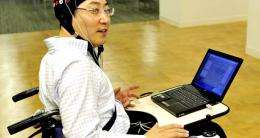
(AP) -- Toyota Motor Corp. says it has developed a way of steering a wheelchair by just detecting brain waves, without the person having to move a muscle or shout a command.

Toyota's system, developed in a collaboration with researchers in Japan, is among the fastest in the world in analyzing brain waves, it said in a release Monday.

Past systems required several seconds to read brain waves, but the new technology requires only 125 milliseconds - or 125 thousandths of a second.

The person in the wears a cap that can read brain signals, which are relayed to a brain scan electroencephalograph, or EEG, on the electrically powered wheelchair, and then analyzed in a computer program.

Research into mobility is part of Toyota's larger strategy to go beyond automobiles in helping people get around in new ways.

The new system allows the person on the wheelchair to turn left or right and go forward, almost instantly, according to researchers.

Coming to a stop still requires more than a thought. The person in the wheelchair must puff up a cheek, which is picked up in a detector worn on the face.

Japanese rival Honda Motor Co. is also working on a system to connect the monitoring of with mechanical moves.

Earlier this year, Honda showed a video that had a person wearing a helmet sitting still but thinking about moving his right hand. The thought was picked up by cords attached to his head inside the helmet. After several seconds, Honda's boy-shaped robot Asimo, programmed to respond to brain signals, lifted its right arm.

Neither Honda nor Toyota said it had any plans to turn the technology into a product for commercial sale as each said they are still developing the research.

©2009 The Associated Press. All rights reserved. This material may not be published, broadcast, rewritten or redistributed.

4.9 /5 (7 votes)  

Filter


Move the slider to adjust rank threshold, so that you can hide some of the comments.


Display comments: newest first

lengould100
Jun 29, 2009

Rank: not rated yet
Will never be fast enough or accurate enough tocontrol autos.
plasticpower
Jun 29, 2009

Rank: not rated yet
Never say never
visual
Jun 30, 2009

Rank: not rated yet
"never" may indeed be the case for non-invasive approaches, however with enough time implants will become quite safe, social taboos against them will fade away and they will eventually become the basis of the next technological revolution.
Rank 4.9 /5 (7 votes)
Related Stories
Relevant PhysicsForums posts
  • Empirical data regarding shower heads and water
    created6 hours ago
  • feed hold button on CNC lathe
    createdFeb 09, 2012
  • RFAC in Fortran
    createdFeb 09, 2012
  • dynamics 2/32
    createdFeb 08, 2012
  • dynamics
    createdFeb 08, 2012
  • Vibration Absorbtion Problem
    createdFeb 08, 2012
  • More from Physics Forums - General Engineering

More news stories

New error-correcting codes guarantee the fastest possible rate of data transmission

Error-correcting codes are one of the triumphs of the digital age. They’re a way of encoding information so that it can be transmitted across a communication channel — such as an optical fiber o ...

Technology / Computer Sciences

created 43 minutes ago | popularity 5 / 5 (2) | comments 0 | with audio podcast

Advanced power-grid model finds low-cost, low-carbon future in West

(PhysOrg.com) -- The least expensive way for the Western U.S. to reduce greenhouse gas emissions enough to help prevent the worst consequences of global warming is to replace coal with renewable and other ...

Technology / Energy & Green Tech

created 10 minutes ago | popularity 5 / 5 (1) | comments 0 | with audio podcast

Small modular reactor design could be a 'SUPERSTAR'

(PhysOrg.com) -- Though most of today's nuclear reactors are cooled by water, we've long known that there are alternatives; in fact, the world's first nuclear-powered electricity in 1951 came from a reactor ...

Technology / Energy & Green Tech

created 3 minutes ago | popularity not rated yet | comments 0 | with audio podcast

US video game sales fall 34 percent in January

(AP) -- U.S. retail sales of video game hardware, software and accessories fell 34 percent in January from a year earlier to $751 million due to the lack of new game titles, according to market researcher NPD Group.

Technology / Business

created 3 hours ago | popularity not rated yet | comments 2

Zynga partners with toy maker Hasbro

Old school toy maker Hasbro and online social game star Zynga on Thursday announced a partnership to mesh the Internet firm's hits with real-world products.

Technology / Business

created 2 hours ago | popularity not rated yet | comments 0


A frank discussion of the power law and linking correlation to causation

(PhysOrg.com) -- Michael Stumpf a mathematics professor at Imperial College in London, and Mason Porter a lecturer at Oxford have teamed together to write and publish a perspective piece in Science regarding the in ...

Mars Science Laboratory computer issue resolved

(PhysOrg.com) -- Engineers have found the root cause of a computer reset that occurred two months ago on NASA's Mars Science Laboratory and have determined how to correct it.

High school students test best with 7 hours' rest

(Medical Xpress) -- Whether or not you know any high school students that actually get nine hours of sleep each night, that’s what federal guidelines currently prescribe.

The question of life in the ancient world

There’s a general feeling that we don’t get the Greeks – ancient or modern. Many, including heads of state like Angela Merkel, visibly shake their head in exasperation, rightly or wrongly, at ...

Study suggests girls can 'rewire' brains to ward off depression

(Medical Xpress) -- What if you could teach your brain to respond differently to things that make you feel sad, down or stressed out? What if doing that helped ward off depression?

UNC investigator issues call to action for schizophrenia research

(Medical Xpress) -- Much of medical research is aimed at figuring out what role a single gene or molecule plays in the development of disease.