Ultrasensitive detector promises improved treatment of viral respiratory infections
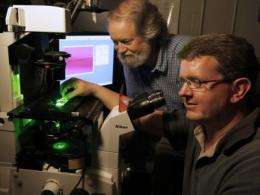
(PhysOrg.com) -- A Vanderbilt chemist and a biomedical engineer have teamed up to develop a respiratory virus detector that is sensitive enough to detect an infection at an early stage, takes only a few minutes to return a result and is simple enough to be performed in a pediatrician's office.
Writing in The Analyst - a journal published by the Royal Society of Chemistry - the developers report that their technique, which uses DNA hairpins attached to gold filaments, can detect the presence of respiratory syncytial virus (RSV) - a leading cause of respiratory infections in infants and young children - at substantially lower levels than the standard laboratory assay.
"We hope that our research will help us break out of the catch-22 that is holding back major advances in the treatment of respiratory viruses," says Associate Professor of Chemistry David Wright, who is working with Professor of Biomedical Engineering Frederick "Rick" Haselton on the new detection method.
According to the chemist, major pharmaceutical companies are not investing in the development of antiviral drugs for RSV and the other major respiratory viruses because there is no way to detect the infections early enough for the drugs to work effectively without harmful side-effects. "There are antiviral compounds out there - we have discovered some of them in my lab - that would work if we can detect the virus early enough, before there is too much virus in the system," he says.
In addition, the lack of a reliable early detection system adds to the growing problem of antibiotic resistance. The symptoms of respiratory infections caused by viral agents are nearly identical to those caused by bacteria. As a result, antibiotics, which target bacteria, are often incorrectly prescribed for viral infections. Not only is this ineffective, but it also increases the number of antibiotic-resistant strains.
Currently, there are several standard tests for RSV including culturing the virus, polymerase chain reaction (PCR) and the enzyme-linked immunosorbent assay (ELISA). To have any of these tests done, doctors must send a mucous sample from a patient to a special laboratory. When combined with delivery times, backlogs and other delays, it frequently takes a day or more to get the results. Unfortunately, respiratory viruses multiply so rapidly that this can be too late for antiviral drugs to work, Wright says.
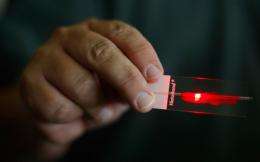
By contrast, "our system could easily be packaged in a disposable device about the size of a ballpoint pen," says Haselton. To perform a test, all that would be required is to pull off a cap that will expose a length of gold wire, dip the wire in the sample, pull the wire through the device and put the exposed wire into a fluorescence scanner. If it lights up, then the virus is present.
The new detector design is a combination of two existing technologies.
One is the filament-based antibody recognition assay (FARA) developed several years ago by Haselton and patented by Vanderbilt. FARA uses antibodies - special proteins produced by the immune system that binds to specific foreign substances - that are coated on the surface of a polyester filament. When the coated filament is exposed to a sample, if it contains any of the target molecules, they stick to the antibodies, forming complexes that can be detected with fluorescent dyes. One advantage of this approach is that a sample can be put through different processing steps simply by pulling the filament through a series of small chambers. In the RSV detection application, the chambers contain washing solutions that remove non-specific binding molecules.
"Originally we thought that we would have to put special seals between the chambers but we found that if we make the openings small enough, then the solutions in the chambers stay in place as we pull the wire through," says Haselton.
The second technology is based on molecular beacon probes, an approach often used in PCR. The probes consist of short lengths of single-strand DNA that normally form a hairpin shape but straighten out when they are bound to a target molecule. A fluorescent dye molecule is attached to one leg of the hairpin and a molecule that quenches its fluorescence is attached to the other. When the probe is in its hairpin configuration, the dye and quencher molecules lay side by side so the probe does not fluoresce. When it is bound to a target, such as a piece of viral RNA, the ends spring apart, turning on the probe's fluorescence.
The Vanderbilt researchers realized that if they attached molecular beacons to a gold-coated filament, the gold could theoretically replace the quencher molecule and inhibit the beacon's fluorescence. However, they had to find a linking molecule - the molecule that attaches the beacon to the wire - that was just the right length to make it work.
Once they solved this problem, the researchers tested the sensitivity of the new system. They found that it could detect the presence of RSV virus particles at levels that are 200 times below the minimum detection level of the standard ELISA method. This extreme sensitivity combined with the basic simplicity of the approach makes it "attractive for further development as a viral detection platform," the scientists write in the Analyst article, which was published online May 15.
According to Haselton, there are two areas where further development is needed. One is sample preparation. Commercial RNA sample preparation kits are available, but they are more expensive and complex than desirable. The team is currently examining the design of a simple pull-through RNA isolation chamber. The team is also exploring ways to reduce false detections. There are a lot of other molecules in mucous besides viral RNA that can bind to some extent with the molecular beacons. However, the researchers argue that it should be possible to reduce the number of false positives significantly by adding a heating step that is calibrated to drive off the molecules that are less strongly bound to the beacons than the viral RNA.
The next major step in the development process is to see how the device performs with real patient samples.
Source: Vanderbilt University (news : web)


