Little-known marine decomposers attract the attention of genome sequencers
June 29, 2009
Little-known marine decomposers attract the attention of genome sequencers

Enlarge

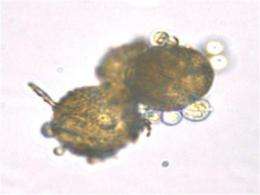
Labyrinthulomycetes from Peconic Bay are shown growing on pollen grains. Credit: Enixy Collado Mercado, Stony Brook University

The Department of Energy's Joint Genome Institute (JGI) announced today that they will sequence the genomes of four species of labyrinthulomycetes. These little-known marine species were selected for sequencing as the result of a proposal submitted to the competitive JGI Community Sequencing Program by a team of microbiologists led by Dr. Jackie Collier, assistant professor at the School of Marine and Atmospheric Sciences (SoMAS) at Stony Brook University.

"Labyrinthulomycetes are a huge group of organisms that behave ecologically like fungi," said Dr. Collier. "But we know so little about them and there is more diversity among this group than among all the animals you can think of."

Labyrinthulomycetes are single-celled marine decomposers that eat non-living plant, algal, and animal matter. They are ubiquitous and abundant—particularly on dead vegetation and in salt marshes and mangrove swamps. Although most labyrinthulomycetes species are not pathogens, the organisms responsible for eelgrass wasting disease and QPX disease in hard clams are part of this group.

In some regions, labyrinthulomycetes may be as important as bacteria in degrading organic matter. In coastal systems, the abundance of bacteria is tied to levels of organic matter from marine sources, while the abundance of labyrinthulomycetes is more closely tied to levels of particulate from land sources. This suggests that labyrinthulomycetes may play an important role in the marine carbon cycle by breaking down material that is difficult to degrade. Because labyrinthulomycetes—unlike bacteria—make long chain (PUFAs), they are also thought to improve the nutritional value of poor quality organic detritus.

"The genome sequences will provide a quantum leap in our understanding of the physiological capacity of these organisms," said Dr. Collier. "The genes can tell us which enzymes a species is capable of producing, which in turn tells us what kinds of material they can potentially degrade and what role they play in a marine ecosystem's food web."

In addition, genomic information might suggest ways to exploit labyrinthulomycetes in novel biotechnological applications. Labyrinthulomycetes produce a wide array of enzymes and some species can degrade crude oil. Also, some labyrinthulomycetes are currently cultured for nutritional supplements. If PUFAs derived from labyrinthulomycetes were to replace fish oils and meal used in aquaculture and animal farming, it would likely reduce the number of fish caught for use as animal feed and have a positive impact on the health of the world's oceans.

Source: Stony Brook University (news : web)


Rank 5 /5 (1 vote)
Relevant PhysicsForums posts
  • Mitosis
    created1 hour ago
  • Stem cell question.
    created3 hours ago
  • Protease cleavage
    created9 hours ago
  • Pertubance in a model
    created15 hours ago
  • Cancer drugs and Alzheimer's, Oh my!
    createdFeb 09, 2012
  • Squishing cells
    createdFeb 09, 2012
  • More from Physics Forums - Biology

More news stories

The power of estrogen -- male snakes attract other males

A new study has shown that boosting the estrogen levels of male garter snakes causes them to secrete the same pheromones that females use to attract suitors, and turned the males into just about the sexiest ...

Biology / Plants & Animals

created 13 hours ago | popularity 4.8 / 5 (5) | comments 1 | with audio podcast

Grass to gas: Researchers' genome map speeds biofuel development

Researchers at the University of Georgia have taken a major step in the ongoing effort to find sources of cleaner, renewable energy by mapping the genomes of two originator cells of Miscanthus x giganteus, a large perenn ...

Biology / Biotechnology

created 10 hours ago | popularity 3.8 / 5 (5) | comments 0 | with audio podcast

Experts reveal how plants don't get sunburn

(PhysOrg.com) -- Experts at the University of Glasgow have discovered how plants survive the harmful rays of the sun.

Biology / Cell & Microbiology

created 13 hours ago | popularity 4.8 / 5 (4) | comments 0 | with audio podcast

Miami battling invasion of giant African snails

No one knows how they got there. But an invasion of African giant snails has southern Florida in a panic over potential crop damage, disease and general yuckiness surrounding the slimy gastropods.

Biology / Ecology

created 17 hours ago | popularity 4 / 5 (1) | comments 4

Protein libraries in a snap

(PhysOrg.com) -- A Rice University undergraduate will depart with not only a degree but also a possible patent for his invention of an efficient way to create protein libraries, an important component of biomolecular ...

Biology / Cell & Microbiology

created 17 hours ago | popularity 4.8 / 5 (4) | comments 0 | with audio podcast


Anonymous knocks CIA website offline (Update)

The website of the Central Intelligence Agency was inaccessible on Friday after the hacker group Anonymous claimed to have knocked it offline.

Google users warned of threat to smartphone wallets

Users of Google smartphone wallets were being warned on Friday that there is a way to crack pass codes intended to thwart thieves from going on illicit shopping sprees.

New error-correcting codes guarantee the fastest possible rate of data transmission

Error-correcting codes are one of the triumphs of the digital age. They’re a way of encoding information so that it can be transmitted across a communication channel — such as an optical fiber o ...

Complex wiring of the nervous system may rely on a just a handful of genes and proteins

Researchers at the Salk Institute have discovered a startling feature of early brain development that helps to explain how complex neuron wiring patterns are programmed using just a handful of critical genes. ...

Humans may have helped the decline of African rainforests 3000 years ago

(PhysOrg.com) -- Large areas of rainforests in Central Africa mysteriously disappeared over three thousand years ago, to be replaced by savannas. The prevailing theory has been that the cause was a change ...

New power source discovered

(PhysOrg.com) -- Researchers at the Massachusetts Institute of Technology (MIT) and RMIT University have made a breakthrough in energy storage and power generation.