Purple sweet potato means increased amount of anti-cancer components
June 29, 2009 Purple sweet potato means increased amount of anti-cancer components

Enlarge

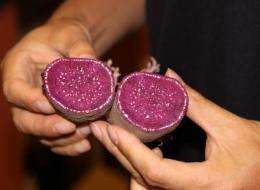
A Kansas State University researcher is studying the potential health benefits of a specially bred purple sweet potato because its dominant purple color results in an increased amount of anti-cancer components. Credit: Kansas State University media relations

A Kansas State University researcher is studying the potential health benefits of a specially bred purple sweet potato because its dominant purple color results in an increased amount of anti-cancer components.

K-State's Soyoung Lim, doctoral student in human nutrition, Manhattan, is working with George Wang, associate professor of human at K-State, to understand the pigment effects of a Kansas-bred purple sweet potato on .

Lim said purple sweet potatoes have high contents of anthocyanin, which is a pigment that presents the purple color in the vegetable. The pigment can produce red, blue and purple colors depending on the source's , such as in foods like blueberries, red grapes and red cabbage.

She said anthocyanins have been epidemiologically associated with a reduced cancer risk, but the anti-cancer ability of the purple sweet potato has not been well investigated.

Lim used a sweet potato with pronounced purple flesh and skin that was developed by K-State's Ted Carey, professor of horticulture, at K-State's John C. Pair Horticultural Center in Haysville.

"Sometimes we can find purple sweet potatoes in the grocery store, but they don't have this purple color on the skin and inside," Lim said.

Three different purple sweet potatoes were used that had varying amounts of anthocyanin for the project. To quantify the amount in each potato, Lim extracted pigments from the vegetables and injected them into an HPLC-MS Analysis, which she said is a method that separates components.

The potatoes were segregated by multiple traits based on flesh and fiber contents. The analysis determined that the Kansas-bred potato had significantly higher anthocyanin contents compared to the other potatoes. The analysis also found two derivatives of anthocyanin that were dominant: cyanidin and peonidin, Lim said.

Lim also measured the potatoes' total phenolic content. Lim said phenols are chemical compounds that have been found to have anti-aging and antioxidant components. The specially bred purple sweet potato had a much higher total phenolic content and antioxidant capacity than the other regularly occurring purple sweet potatoes, she said.

The K-State researchers also wanted to see the specific effects of cyanidin and peonidin. Lim treated human colon cancer cells with low concentrations of the pigment derivatives and also studied the effects on the cell cycles.

Cyanidin and peonidin showed significant cell growth inhibition for the cancer cells, but there were no significant changes in the cell cycle. Lim said a better understanding of the underlying mechanisms in the Kansas-bred potato could provide scientific evidence of its health benefits.

Lim presented the research at the Experimental Biology Meeting in New Orleans in April. She is doing a follow-up study this summer that will involve treating animal cells with the pigments.

Source: Kansas State University (news : web)


Rate this story - 5 /5 (3 votes)

Rank Filter

Move the slider to adjust rank threshold, so that you can hide some of the comments.


Display comments: newest first

  • marjon - Jun 29, 2009
    • Rank: 5 / 5 (1)
    How are they different than ube, a purple sweet potato in the Philippines?

June 29, 2009 all stories

Comments: 1

5 /5 (3 votes)

  • hide
  • Related Stories

  • Compounds that color fruits and veggies may protect against colon cancer
    created Aug 19, 2007 | popularity not rated yet | comments 0
  • Purple pigments and obesity
    created Feb 11, 2008 | popularity not rated yet | comments 0
  • Colour purple rules the mailbox
    created Feb 03, 2006 | popularity not rated yet | comments 0
  • Motorola Debuts MOTORAZR V3i in Purple
    created May 01, 2007 | popularity not rated yet | comments 0
  • New study suggests Concord grape juice may provide protection against breast cancer
    created Aug 09, 2007 | popularity not rated yet | comments 0


  • hide
  • Relevant PhysicsForums posts

Other News

Whooping cough vaccine may be losing its punch: study

Medicine & Health / Diseases

created 41 minutes ago | popularity not rated yet | comments 0

(PhysOrg.com) -- Vaccination programs against whooping cough may not be fully effective because the bacteria that cause the disease have evolved new strains, a new study has found. A team of Australian scientists has ...


IQ among strongest predictors of cardiovascular disease -- second only to cigarette smoking

Medicine & Health / Health

created 3 hours ago | popularity not rated yet | comments 6 | with audio podcast

as reflected by low results on written or oral tests of IQ - have been associated with a raised risk of cardiovascular disease, no study has so far compared the relative strength of this association with other established ...


Communication breakdown: What happens to nerve cells in Parkinson's disease

Medicine & Health / Neuroscience

created 3 hours ago | popularity not rated yet | comments 0 | with audio podcast

A new study from The Montreal Neurological Institute and Hospital - The Neuro - at McGill University is the first to discover a molecular link between Parkinson's disease and defects in the ability of nerve cells to communicate. ...


A common cholesterol drug fights cataracts, too

Medicine & Health / Medications

created 2 hours ago | popularity not rated yet | comments 1

Statins, a class of drugs used to lower cholesterol levels, have been successfully fighting heart disease for years. A new study from Tel Aviv University has now found that the same drugs cut the risks of cataracts in men ...


Changes proposed in how psychiatrists diagnose

Medicine & Health / Psychology & Psychiatry

created 2 hours ago | popularity not rated yet | comments 0

(AP) -- Don't say "mental retardation" - the new term is "intellectual disability." No more diagnoses of Asperger's syndrome - call it a mild version of autism instead. And while "behavioral addictions" will be new to doctors' ...