Study of flower color shows evolution in action
June 29, 2009 Study of flower color shows evolution in action

Enlarge

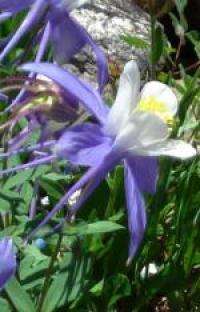
This is the Rocky Mountain Columbine. Credit: R. Kelly Dawe

Scientists at UC Santa Barbara have zeroed in on the genes responsible for changing flower color, an area of research that began with Gregor Mendel's studies of the garden pea in the 1850's.

In an article published recently in the Proceedings of the National Academies of Sciences, two researchers document their studies of the evolution of columbine flowers in North America. They studied red columbines pollinated by hummingbirds, and white or yellow columbines pollinated by hawkmoths. They believe that a color shift from red to white or yellow has happened five times in North America.

"What is important in this research is that hawkmoths mostly visit -- and pollinate -- white or pale flowers," said senior author Scott A. Hodges, professor of ecology, evolution and marine biology at UCSB. "We have shown experimentally that hawkmoths prefer these paler colors."
Study of flower color shows evolution in action
Enlarge

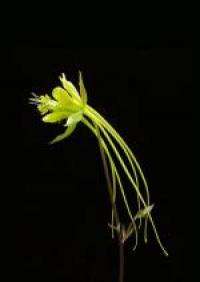
This Longspur Columbine (A. longissima) has the longest nectar spurs in the genus. Credit: Scott Hodges, UCSB

When a plant population shifts from being predominantly hummingbird-pollinated where flowers are red, to hawkmoth-pollinated, natural selection works to change the flower color to white or yellow, he explained.

"Ultimately we want to know if evolution can be predictable," said Hodges. "In other words, we want to know if each time there is an evolutionary change in flower color, does it happen in the same way? Having identified all the genes that are intimately involved with making red and blue columbines now allows us to determine how these evolutionary transitions have occurred."

In earlier research, Hodges showed that evolve in a predictable fashion to match the mouthparts of pollinating birds and insects. Thus the pollinators of the yellow columbine flower, A. longissima, are predicted to have exceptionally long tongues to reach the nectar at the bottom.

Source: University of California - Santa Barbara (news : web)


print this article email this article download pdf blog this article bookmark this article     Stumble it Digg this share on Facebook retweet share on Reddit add to delicious
Rate this story - 4.4 /5 (5 votes)

Rank Filter

Move the slider to adjust rank threshold, so that you can hide some of the comments.


Display comments: newest first

  • JCincy - Jun 29, 2009
    • Rank: 1 / 5 (1)
    How does this demonstrate evolution?

    Was new genetic information obtained by the flowers to change colors or was the information already present?

    Please note that natural selection and evolution are two mutually independent processes. Observing one, doesn't verify the other.
  • LariAnn - Jun 29, 2009
    • Rank: 2.3 / 5 (3)
    The title of this article is misleading, as it does not show "evolution" in action, but rather adaptation. The columbine flowers are still columbines, and the existing pollinators find the flowers which their abilities enable them to. If the population of either type of pollinator falls or rises, the amount of corresponding flowers pollinated (and seeds produced) will also change. This is basic dominant and recessive gene information that I don't believe should be slanted as more "proof" of evolution. After all, the columbine flowers are not in the process of changing into an entirely different plant; they are merely expressing within their presently existing range of genetic resources.
  • mabarker - Jul 15, 2009
    • Rank: 1 / 5 (1)
    Three cheers for JCincy & LariAnn!! Clear & critical thinking is the rule for both of you - which is why neither 1 of you received 5 stars. *Natural selection is not Evolution* said Ronald Fisher in his book The Genetical Theory of Natural Selection. As a non-darwinist I see natural selection not as the macroevolutionist does - having the ability to *create* anything. Four evolutionary naturalists said in 1989, *NS can act only on those biologic properties that already exist; it cannot create properties in order to meet adaptational needs* - p. 516 of Parasitology (6th ed).
    Keep up the good work you 2!!

June 29, 2009 all stories

Comments: 3

4.4 /5 (5 votes)
  • Stumble this up

  • Digg this

  • share this

  • hide
  • Related Stories

  • Birds, Bees, and Moths Drive Flower Evolution
    created Jun 07, 2007 | popularity not rated yet | comments 0
  • Snapdragons take the evolutionary high-road
    created Aug 17, 2006 | popularity not rated yet | comments 0
  • Study: How bees handle complex colors
    created Nov 01, 2005 | popularity not rated yet | comments 0
  • New research provides better understanding of the birds and the bees
    created Dec 18, 2007 | popularity not rated yet | comments 0
  • Flowers shape themselves to guide their pollinators to the pollen
    created Apr 03, 2007 | popularity not rated yet | comments 0


  • hide
  • Relevant PhysicsForums posts

  • Human Leukocyte Antigen (HLA) typing
    created 1hour ago
  • Breeding program
    created Nov 20, 2009
  • How does a concentration gradient provide energy?
    created Nov 20, 2009
  • Eyesight and Neural Damage from Electronics
    created Nov 19, 2009
  • More from Physics Forums - Biology

Other News

The Monarchs' annual migration ritual has yet to be scientifically explained

Tree-eating bugs threaten Monarch butterfly in Mexico

Biology / Ecology

created 3 hours ago | popularity not rated yet | comments 0

The mysterious Monarch butterfly, which migrates en masse annually between Canada and Mexico, is now facing a new peril: another insect thriving in Western Mexican forests.


Extinct goat Myotragus balearicus

Extinct goat was cold-blooded

Biology / Plants & Animals

created Nov 18, 2009 | popularity 4.9 / 5 (30) | comments 10

(PhysOrg.com) -- An extinct goat that lived on a barren Mediterranean island survived for millions of years by reducing in size and by becoming cold-blooded, which has never before been discovered in mammals.


Bigger not necessarily better, when it comes to brains

Bigger not necessarily better, when it comes to brains

Biology / Plants & Animals

created Nov 17, 2009 | popularity 4.4 / 5 (16) | comments 11

(PhysOrg.com) -- Tiny insects could be as intelligent as much bigger animals, despite only having a brain the size of a pinhead, say scientists at Queen Mary, University of London.


Right-handed chimpanzees provide clues to the origin of human language

Biology / Plants & Animals

created Nov 16, 2009 | popularity 3 / 5 (1) | comments 7

Most of the linguistic functions in humans are controlled by the left cerebral hemisphere. A study of captive chimpanzees at the Yerkes National Primate Research Center (Atlanta, Georgia), reported in the January 2010 issue ...


The creature was found at a depth of 161 metres

Japanese researchers film rare baby fish 'fossil'

Biology / Plants & Animals

created Nov 17, 2009 | popularity 4.7 / 5 (7) | comments 4

Japanese marine researchers said Tuesday they had found and successfully filmed a young coelacanth -- a rare type of fish known as "a living fossil" -- in deep water off Indonesia.