First ever worldwide census of caribou and reindeer reveals a dramatic decline
June 29, 2009 By Michael Brown First ever worldwide census of caribou and reindeer reveals a dramatic decline

Enlarge

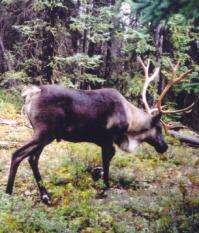
Caribou and reindeer harassed by insects do not consume normal levels of food and can’t put on the required weight to get them through an Arctic winter.

(PhysOrg.com) -- Caribou and reindeer numbers worldwide have plunged almost 60 per cent in the last three decades.

The dramatic revelation, published recently in the journal , came out of the first-ever comprehensive census carried out by biologists at the University of Alberta.

Study co-author and PhD student Liv Vors says global warming and industrial development are responsible for driving this dramatic decline in caribou and reindeer numbers around the world.

"With Peary caribou on Canada's high arctic islands, for example, there were probably at least 50,000 of them 60 years ago; now there are fewer than 1,000," said Vors.

An earlier spring green-up, which is especially important for pregnant females who need this highly nutritious flush of growth to provide high-quality milk for their newborns, seems to be wreaking havoc with migrating caribou and reindeer.

"Now that spring arrives earlier in the Arctic than it used to, the plants may be past their prime by the time the caribou reach the calving grounds," said Vors. "They don't appear to have adjusted their timing of migration."

Vors says more freezing rain during the winter months force a layer of ice on the ground, which restricts access to lichen and other forage, forcing migrating animals to travel further to find food. During the summer, an increased insect presence interrupts feeding patterns.

"Caribou and reindeer that are harassed by biting and parasitic insects spend less time feeding and more time running around to shake off these pests," she said. "Less feeding equals less body fat, which is crucial to surviving winter."

Hunting likely played a role in the decline of non-migratory woodland caribou in the early part of the 20th century when new roads gave greater access into the boreal and small groups of woodland caribou were frequently shot on site. Vors says, though, that it is no longer legal for non-Aboriginal hunters to hunt woodland caribou. For Aboriginal populations who are dependent on caribou and reindeer for sustenance, the decline of caribou is leading to both economic and spiritual hardships.

"If people cannot hunt caribou, they must purchase meat, which is prohibitively expensive in the Arctic," said Vors. "Caribou and reindeer also play significant roles in northern spirituality and mythology. Some values that caribou and reindeer sustain include education in traditional ways of life, kinship and bonding through hunting caribou and reindeer and the bequest of these herds to future generations."

Provided by University of Alberta (news : web)


Rate this story - 3.9 /5 (15 votes)

Rank Filter

Move the slider to adjust rank threshold, so that you can hide some of the comments.


Display comments: newest first

  • jonnyboy - Jun 29, 2009
    • Rank: 3 / 5 (2)
    If this is the first ever worldwide census then how can it be less than the itself ?
  • JCincy - Jun 29, 2009
    • Rank: not rated yet
    If this is the first ever worldwide census then how can it be less than the itself ?


    I agree. If there is no comparison data how can a comparison be made.
  • Doug_Huffman - Jun 29, 2009
    • Rank: not rated yet
    Data? Wee don' need no steenking data, we got glow-bull warning!

June 29, 2009 all stories

Comments: 3

3.9 /5 (15 votes)

  • hide
  • Related Stories

  • First ever worldwide census analysis of caribou/reindeer numbers reveals dramatic decline
    created Jun 11, 2009 | popularity not rated yet | comments 0
  • Alberta caribou at risk of extinction
    created Dec 22, 2005 | popularity not rated yet | comments 0
  • Global Warming Linked to Caribou-Calf Mortality
    created May 02, 2008 | popularity not rated yet | comments 0
  • Mountain caribou's ancient ancestry revealed
    created Jan 28, 2009 | popularity not rated yet | comments 0
  • Climate change does double-whammy to animals in seasonal environments
    created May 22, 2008 | popularity not rated yet | comments 0


  • hide
  • Relevant PhysicsForums posts

Other News

giant oarfish

Bizarre giant oarfish filmed (w/ Video)

Biology / Plants & Animals

created 53 minutes ago | popularity 5 / 5 (1) | comments 0 | with audio podcast report

(PhysOrg.com) -- A rare giant oarfish, probably the largest bony fish in the ocean, has been filmed off the Gulf of Mexico. This is possibly the first time the fish has been observed in its natural environment.


Scientists release Key Largo wood rats in first test of restocking experiment

Biology / Ecology

created 33 minutes ago | popularity not rated yet | comments 0

The seven pioneers spent the week preparing for their upcoming ordeal in North Key Largo, sampling berries and other local fare, redecorating homes with sticks, leaves and whatever else they got their little paws on, and ...


Great tits: birds with character

Great tits: birds with character

Biology / Plants & Animals

created 13 hours ago | popularity 5 / 5 (3) | comments 3 | with audio podcast

(PhysOrg.com) -- In humans and animals alike, individuals differ in sets of traits that we usually refer to as personality. An important part of the individual difference in personality is due to variation ...


Cells can read damaged DNA without missing a beat

Biology / Cell & Microbiology

created 12 hours ago | popularity 5 / 5 (1) | comments 0 | with audio podcast

Scientists have shown that cells' DNA-reading machinery can skim through certain kinds of damaged DNA without skipping any letters in the genetic "text." The studies, performed in bacteria, suggest a new mechanism that can ...


Study carried out into biological risks of eating reptiles

Study carried out into biological risks of eating reptiles

Biology / Cell & Microbiology

created 15 hours ago | popularity 3 / 5 (2) | comments 4

Reptiles are bred in captivity primarily for their skins, but some restaurants and population groups also want them for their meat. A study shows that eating these animals can have side effects that call into ...