Nanotubes weigh the atom
June 29, 2009
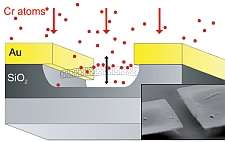
Diagram and insert image of a carbon nanotube. © CARDEQ
(PhysOrg.com) -- How can you weigh a single atom? European researchers have built an exquisite new device that can do just that. It may ultimately allow scientists to study the progress of chemical reactions, molecule by molecule.
Carbon nanotubes are ultra-thin fibres of carbon and a nanotechnologist’s dream.
They are made from thin sheets of carbon only one atom thick - known as graphene - rolled into a tube only a few nanometres across. Even the thickest is more than a thousand times thinner than a human hair.
Interest in carbon nanotubes blossomed in the 1990s when they were found to possess impressive characteristics that make them very attractive raw materials for nanotechnology of all kinds.
“They have unique properties,” explains Professor Pertti Hakonen of Helsinki University of Technology. “They are about 1000 times stronger than steel and very good thermal conductors and good electrical conductors.”
Hakonen is coordinator of the EU-funded CARDEQ project which is exploiting these intriguing materials to build a device sensitive enough to measure the masses of atoms and molecules.
Vibrating strings
A carbon nanotube is essentially an extremely thin, but stiff, piece of string and, like other strings, it can vibrate. As all guitar players know, heavy strings vibrate more slowly than lighter strings, so if a suspended carbon nanotube is allowed to vibrate at its natural frequency, that frequency will fall if atoms or molecules become attached to it.
It sounds simple and the idea is not new. What is new is the delicate sensing system needed to detect the vibration and measure its frequency. Some nanotubes turn out to be semiconductors, depending on how the graphene sheet is wound, and it is these that offer the solution that CARDEQ has developed.
Members of the consortium have taken the approach of building a semiconducting nanotube into a transistor so that the vibration modulates the current passing through it. “The suspended nanotube is, at the same time, the vibrating element and the readout element of the transistor,” Hakonen explains.
“The idea was to run three different detector plans in parallel and then select the best one,” he says. “Now we are down to two. So we have the single electron transfer concept, which is more sensitive, and the field effect transistor concept, which is faster.”
Single atoms
Last November, CARDEQ partners in Barcelona reported that they had sensed the mass of single chromium atoms deposited on a nanotube. But Hakonen says that even smaller atoms, of argon, can now be detected, though the device is not yet stable enough for such sensitivity to be routine. “When the device is operating well, we can see a single argon atom on short time scales. But then if you measure too long the noise becomes large.”
CARDEQ is not alone in employing carbon nanotubes as mass sensors. Similar work is going on at two centres in California - Berkeley and Caltech - though each has adopted a different method to measuring the mass.
All three groups have announced they can perform mass detection on the atomic level using nanotubes, but CARDEQ researchers provided the most convincing data with a clear shift in the resonance frequency.
But a single atom is nowhere near the limit of what is possible. Hakonen is confident they can push the technology to detect the mass of a single nucleon - a proton or neutron.
“It’s a big difference,” he admits, “but typically the improvements in these devices are jump-like. It’s not like developing some well-known device where we have only small improvements from time to time. This is really front-line work and breakthroughs do occur occasionally.”
Biological molecules
If the resolution can be pared down to a single nucleon, then researchers can look forward to accurately weighing different types of molecules and atoms in real time.
It may then become possible to observe the radioactive decay of a single nucleus and to study other types of quantum mechanical phenomena.
But the real excitement would be in tracking chemical and biological reactions involving individual atoms and molecules reacting right there on the vibrating nanotube. That could have applications in molecular biology, allowing scientists to study the basic processes of life in unprecedented detail. Such practical applications are probably ten years away, Hakonen estimates.
“It will depend very much on how the technology for processing carbon nanotubes develops. I cannot predict what will happen, but I think chemical reactions in various systems, such as proteins and so on, will be the main applications in the future.”
The CARDEQ project received funding from the FET-Open strand of the EU’s Sixth Framework Programme for ICT research.
More information: http://www.cardeq.eu/
Provided by ICT Results
-
Golden scales: Nanoscale mass sensor from Berkeley can be used to weigh individual atoms and molecules
Jul 28, 2008 |
not rated yet |
0
-
Sandia researcher examines the physics of carbon nanotubes
May 01, 2008 |
not rated yet |
0
-
Using a carbon nanotube, Cornell researchers make an oscillator so small it might weigh a single atom
Sep 15, 2004 |
not rated yet |
0
-
Good vibrations in nanotube research
Oct 15, 2007 |
not rated yet |
0
-
Excitons play peek-a-boo on carbon nanotubes
Jun 07, 2007 |
not rated yet |
0
-
Engineers build first sub-10-nm carbon nanotube transistor
Feb 01, 2012 |
4.9 / 5 (30) |
30
-
Something old, something new: Evolution and the structural divergence of duplicate genes
Jan 31, 2012 |
4.6 / 5 (7) |
1
-
The hidden nanoworld of ice crystals: Revealing the dynamic behavior of quasi-liquid layers
Jan 30, 2012 |
5 / 5 (3) |
1
-
Stock market network reveals investor clustering
Jan 27, 2012 |
3.9 / 5 (23) |
8
-
Of microchemistry and molecules: Electronic microfluidic device synthesizes biocompatible probes
Jan 26, 2012 |
5 / 5 (1) |
0
-
A grandfather pulls his granddaughter, whose mass is 20.5 kg
1 hour ago
-
what is significance of torque
1 hour ago
-
Difference between volume displaced fluid and volume of the object
2 hours ago
-
Questions about Galileo statement?
2 hours ago
-
Question on Kirchoff's Laws
7 hours ago
-
Changes in Water Weight
8 hours ago
- More from Physics Forums - General Physics
More news stories
'Dark plasmons' transmit energy
Microscopic channels of gold nanoparticles have the ability to transmit electromagnetic energy that starts as light and propagates via "dark plasmons," according to researchers at Rice University.
5 hours ago |
5 / 5 (4) |
0
|
Nanotube therapy takes aim at breast cancer stem cells
Wake Forest Baptist Medical Center researchers have again proven that injecting multiwalled carbon nanotubes (MWCNTs) into tumors and heating them with a quick, 30-second laser treatment can kill them.
Nanotechnology / Bio & Medicine
10 hours ago |
5 / 5 (1) |
0
|
Inspired by steel, nanomanufacturing gets wear-resistant carbide tip
(PhysOrg.com) -- Scientists at the University of Pennsylvania, the University of Wisconsin-Madison and IBM Research - Zurich have fabricated an ultrasharp silicon carbide tip possessing such high strength ...
15 hours ago |
5 / 5 (3) |
1
|
New technology platform for molecule-based electronics
Researchers at the Nano-Science Center at the University of Copenhagen have developed a new nano-technology platform for the development of molecule-based electronic components using the wonder material graphene. At the same ...
Nanotechnology / Nanomaterials
12 hours ago |
5 / 5 (2) |
0
Australians risking skin cancer to avoid nanoparticles
More than three in five Australians are concerned enough about the health implications of nanoparticles in sunscreens to want to know more about their impact. And while the initial scientific information released suggests ...
Nanotechnology / Bio & Medicine
14 hours ago |
5 / 5 (1) |
0
Hydrogen from acidic water: Researchers develop potential low cost alternative to platinum for splitting water
A technique for creating a new molecule that structurally and chemically replicates the active part of the widely used industrial catalyst molybdenite has been developed by researchers with the Lawrence Berkeley ...
FDA-approved drug rapidly clears amyloid from the brain, reverses Alzheimer's symptoms in mice
Neuroscientists at Case Western Reserve University School of Medicine have made a dramatic breakthrough in their efforts to find a cure for Alzheimer's disease. The researchers' findings, published in the journal Science, show t ...
Ultraviolet protection molecule in plants yields its secrets
Lying around in the sun all day is hazardous not just for humans but also for plants, which have no means of escape. Ultraviolet (UV) radiation from the sun can damage proteins and DNA inside cells, leading ...
Anyone can learn to be more inventive, cognitive researcher says
There will always be a wild and unpredictable quality to creativity and invention, says Anthony McCaffrey, a cognitive psychology researcher at the University of Massachusetts Amherst, because an "Aha moment" is rare and ...
Cell biologists describes mechanism by which some people may be more susceptible to colon cancer
An international research team led by cell biologists at the University of California, Riverside has uncovered a new insight into colon cancer, the third leading cause of cancer-related deaths in the United ...
New method makes culture of complex tissue possible in any lab
Scientists at the University of California, San Diego have developed a new method for making scaffolds for culturing tissue in three-dimensional arrangements that mimic those in the body. This advance, published online in ...