Scientists' Drill Hits Magma: Only Third Time on Record
June 29, 2009
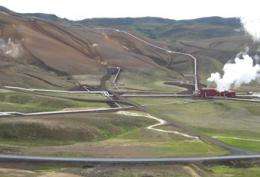
The geothermal field at Krafla, Iceland, where a borehole being drilled for a geothermal energy research project hit molten rock at 6,900 feet. (Peter Schiffman/UC Davis)
(PhysOrg.com) -- Scientists drilling a borehole deep into Iceland’s rocky crust to explore new methods of using geothermal energy hit a major roadblock on Thursday: Their drill ran into molten rock at a depth of 6,900 feet.
“This is only the third time that magma has ever flowed into a geothermal drill hole, as far as we know,” said Peter Schiffman, a geology professor at UC Davis and member of the international team conducting the study. “A research project in Hawaii hit magma in 2005, and in 1977 magma erupted out the top of a producing geothermal well not far from our site in Krafla, Iceland.”
In Hawaii, drilling stopped. And Schiffman is doubtful that this project, known as the Iceland Deep Drilling Project, or IDDP, can continue. But if the magma body is narrow — as he and the research team expect it is — it may be possible to bore through it or around it, he said. “We’ve been able to keep circulation of cold water through the drill string, so our equipment is still functional.”
The team had originally planned to drill to 11,500 feet, or almost 2.2 miles into the earth.
The main purpose of IDDP — an international research effort supported by the National Science Foundation, the International Continental Drilling Program, Alcoa Inc., and Icelandic power companies — is to investigate the economic feasibility of extracting energy from hydrothermal systems that are under extremely high temperatures and pressures.
Drilling began at the site near Krafla in northeast Iceland in December 2008. After reaching a depth of 2,600 feet, the project was put on hold for two months before resuming in early March.
Around the middle of April, Schiffman said, drilling became difficult. “We kept drilling, but had lots of technical problems. We just seemed to be stuck at the same depth,” he said. “Just yesterday we realized that we had run into magma.”
Schiffman is receiving updates from his UC Davis colleagues who are onsite in Iceland: geology professor Robert Zierenberg and graduate student Naomi Marks. The pair reported that a phenomenon known as “steam flashing” seems to have occurred on Thursday (June 25), when drilling fluid came in contact with magma, creating an explosion. Glass shards removed from the hole provided evidence for this, Schiffman said. These most likely formed when the fluid, which is principally water, quenched molten rock.
Based on geophysical mapping of the area, Schiffman said, the team suspects that it has encountered a small offshoot of a larger magma body that lies more than two miles below the surface. “Whether we can keep drilling or not will depend on the thickness of this magma finger, and whether it’s horizontally or vertically oriented,” he said.
If the hole cannot be drilled any deeper, it might prove useful for testing a system of geothermal energy extraction that involves sending cold water into one borehole to be retrieved as superheated steam from deeper holes nearby, Schiffman said.
More information about IDDP can be found at http://www.iddp.is/about.php
-
Energy From Hot Rocks
Nov 08, 2007 |
not rated yet |
0
-
Magma Discovered in Situ for First Time
Dec 16, 2008 |
not rated yet |
0
-
Scientists penetrate fossil magma chamber beneath intact ocean crust
Apr 20, 2006 |
not rated yet |
0
-
First riser-drilling research operations undertaken in Nankai Trough Seismogenic Zone
Jun 29, 2009 |
not rated yet |
0
-
Researchers drill historic hole in atlantic ocean floor
Apr 28, 2005 |
not rated yet |
0
-
Engineers build first sub-10-nm carbon nanotube transistor
Feb 01, 2012 |
4.9 / 5 (28) |
26
-
Something old, something new: Evolution and the structural divergence of duplicate genes
Jan 31, 2012 |
4.6 / 5 (7) |
1
-
The hidden nanoworld of ice crystals: Revealing the dynamic behavior of quasi-liquid layers
Jan 30, 2012 |
5 / 5 (3) |
1
-
Stock market network reveals investor clustering
Jan 27, 2012 |
4 / 5 (22) |
8
-
Of microchemistry and molecules: Electronic microfluidic device synthesizes biocompatible probes
Jan 26, 2012 |
5 / 5 (1) |
0
-
Balance of oxygen in the atmosphere
Feb 01, 2012
-
The case for a methanol-based economy
Jan 30, 2012
-
Weather in a rotating cylinder
Jan 25, 2012
-
Importance of difference between SVP over ice and water?
Jan 19, 2012
-
Ozone and atmosphere sampling
Jan 16, 2012
-
Novel Geothermal Energy Source
Jan 14, 2012
- More from Physics Forums - Earth
More news stories
Russia 'drills into' Antarctic subglacial lake
A Russian team has succeeded in drilling through four kilometres (2.5 miles) of ice to the surface of a mythical subglacial Antarctic lake which could hold as yet unknown life forms, reports said Monday.
Space & Earth / Earth Sciences
18 hours ago |
5 / 5 (9) |
13
High planetary tilt lowers odds for life?
Highly-tilted worlds would have extreme seasons, subjecting life to alternating periods of scorching and subzero temperatures. This could make the development of all but hardiest, simplest creatures a long ...
Space & Earth / Space Exploration
18 hours ago |
4.8 / 5 (10) |
9
|
Researchers uncover a mechanism to explain dune field patterns
In a study of the harsh but beautiful White Sands National Monument in New Mexico, University of Pennsylvania researchers have uncovered a unifying mechanism to explain dune patterns. The new work represents a contribution ...
Space & Earth / Earth Sciences
10 hours ago |
3.5 / 5 (2) |
1
|
UNH ocean scientists shed new light on Mariana Trench
An ocean mapping expedition has shed new light on deepest place on Earth, the 2,500-kilometer long Mariana Trench in the western Pacific Ocean near Guam. Using a multibeam echo sounder, state-of-the-art equipment ...
Space & Earth / Earth Sciences
12 hours ago |
4.8 / 5 (5) |
0
|
ESO team succeeds in linking telescopes at Paranal Observatory into giant VLT
(PhysOrg.com) -- Researchers working as part of the European Southern Observatory (ESO) at the Cerra Paranal Mountain Observatory in the Atacama Desert in Chile, have succeeded in virtually connecting all ...
Long-term study shows epilepsy surgery improves seizure control and quality of life
While epilepsy surgery is a safe and effective intervention for seizure control, medical therapy remains the more prominent treatment option for those with epilepsy. However, a new 26-year study reveals that following epilepsy ...
Nicira promises virtual networks will transform networking
(PhysOrg.com) -- For the past four years, founders of the start-up company Nicira have been developing cutting-edge software that they predict will transform the networking technology underlying the Internet. ...
Navy to begin tests on electromagnetic railgun prototype launcher
The Office of Naval Research (ONR)'s Electromagnetic (EM) Railgun program will take an important step forward in the coming weeks when the first industry railgun prototype launcher is tested at a facility ...
Study of diving beetles suggest sperm evolution may be driven by changes in female reproductive organs
Studying female reproductive tracts and sperm in diving beetles (Dytiscidae), researchers from the University of Arizona and Syracuse University have obtained a glimpse into a bizarre and amazing world of spe ...
Fossil cricket: Jurassic love song reconstructed
Some 165 million years ago, the world was host to a diversity of sounds. Primitive bushcrickets and croaking amphibians were among the first animals to produce loud sounds by stridulation (rubbing certain body parts together). ...
New insight from whole-genome sequencing of Europe's 2011 E. coli outbreaks
Using whole-genome sequencing, a team led by researchers from Harvard School of Public Health (HSPH) and the Broad Institute has traced the path of the E. coli outbreak that sickened thousands and killed over 50 people in Ger ...
Jun 29, 2009
Rank: 3.3 / 5 (10)
Jun 29, 2009
Rank: 4.3 / 5 (3)
Kinda surprised that this is only the third time though...
Jun 29, 2009
Rank: 4 / 5 (1)
Jun 29, 2009
Rank: 4 / 5 (8)
We use nuclear heat just to boil water into steam for power. Sounds like you just need a way to harness the steam that results from water touching the magma... I would call that geothermal energy.
Jun 30, 2009
Rank: 4 / 5 (1)
Jun 30, 2009
Rank: 5 / 5 (1)
Jun 30, 2009
Rank: 3.8 / 5 (6)
Interestingly, I've seen claims that most geothermal heat energy is due to the decay of thorium and other radioactive materials in the earth's crust. The claim is that any kenetic energy left over from the formation of the planet would have dissipated by now. If true, we've been living on top of a nuclear reactor for all of human evolution!
As to why not simply use THIS reactor rather than build man-made ones... the answer can be found in the sustainability and safty of the energy source.
We understand the aging mechanisms in a nuclear reactor and can refuel it and decommission it. Poke a hole in the magma and we don't yet know how long we can draw heat from it (if it cools gradually) or if we end up with some sudden blow-out.... including release of potentially radioactive gasses or dust clouds.
I'd like to hear someone discuss the balance the risks: a) man-made nuclear power with underground disposal of wastes products, and b) geothermal blow-out. As I understand it, we fear the contamination of ground water from degrading nuclear wastes stored deep in mines. Why don't we fear the contamination of groundwater from holes drilled through unknown formations of, potentially radioactive, certainly chemically active, superheated rock?
Are we not "most foolish" when we paralize ourselves with fears of well-known dangers, while blythly failing to realize how much greater is our ignorance of unknown risks?
E.g. Chernobyl, the only "level 7" nuclear disaster, releasing 400 times more fall out than the bomb at Hiroshima, led to the eventual death of roughly as many as died on the morning of 9-11. Yet in less than a decade we question our fear of terrorists but still firmly fear the impact of nuclear power.
Reality: even global warming, under the most extreme cases mankind could cause, pales in comparison the the disasters documented in the geological record. Not that we should not fear the potential of climate change, but rather we should respect our earth's history and be more humble about our ignorance.
As to nuclear power. We may be fearful in this country and resist using it, but the rest of the world is going ahead with it, including countries with unstable governments and much less concern about the safety of mankind. And, to the degree there IS a risk of radioactive polution, it is global in scope. Our self-restraint will not restrain the French, let along the North Koreans or the Iranians. The experiments are underway... we should be using all our abililities to ensure safety, not simply to ensure ignorance (on our part) until it is too late.
Jun 30, 2009
Rank: 2.7 / 5 (3)
Jun 30, 2009
Rank: 5 / 5 (2)
I would call that nuclear decay heat.
Jun 30, 2009
Rank: 5 / 5 (2)
Because uranium and thorium and their equilibrium decay products is found everywhere; that's where radon gas comes from.
Lava is molten because of the heat generated by nuclear decay and because it has a thick insulating blanket with kilometers of rock on-top of it.
Lava happens to have a quite a lot more uranium and thorium than your average crust, so if you're paranoid about adding a bit of radon gas to the natural background I suppose you might find geothermal unerving.
Not even in places like Ramsar, Iran where background radiation from radon is up to 200 mSv/year in some parts is it possible to detect any increase in cancer risk. That doesn't mean the LNT hypothesis is necessarily false, it just means radiation is a lousy carcinogen compared to your everyday stuff like metabolism or particulate pollution.
Jun 30, 2009
Rank: 2 / 5 (2)
Jun 30, 2009
Rank: not rated yet
Jun 30, 2009
Rank: 2.3 / 5 (3)
Geothermal involves sulfates and other compounds which are highly toxic and corrosive.
On the other hand, well designed and constructed nuclear reactors produce almost no net pollution and leave us only with waste rods which could easily be disposed of by shipping them into the sun on a rocket, or dumping them into the challenger deep where they will be crushed to oblivion 7 miles under water, and subducted back into the earth's mantle.
Jul 01, 2009
Rank: 1 / 5 (1)
I like the potential of a thermal, solar, wind, nuclear, hydro, oil, coal.
The trick is to reduce the pollution. That's where all the money should be going right now. Employing all the unemployed people to contribute to figuring out how to use energy more efficiently and cleanly.
Then everyone would be earning money and decreasing our negative impact on the environment for the future of our species.
Jul 01, 2009
Rank: not rated yet
Jul 02, 2009
Rank: not rated yet
Jul 04, 2009
Rank: not rated yet
Any source for this claim? Why should magma differ in composition from the surrounding crust?
In any case it may be possible to contain radioactivity if the magma will act predictably enough.
Jul 04, 2009
Rank: 5 / 5 (1)
They use regular drills because it's cheaper.
Jul 05, 2009
Rank: not rated yet
http://www.magma-power.com/
I would be greatly interested to read responses to the information presented there.
Jul 06, 2009
Rank: not rated yet
Magma energy is certainly worth investigating, commercializing it may be quite challenging but it should be possible.
It will probably be much easier in places where magma is close to the surface as with deep drilling there is the problem of how to efficiently get the energy to the surface.
With high pressure steam it's easy as it will move to the surface on it's own. Magma on the other hand will probably cool and solidify on the way.
Perhaps it would be possible to use metal heat exchanging heads connected with water pipes. This however will require careful positioning of the drill relative to the magma, and it might be impractical for large scale energy extraction.
Much depends on how stable magma sources are, how much energy can be extracted before they cool down and retreat and so on.
Drilling into magma can also be dangerous, a good example is the mud volcano created by gas exploration drilling two years ago in Indonesia. Poor drilling techniques may have been at least partly responsible here since the well was not properly secured AFAIR:
http://www.scienc...3238.htm
Jul 06, 2009
Rank: not rated yet
Because it has not been subjected to the errosion and weathering that tends to remove uranium and thorium from the exposed surface of the crust. Radon has a fairly short half-life, if it does not escape into the air before it decays its daughter products do not get into people's lungs. That's why only the thin surface layer maters as far as radon is concerned. More over, radon is a noble gas and will not form chemical bonds; it will be more mobile, possibly a lot more mobile, in molten rock as opposed to solid.
I don't find it particularly worrisome since I'm not convinced the LNT model is true for such tiny doses as background radiation(it has not possible to detect an increased lung cancer rate in parts of Ramsar, Iran where background radiation from radon is ~100 mSv/year).
Mostly it just irks me that if a nuclear plant leaks some tritium amounting to as much radiation exposure to nearby inhabitants as eating a banana(some of that potassium is potassium-40...) it ends up on the evening news as if it were a major disaster. Nobody bothers one hoot about much larger, routine radiation exposures from other industries. E.g. all that uranium and thorium that goes up the chimney from coal plants, the radon and daughter products that gets delivered into peoples homes with the natural gas they burn or the radon released by a mountain of phosphate mine tailings(phosphate rock typically has ~100 ppm U, versus ~3 ppm for average crust and less than 1 ppm in average soil).
Jul 06, 2009
Rank: not rated yet
-Does anyone know the temperature tolerances for high-end drilling equipment? Unfortunately, the magma temperature is not mentioned.
BTW, since Sweden has the formal leadership of the European Union for the next six months, maybe they can push for more geothermal tech cooperation between the other EU countries and their Icelandic brethren, even though Iceland is not part of the EU.
Jul 06, 2009
Rank: not rated yet
All heavy metals, and many non-metallics, in the crust were originally leached out of magma by superheated water and deposited where the water cooled. That's why mining districts tend to cluster along fault lines.
Jul 06, 2009
Rank: not rated yet
Blasting water down a borehole to react with magma causes earthquakes. Nothing really beyond a 3 on the scale but who knows what is possible on a fully functioning site.