From human bite to robot jaws
June 30, 2009
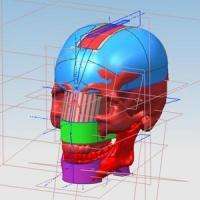
This is the Chewing Robot concept. Credit: Dr. Kazem Alemzadeh
The UK spends around £2.5 billion each year on dental materials to replace or strengthen teeth. The Chewing Robot is a new biologically inspired way to test dental materials and it will be shown to the public for the first time at this year's Royal Society Summer Science Exhibition [30 June to 4 July].
Researchers at the University of Bristol's Department of Mechanical Engineering in collaboration with the Department of Oral and Dental Science have developed the Chewing Robot to study dental wear formation on human teeth.
Dental elements, such as crowns and bridges, are made from well-known metals, polymers and ceramics but their dental wear properties are often poorly understood. Clinical trials examining the wear of human teeth are expensive and time-consuming. By the time a new material has been tested, it is often obsolete.
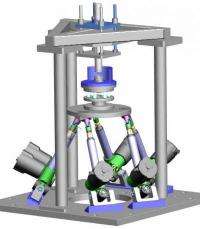
This is a CAD Model of the Chewing Robot Credit: Dr. Daniel Raabe
The movements and forces involved in natural chewing action have been replicated using the new chewing simulator -- the Chewing Robot. The robot is based on a three-dimensional mechanism with six linear actuators that reproduce the motion and forces sustained by teeth within a human mouth.A human jaw is a powerful and complex piece of natural machinery, allowing a person to chew in many different ways. The lower jaw and the teeth move with six degrees of freedom, translating and rotating along each of the Cartesian axes.
Dr Kazem Alemzadeh, Senior Lecturer in the Department of Mechanical Engineering recognised that the Stewart-Gough platforms have been used to provide and control the same six degrees of freedom in aircraft simulators, and so he proposed the Chewing Robot concept based on just such a platform. The design and development of the Chewing Robot was carried out by Daniel Raabe, a PhD student in the Department of Mechanical Engineering.
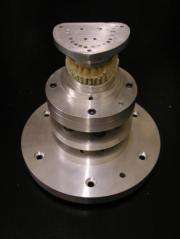
This is the Chewing Robot concept. Credit: Drs. Kazem Alemzadeh and Daniel Raabe
The robot has the potential to dramatically improve the process of developing and testing new dental materials.Daniel Raabe said: "By reproducing natural bite forces and movements, the Chewing Robot can help improve and accelerate the process of developing new dental restorative materials that may someday be found in a person's mouth."
-
Nasal Spray May End Dental Needle Injections for Upper Teeth Repair
Feb 17, 2009 |
not rated yet |
0
-
Placement of dental implants results in minimal bone loss
May 12, 2009 |
not rated yet |
0
-
Scientists develop new tool to improve oral hygiene
Jan 13, 2009 |
not rated yet |
0
-
Mouthwash doesn't affect fillings, crowns
Jan 12, 2007 |
not rated yet |
0
-
Seeing through tooth decay
Aug 22, 2008 |
not rated yet |
0
-
Engineers build first sub-10-nm carbon nanotube transistor
Feb 01, 2012 |
4.9 / 5 (30) |
30
-
Something old, something new: Evolution and the structural divergence of duplicate genes
Jan 31, 2012 |
4.6 / 5 (7) |
1
-
The hidden nanoworld of ice crystals: Revealing the dynamic behavior of quasi-liquid layers
Jan 30, 2012 |
5 / 5 (3) |
1
-
Stock market network reveals investor clustering
Jan 27, 2012 |
3.9 / 5 (23) |
8
-
Of microchemistry and molecules: Electronic microfluidic device synthesizes biocompatible probes
Jan 26, 2012 |
5 / 5 (1) |
0
-
Force free body diagram problem on gym equipment
1 hour ago
-
Empirical data regarding shower heads and water
9 hours ago
-
feed hold button on CNC lathe
Feb 09, 2012
-
RFAC in Fortran
Feb 09, 2012
-
dynamics 2/32
Feb 08, 2012
-
dynamics
Feb 08, 2012
- More from Physics Forums - General Engineering
More news stories
Netflix light on flicks as viewers soak up TV shows
Like most fresh faces that arrive in Hollywood, Netflix wanted to be a movie star. But now it's learning what many in Tinseltown have known for decades: Movies are sexy, but the real money is in television.
6 minutes ago |
not rated yet |
0
Sony's Hirai refuses to abandon dire TV business
Struggling Japanese entertainment giant Sony will not abandon its cash-bleeding television business, its incoming CEO says, but he acknowledges tough decisions lie ahead including over redundancies.
36 minutes ago |
not rated yet |
0
New error-correcting codes guarantee the fastest possible rate of data transmission
Error-correcting codes are one of the triumphs of the digital age. Theyre a way of encoding information so that it can be transmitted across a communication channel such as an optical fiber o ...
Technology / Computer Sciences
3 hours ago |
5 / 5 (3) |
2
|
Small modular reactor design could be a 'SUPERSTAR'
(PhysOrg.com) -- Though most of today's nuclear reactors are cooled by water, we've long known that there are alternatives; in fact, the world's first nuclear-powered electricity in 1951 came from a reactor ...
Technology / Energy & Green Tech
2 hours ago |
5 / 5 (4) |
9
|
Advanced power-grid model finds low-cost, low-carbon future in West
(PhysOrg.com) -- The least expensive way for the Western U.S. to reduce greenhouse gas emissions enough to help prevent the worst consequences of global warming is to replace coal with renewable and other ...
Technology / Energy & Green Tech
2 hours ago |
5 / 5 (1) |
3
|
Experts reveal how plants don't get sunburn
(PhysOrg.com) -- Experts at the University of Glasgow have discovered how plants survive the harmful rays of the sun.
Fool's gold may prove an unlikely alternative to overexploited catalytic materials
Catalytic materials, which lower the energy barriers for chemical reactions, are used in everything from the commercial production of chemicals to catalytic converters in car engines. However, with current catalytic materials ...
Curry spice component may help slow prostate tumor growth
Curcumin, an active component of the Indian curry spice turmeric, may help slow down tumor growth in castration-resistant prostate cancer patients on androgen deprivation therapy (ADT), a study from researchers ...
Unpicking HIV’s invisibility cloak
Drug researchers hunting for alternative ways to treat human immunodeficiency virus (HIV) infections may soon have a novel targetits camouflage coat. HIV hides inside a cloak unusually rich in a sugar ...
What lies beneath: Mapping hidden nanostructures
The ability to diagnose and predict the properties of materials is vital, particularly in the expanding field of nanotechnology. Electron and atom-probe microscopy can categorize atoms in thin sheets of material, ...
To avoid early labor and delivery, weight and diet changes not the answer
One of the strongest known risk factors for spontaneous or unexpected preterm birth any birth that occurs before the 37th week of pregnancy, most often without a known cause is already having had one. For women ...

