Researchers unveil whiskered robot rat
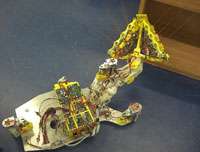
A team of scientists have developed an innovative robot rat which can seek out and identify objects using its whiskers. The SCRATCHbot robot will be demonstrated this week at an international workshop looking at how robots can help us examine the workings of the brain.
Researchers from the University of Sheffield and the Bristol Robotics Lab, a partnership between the University of the West of England and the University of Bristol, have developed the SCRATCHbot, which is a significant milestone in the pan-European "ICEA" project to develop biologically-inspired artificial intelligence systems. As part of this project Professor Tony Prescott, from the University of Sheffield's Department of Psychology, is working with the Bristol Robotics Lab to design innovative artificial touch technologies for robots that will also help us understand how the brain controls the movement of the sensory systems.
The new technology has been inspired by the use of touch in the animal kingdom. In nocturnal creatures, or those that inhabit poorly-lit places, this physical sense is widely preferred to vision as a primary means of discovering the world. Rats are especially effective at exploring their environments using their whiskers. They are able to accurately determine the position, shape and texture of objects using precise rhythmic sweeping movements of their whiskers, make rapid accurate decisions about objects, and then use the information to build environmental maps.
Robot designs often rely on vision to identify objects, but this new technology relies solely on sophisticated touch technology, enabling the robot to function in spaces such as dark or smoke-filled rooms, where vision cannot be used.
The new technology has the potential for a number of further applications from using robots underground, under the sea, or in extremely dusty conditions, where vision is often seriously compromised. The technology could also be used for tactile inspection of surfaces, such as materials in the textile industry, or closer to home in domestic products, for example vacuum cleaners that could sense textures for optimal cleaning.
Professor Prescott said: "Our project has reached a significant milestone in the development of actively-controlled, whisker-like sensors for intelligent machines. Although touch sensors are already employed in robots, the use of touch as a principal modality has been overlooked until now. By developing these biomimetic robots, we are not just designing novel touch-sensing devices, but also making a real contribution to understanding the biology of tactile sensing."
Dr. Tony Pipe, from the Bristol Robotics Lab, said: "For a long time, vision has been the biological sensory modality most studied by scientists. But active touch sensing is a key focus for those of us looking at biological systems which have implications for robotics research. Sensory systems such as rats' whiskers have some particular advantages in this area. In humans, for example, where sensors are at the fingertips, they are more vulnerable to damage and injury than whiskers. Rats have the ability to operate with damaged whiskers and in theory broken whiskers on robots could be easily replaced, without affecting the whole robot and its expensive engineering.
"Future applications for this technology could include using robots underground, under the sea, or in extremely dusty conditions, where vision is often a seriously compromised sensory modality. Here, whisker technology could be used to sense objects and manoeuvre in a difficult environment. In a smoke filled room for example, a robot like this could help with a rescue operation by locating survivors of a fire. This research builds on previous work we have done on whisker sensing."
Source: University of Sheffield


