Researchers discover new fluorescent silicon nanoparticles
June 30, 2009 University of Leicester researchers discover new fluorescent silicon nanoparticles

Enlarge

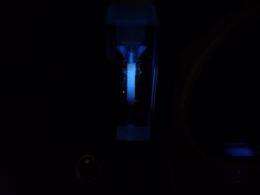
This is a suspension of nanoparticles in a quarz-glass cell exposed to ultra violet light. Credit: Dr Klaus von Haeften, University of Leicester

Researchers in the Department of Physics and Astronomy at the University of Leicester have developed a new synthesis method, which has led them to the discovery of fluorescent silicon nanoparticles and may ultimately help track the uptake of drugs by the body's cells.

Dr Klaus von Haeften explained: "A key advantage of the new method is the independent control of the nanoparticles' size and their surface properties. The method is extremely versatile and produces the fluorescent suspensions in one go. The findings may revolutionise the performance of electronic chips while satisfying the increasing demand for higher integration densities."

The contain just a few hundred silicon atoms and their fluorescence were discovered after mixing them with water. This resulted in stability in fluorescence intensity over more than a three month period.

An interdisciplinary research project with the Department of Chemistry, led by Professor Chris Binns and Dr Glenn Burley, also incorporates this new method of synthesis. They are aiming to link nanoparticles to drugs involved in the diagnosis and treatment of cancer.
Researchers discover new fluorescent silicon nanoparticles
Enlarge

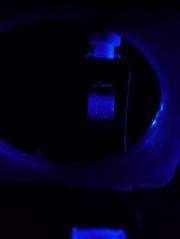
This is a suspension of nanoparticles in a quarz-glass cell exposed to ultra violet light. The nanoparticles emit deep-blue fluorescence. Credit: Dr Klaus von Haeften, University of Leicester

Professor of Nanoscience in the Department of Physics and Astonomy, Chris Binns said: "Nanotechnology, that is, the use of structures whose dimensions are on the nanometre scale, to build new materials and devices, appears to hold the key to future developments in a wide range of technologies, including materials, science, information technology and healthcare."

Dr von Haeften added: "The approach developed in Leicester could be a key step towards the production of a variety of biomedical sensors that could help track the uptake of drugs by cells."

The benign nature of silicon also makes the nanoparticles useful as fluorescent markers for tagging biologically sensitive materials. The light from a single nanoparticle can be readily detected.

The results of this work were published this week Applied Physics Letters journal by researchers Anthony Brewer and Klaus von Haeften.

More information: The research appears in: volume (94) of Appl. Phys. Lett. and the page number (261102)

Source: University of Leicester (news : web)


print this article email this article download pdf blog this article bookmark this article     Stumble it Digg this share on Facebook retweet share on Reddit add to delicious
Rate this story - 4 /5 (3 votes)


June 30, 2009 all stories

Comments: 0

4 /5 (3 votes)
  • Stumble this up

  • Digg this

  • share this

  • hide
  • Related Stories

  • Nanoparticles – Power to be Reckoned With
    created Jun 22, 2006 | popularity not rated yet | comments 0
  • 'There's Gold In Them That Exhausts!'
    created Aug 30, 2007 | popularity not rated yet | comments 0
  • Scientists to tackle illness with 'silver nanobullet'
    created Mar 31, 2006 | popularity not rated yet | comments 0
  • New way of making 'nanostructured films' wins innovation fellowship
    created Aug 23, 2005 | popularity not rated yet | comments 0
  • Gold nanoparticles could improve antisense cancer drugs
    created May 18, 2006 | popularity not rated yet | comments 0


  • hide
  • Relevant PhysicsForums posts

Other News

Nanoparticles used in common household items caused genetic damage in mice

Nanotechnology / Bio & Medicine

created Nov 16, 2009 | popularity 4.7 / 5 (22) | comments 11

Titanium dioxide (TiO2) nanoparticles, found in everything from cosmetics to sunscreen to paint to vitamins, caused systemic genetic damage in mice, according to a comprehensive study conducted by researchers at UCLA's Jonsson ...


Using superconducting probes to get a picture of what it's like inside CNTs

Nanotechnology / Nanophysics

created Nov 20, 2009 | popularity 4.9 / 5 (7) | comments 0

(PhysOrg.com) -- "Carbon nanotubes are exciting for fundamental physics, and for potential technological applications," Nadya Mason tells PhysOrg.com. "However, we are generally limited in the way that we can study them. ...


Nanotube defects equal better energy and storage systems

Nanotube defects equal better energy and storage systems

Nanotechnology / Nanomaterials

created Nov 19, 2009 | popularity 4.4 / 5 (9) | comments 2

(PhysOrg.com) -- Most people would like to be able to charge their cell phones and other personal electronics quickly and not too often. A recent discovery made by UC San Diego engineers could lead to carbon ...


When It Comes to Drug Delivery, Size Matters

Nanotechnology / Bio & Medicine

created Nov 20, 2009 | popularity 5 / 5 (1) | comments 0

(PhysOrg.com) -- One of the great promises of nanotechnologies lies in its ability to create drug-containing nanoparticles decorated with targeting molecules that recognize and bind to cancer cells, providing drug delivery ...


Scientists synthesize graphene-like material: Polymer with honeycomb structure

Scientists synthesize graphene-like material: Polymer with honeycomb structure

Nanotechnology / Nanomaterials

created Nov 19, 2009 | popularity 4.5 / 5 (6) | comments 1

Two-dimensional carbon layers, so-called graphenes, are regarded as a possible substitute for silicon in the semiconductor industry. The electronic properties of these layers can be varied by "building in" ...