NASA, Japan Release Most Complete Topographic Map of Earth
June 30, 2009
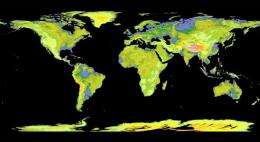
NASA and Japan's Ministry of Economy, Trade and industry (METI) released the Advanced Spaceborne Thermal Emission and Reflection Radiometer (ASTER) Global Digital Elevation Model (GDEM) to the worldwide public on June 29, 2009.
(PhysOrg.com) -- NASA and Japan released a new digital topographic map of Earth Monday that covers more of our planet than ever before. The map was produced with detailed measurements from NASA's Terra spacecraft.
The new global digital elevation model of Earth was created from nearly 1.3 million individual stereo-pair images collected by the Japanese Advanced Spaceborne Thermal Emission and Reflection Radiometer, or Aster, instrument aboard Terra. NASA and Japan's Ministry of Economy, Trade and Industry, known as METI, developed the data set. It is available online to users everywhere at no cost.
"This is the most complete, consistent global digital elevation data yet made available to the world," said Woody Turner, Aster program scientist at NASA Headquarters in Washington. "This unique global set of data will serve users and researchers from a wide array of disciplines that need elevation and terrain information."
According to Mike Abrams, Aster science team leader at NASA's Jet Propulsion Laboratory in Pasadena, Calif., the new topographic information will be of value throughout the Earth sciences and has many practical applications. "Aster's accurate topographic data will be used for engineering, energy exploration, conserving natural resources, environmental management, public works design, firefighting, recreation, geology and city planning, to name just a few areas," Abrams said.
Previously, the most complete topographic set of data publicly available was from NASA's Shuttle Radar Topography Mission. That mission mapped 80 percent of Earth's landmass, between 60 degrees north latitude and 57 degrees south. The new Aster data expand coverage to 99 percent, from 83 degrees north latitude and 83 degrees south. Each elevation measurement point in the new data is 30 meters (98 feet) apart.
"The Aster data fill in many of the voids in the shuttle mission's data, such as in very steep terrains and in some deserts," said Michael Kobrick, Shuttle Radar Topography Mission project scientist at JPL. "NASA is working to combine the Aster data with that of the Shuttle Radar Topography Mission and other sources to produce an even better global topographic map."
NASA and METI are jointly contributing the Aster topographic data to the Group on Earth Observations, an international partnership headquartered at the World Meteorological Organization in Geneva, Switzerland, for use in its Global Earth Observation System of Systems. This "system of systems" is a collaborative, international effort to share and integrate Earth observation data from many different instruments and systems to help monitor and forecast global environmental changes.
NASA, METI and the U.S. Geological Survey validated the data, with support from the U.S. National Geospatial-Intelligence Agency and other collaborators. The data will be distributed by NASA's Land Processes Distributed Active Archive Center at the U.S. Geological Survey's Earth Resources Observation and Science Data Center in Sioux Falls, S.D., and by METI's Earth Remote Sensing Data Analysis Center in Tokyo.
Aster is one of five Earth-observing instruments launched on Terra in December 1999. Aster acquires images from the visible to the thermal infrared wavelength region, with spatial resolutions ranging from about 15 to 90 meters (50 to 300 feet). A joint science team from the U.S. and Japan validates and calibrates the instrument and data products. The U.S. science team is located at JPL.
For visualizations of the new Aster topographic data, visit: http://www.nasa.go … 0090629.html .
Data users can download the Aster global digital elevation model at: https://wist.echo. … i/imswelcome and http://www.gdem.aster.ersdac.or.jp .
-
NASA Goes 'Down Under' for Shuttle Mapping Mission Finale
Jan 07, 2005 |
not rated yet |
0
-
Fires Burning Near Big Sur, California
Jul 01, 2008 |
not rated yet |
0
-
NASA Sees Santa Barbara Wildfires
Aug 08, 2007 |
not rated yet |
0
-
New NASA Images: 3D View of Athens
Aug 23, 2004 |
not rated yet |
0
-
NASA Infrared Images May Provide Volcano Clues
Oct 05, 2004 |
not rated yet |
0
-
Engineers build first sub-10-nm carbon nanotube transistor
Feb 01, 2012 |
4.9 / 5 (30) |
30
-
Something old, something new: Evolution and the structural divergence of duplicate genes
Jan 31, 2012 |
4.6 / 5 (7) |
1
-
The hidden nanoworld of ice crystals: Revealing the dynamic behavior of quasi-liquid layers
Jan 30, 2012 |
5 / 5 (3) |
1
-
Stock market network reveals investor clustering
Jan 27, 2012 |
3.9 / 5 (23) |
8
-
Of microchemistry and molecules: Electronic microfluidic device synthesizes biocompatible probes
Jan 26, 2012 |
5 / 5 (1) |
0
-
Discrepancy between oxygen and carbon-dioxide levels
16 hours ago
-
where gems are found in the world
19 hours ago
-
Wind Waves in Reservoir ~ Wind run-up and Wind set-up
Feb 08, 2012
-
Balance of oxygen in the atmosphere
Feb 01, 2012
-
The case for a methanol-based economy
Jan 30, 2012
-
Weather in a rotating cylinder
Jan 25, 2012
- More from Physics Forums - Earth
More news stories
Could Venus be shifting gear?
(PhysOrg.com) -- ESAs Venus Express spacecraft has discovered that our cloud-covered neighbour spins a little slower than previously measured. Peering through the dense atmosphere in the infrared, the ...
Space & Earth / Space Exploration
4 hours ago |
5 / 5 (5) |
7
|
Humans may have helped the decline of African rainforests 3000 years ago
(PhysOrg.com) -- Large areas of rainforests in Central Africa mysteriously disappeared over three thousand years ago, to be replaced by savannas. The prevailing theory has been that the cause was a change ...
Mars Science Laboratory computer issue resolved
(PhysOrg.com) -- Engineers have found the root cause of a computer reset that occurred two months ago on NASA's Mars Science Laboratory and have determined how to correct it.
Space & Earth / Space Exploration
5 hours ago |
5 / 5 (5) |
3
|
Clam fields found at deep, low-temperature Mariana vents
(PhysOrg.com) -- Scientists have marveled at the unusual life forms thriving at high temperature hydrothermal vents of the deep ocean.
Space & Earth / Earth Sciences
5 hours ago |
not rated yet |
0
|
Two new moons for Jupiter
Advances in technology have lead to the discovery of new planets outside of our Solar System, and now even new moons in our own backyard.
Space & Earth / Space Exploration
4 hours ago |
not rated yet |
2
Putting the squeeze on planets outside our solar system
(PhysOrg.com) -- Using high-powered lasers, scientists at Lawrence Livermore National Laboratory and collaborators discovered that molten magnesium silicate undergoes a phase change in the liquid state, abruptly ...
India probes Google over 'forex transactions'
Indian authorities are probing whether online giant Google broke domestic foreign-exchange transactions rules while shifting funds abroad, the Press Trust of India reported on Friday.
Germany freezes signing of disputed Internet pact
Germany on Friday halted the signing of a controversial international accord billed as a way to beat online piracy that has sparked angry protests, saying it needed more time to consider it.
Health experts, scientists to discuss bird flu studies
The World Health Organization said Friday it will meet next week to determine whether scientists can publish research on a bird flu virus that may be easily passed among humans.
Employers feel no love for unscrupulous practice of 'service sweethearting'
A new study led by two Florida State University marketing professors finds that some frontline service employees who are rewarded for hikes in customer loyalty and satisfaction also may engage in "service ...
Obama forges compromise birth control plan
US President Barack Obama Friday announced a compromise to defuse a row over access to birth control which prompted election-year Republican critics to claim he was waging a war on religion.
Jul 02, 2009
Rank: not rated yet
I was pleased to read that NASA and Japan's METI have a new topographic map of Earth.
There can be little or no doubt of the value of such information to the taxpayers who support NASA and METI.
With kind regards,
Oliver K. Manuel
http://www.omatumr.com