Wind + water = untapped energy: An abundance of power exists above Earth's oceans, study finds
June 30, 2009 by Jennifer Fitzenberger
A study by UCI Earth scientists finds that wind energy over the planet's oceans is a vastly underutilized renewable resource.
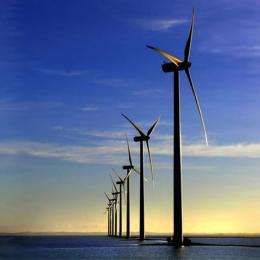
(PhysOrg.com) -- Wind energy over the planet's oceans is a vastly underutilized renewable resource, according to UC Irvine researchers.
At 80 meters above the ocean - the typical wind turbine height - more than 50 percent more power is available than at 10 meters, the height important to the shipping industry upon which previous wind estimates were made.
Though Europe has led the development of offshore wind farms, conditions make U.S. coastal oceans prime for strong winds: The air is stable, and the water is cold, notes Charlie Zender, study co-author and Earth system science associate professor.
"In the midlatitudes, you find these stable environments where air really takes off and accelerates rapidly as you move away from the ocean's surface," he says. "There's a lot of power in the wind. The more we compare it to other energy sources, the more I'm impressed."
Ocean wind power has a lot of perks: It is clean and renewable and takes no land-based real estate - unlike other energy sources, such as coal-powered plants. Ocean turbines, typically placed in water up to 40 meters deep, can be closer to population centers than power plants, reducing leakage and cost of transmission lines. And networks of ocean wind farms are as reliable as coal plants at producing consistent levels of power, Zender says.
Offshore wind turbine towers, however, must be anchored to the ocean floor - restricting their distance from the coast - and they cost about 50 percent more than land models, partly because upkeep is more difficult. "There are issues with every energy resource," Zender says, "but wind has relatively few compared to coal, ethanol or nuclear power."
The study by Zender and graduate student Scott Capps is the first to calculate potential wind energy over the ocean at realistic turbine heights. Researchers started with the previous 10-meter wind estimates and made adjustments for humidity levels and air and ocean temperatures, which influence wind speed.
With global calculations made twice a day between 2000 and 2006, they estimated the average global ocean wind power at 841 watts for every square meter swept by turbine rotors. A single ocean turbine produces about 1 million watts of power, enough to continuously supply about 1,000 houses.
Says Zender: "When you put our research together with existing studies over land, you get - for the first time - a global estimate of wind power reserves."
The National Science Foundation and NASA supported the study, published recently in the journal Geophysical Research Letters.
Provided by University of California, Irvine


Sails actually act as airfoils, and the wind blowing across them generates horizontal "lift", wich drives the ship. Here that force would be used to turn generators, which would be a source of extra losses. If you want a wind powered ship, it's more efficient to use sails.
Which may not be a bad idea, in some cases. If speed isn't a factor, why not go back to sails? Keep the engines as backup.
Also kite power over land might be competing with ocean wind turbines. Of course it has it's own benefits and problems. Just look for relevant articles that have been here earlier.
Which is WHAT, exactly? I hate it when reporters leave me hanging like that...
Depending on what you mean exacty, you are propsing a perpetual motion machine. Sailing down or across the wind, you might be able to turn some of the wind into electricity to drive a propeller. Sailing up wind will cause you to run afoul of the the law of entropy so that you could not produce enough energy to push against the wind from which you derive your energy.
But wait, I have a simpler scheme: Just put up a big sail and you can directly convert wind to propulsion without the losses of converting to electricity first. Pure mechanical conversion known to the ancients as: a sailboat. You still can't sail directly up wind though for the above reason.
Now, if you made the sails out of some flexible solar panels, you could indeed turn that propeller.
If the boat was moving against the wind or with it would have relatively little effect on the propellers. Tidal movement would cause more resistance. However if there were 1000 wind turbines and only a couple of propellers that would provide a large amount of energy for running the propellers which would only be needed for occasional realignment due to the anchors taking most of the strain.
They would probably need some new tech for the flexible and adjustable high voltage cable system to pipe the captured energy back onshore.
The wind from category 3-5 hurricanes often breaks anomometers, so what do you think it will do to a giant wind turbine designed to capture the maximum amount of wind? Oh yeah, it will demolish them by the hundreds...just one hurricane hitting an ocean based wind farm will totally destroy the entire project from either the wind itself, or the wave action on top of the storm surge.
Hurricanes are so common that it really isn't even a "hit or miss" thing. A category 3 or 4 storm passes relatively near each major coastal zone almost every year. Even if the wind farms could survive the wind events, the wave action will demolish them, even from distances of hundreds of miles See Ike, Katrina(at one time, approximately 17.9 meter dominant wave heights in the gulf with at least one rogue wave of 79ft,) Ivan (at least one wave was reported by an oil platform as high as 90ft,) Rita, Camille, Hugo, Isabel.
Whle those are extreme storms which won't happen all the time, still, you can be reasonably sure that any wind farm in the gulf or east coast will be struck by AT LEAST the outter bands of a minimum hurricane every 1 to 3 years, and will take a direct hit from a major hurricane every few years. A point offshore in the water has a greater percentage chance of being hit by a storm of a particular strength than a point on land, because its easier for a strong storm to still be...strong...by the time it reaches taht point, since it is still over water.
Along the east coast, the way they hook just before hitting land every time, a single hurricane could wipe out hundreds of miles worth of turbines, and this WILL happen every few years, because they follow the same pattern every year or two.
In europe, they get storms, but they are mostly upper level features, not catasrophic surface wind events like a hurricane every few years. This just won't work on the east coast or gulf. Maybe west coast, but not east or gulf.
Dude... Don't you think the designers would design accordingly, if they wanted to deploy in those locations?? Have you counted the oil rigs in the Gulf of Mexico? What makes the complex, bulky oil rigs better capable of withstanding hurricanes, than the much simpler, monolithic steel-rod construction of a wind turbine tower?
If the engineers designing these things have a single solitary functioning neuron inside their crania, they will allow for the turbine blades to fold and latch to the tower's stem, if not completely stow away inside it -- or something equivalent -- when a major hurricane approaches. Just like a sailing ship pulling down the sails to weather a storm...
And off the coast of Florida and California where they don't want ugly structures spoiling their views...
http://www.superwind.com/
That'd be a great place, if you want to completely eliminate the New England fishing industry. A lot of that area is off limits to projects of any kind as those banks are quickly becomming threatened areas.
http://www.states...ice.html