Integrated optical trap holds particles for on-chip analysis
June 30, 2009 Integrated optical trap holds particles for on-chip analysis

Enlarge

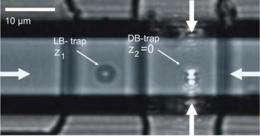
The integrated optical trap allows independent manipulation of trapped microbeads as shown in this view of two microbeads trapped by two different dual-beam traps. Image courtesy of H. Schmidt.

(PhysOrg.com) -- A new type of optical particle trap can be used to manipulate bacteria, viruses and other particles on a chip as part of an integrated optofluidic platform. The optical trap is the latest innovation from researchers at the Jack Baskin School of Engineering at the University of California, Santa Cruz, who are developing new sensor technology for biomedical analysis and other applications.

"Ultimately, it could have applications for rapid detection of bacteria and viruses in hospitals, for cell sorting in research labs, and for process monitoring in chemical engineering," said Holger Schmidt, professor of electrical engineering and director of the W. M. Keck Center for Nanoscale Optofluidics at UCSC.

The new technique offers the potential to create a smaller, cheaper version of the sophisticated equipment used to perform fluorescence-activated cell sorting (FACS), Schmidt said.

"The capabilities of our optofluidic platform are continuing to grow. We have gone from the detection of single molecules and single viruses to now being able to control the movement of particles," he said.

Schmidt's group has received a $400,000 grant from the National Institutes of Health to explore particle trapping and sorting and other applications of the optofluidics platform. An article describing the optical trap for on-chip particle analysis has been published online by the journal Lab on a Chip. First author Sergei Kuhn was a postdoctoral researcher in Schmidt's lab and is now at the Max-Born Institute in Berlin. Coauthors include David Deamer and Philip Measor at UCSC and E. J. Lunt, B. S. Phillips, and A. R. Hawkins of Brigham Young University, where the optofluidic chips are fabricated.

Optical traps and "" use the momentum carried by the photons in a beam of light to exert forces on microscopic objects, enabling researchers to manipulate objects ranging from biological molecules to living cells. Schmidt's group developed a new way to perform optical trapping on a chip-based platform.

The technique relies on an earlier innovation from Schmidt's lab: a hollow-core optical waveguide that can direct a beam of light through a liquid-filled channel on a chip. To trap particles, the researchers used two laser beams at opposite ends of a channel. A particle gets trapped at the point where the forces exerted by the two beams are equal, and the particle can be moved by changing the relative power of the two laser beams.

"We can also use this like an optical leaf blower to push all the particles in a sample to the same spot and increase the concentration," Schmidt said. "The goal is to control the position and movement of particles through channels on a chip so they can be studied using fluorescence analysis and other optical methods."

Provided by University of California, Santa Cruz


Rate this story - 5 /5 (1 vote)


June 30, 2009 all stories

Comments: 0

5 /5 (1 vote)

  • hide
  • Related Stories

  • Researchers achieve atomic spectroscopy on a chip
    created Jun 01, 2007 | popularity not rated yet | comments 0
  • Silicon chip beams light through a liquid-core waveguide to detect one particle at a time
    created Jul 03, 2007 | popularity not rated yet | comments 0
  • Researchers demonstrate a new type of optical tweezer
    created Feb 25, 2008 | popularity not rated yet | comments 0
  • Using light to move and trap DNA molecules
    created Jan 02, 2009 | popularity not rated yet | comments 0
  • Team 'tractor beam' for manipulation of cells on silicon
    created Oct 30, 2007 | popularity not rated yet | comments 0


  • hide
  • Relevant PhysicsForums posts

  • Water drop microscope!
    created 1hour ago
  • Light powered spaceship
    created 2 hours ago
  • What would a voltmeter read if it were connected between the surface of the cylinder
    created 2 hours ago
  • Interception angle
    created 4 hours ago
  • More from Physics Forums - General Physics

Other News

Nanoscale Structures with Superior Mechanical Properties Developed

Nanoscale Structures with Superior Mechanical Properties Developed

Nanotechnology / Nanomaterials

created 19 hours ago | popularity 4.6 / 5 (10) | comments 2 | with audio podcast

(PhysOrg.com) -- Researchers at the California Institute of Technology have developed a way to make some notoriously brittle materials ductile -- yet stronger than ever -- simply by reducing their size.


Spray-on liquid glass

Spray-on liquid glass is about to revolutionize almost everything

Nanotechnology / Nanomaterials

created Feb 02, 2010 | popularity 4.7 / 5 (240) | comments 93 | with audio podcast report

(PhysOrg.com) -- Spray-on liquid glass is transparent, non-toxic, and can protect virtually any surface against almost any damage from hazards such as water, UV radiation, dirt, heat, and bacterial infections. ...


IBM Scientists Demonstrate World's Fastest Graphene Transistor

IBM Scientists Demonstrate World's Fastest Graphene Transistor

Nanotechnology / Nanophysics

created Feb 05, 2010 | popularity 4.9 / 5 (38) | comments 25 | with audio podcast

(PhysOrg.com) -- In a just-published paper in the magazine Science, IBM researchers demonstrated a radio-frequency graphene transistor with the highest cut-off frequency achieved so far for any graphene device ...


Conductive eTextiles: Stanford finds a new use for cloth

Conductive eTextiles: Researchers move from making batteries from paper to making batteries from cloth

Nanotechnology / Nanomaterials

created Feb 05, 2010 | popularity 4.3 / 5 (7) | comments 4 | with audio podcast

(PhysOrg.com) -- Stanford researchers have moved from making batteries from paper to making batteries from cloth. Your-T-shirt could become a lighted, moving display.


Carbon Based Chips May One Day Replace Silicon Transistors

Carbon Based Chips May One Day Replace Silicon Transistors

Nanotechnology / Nanomaterials

created Feb 03, 2010 | popularity 4.7 / 5 (18) | comments 3 | with audio podcast weblog

(PhysOrg.com) -- IBM researchers are hopeful that, over the next decade, silicon-based transistors will be replaced by carbon-based transistors. IBM has already laid out the ground work for carbon-based transistors.