Largest ever survey of very distant galaxy clusters completed
June 30, 2009 Largest ever survey of very distant galaxy clusters completed

Enlarge

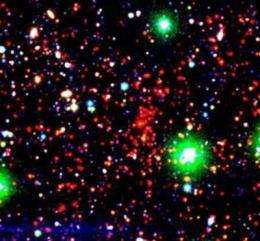
This is one of the most distant galaxy clusters ever discovered. Credit: G. Wilson, UC Riverside, and A. Muzzin, Yale University.

An international team of researchers led by a UC Riverside astronomer has completed the largest ever survey designed to find very distant clusters of galaxies.

Named the Spitzer Adaptation of the Red-sequence Cluster Survey, "SpARCS" detects galaxy clusters using deep ground-based optical observations from the CTIO 4m and CFHT 3.6m telescopes, combined with Spitzer infrared observations.

In a universe which astronomers believe to be 13.7 billion years old, SpARCS is designed to find clusters, snapped as they appeared long ago in time, when the universe was 6 billion years old or younger.

Clusters of galaxies are rare regions of the universe consisting of hundreds of galaxies containing trillions of stars, plus hot gas and mysterious . Most of the mass in clusters is actually in the form of invisible dark matter which astronomers are convinced exists because of its influence on the orbits of the visible galaxies.

An example of one of the most massive clusters found in the SpARCS survey is shown in the accompanying image. Seen when the universe was a mere 4.8 billion years old, this is also one of the most distant clusters ever discovered. Many similar-color red cluster galaxies can be seen in the image (the green blobs are stars in our own galaxy, The Milky Way).

"We are looking at massive structures very early in the universe's history," said Gillian Wilson, an associate professor of physics and astronomy who leads the SpARCS project.

The SpARCS survey has discovered about 200 new cluster candidates.

"It is very exciting to have discovered such a large sample of these rare objects," Wilson said. "Although we are catching these clusters at early times, we can tell by their red colors that many of the galaxies we are seeing are already quite old. We will be following up this new sample for years to come, to better understand how clusters and their galaxies form and evolve in the ."

More information: A summary of the survey and additional images of newly discovered clusters may be found in two companion papers led by Wilson and Adam Muzzin of Yale University, published in the June 20 issue of The Astrophysical Journal.

Source: University of California - Riverside (news : web)


print this article email this article download pdf blog this article bookmark this article     Stumble it Digg this share on Facebook retweet share on Reddit add to delicious
Rate this story - 4.4 /5 (8 votes)

Rank Filter

Move the slider to adjust rank threshold, so that you can hide some of the comments.


Display comments: newest first

  • brant - Jun 30, 2009
    • Rank: not rated yet
    Are they young or are they old???
  • HenisDov - Jul 01, 2009
    • Rank: 1 / 5 (1)
    Energy-Mass Superposition
    The Fractal Oneness Of The Universe


    The universe is the archetype of quantum within classical physics, which is the fractal oneness of the universe.

    Astronomically there are two physics, a classical physics behaviour of and between galactic clusters, and a quantum physics behaviour WITHIN the galactic clusters.

    The onset of big-bang's inflation, the cataclysmic resolution of the Original Superposition, started gravity, with formation - by dispersion - of galactic clusters that behave as classical Newtonian bodies and continuously reconvert their original pre-inflation masses back to energy, thus fueling the galactic clusters expansion, and with endless quantum-within-classical intertwined evolutions WITHIN the clusters in attempts to delay-resist this reconversion.


    Dov Henis
    (Comments from 22nd century)
    http://blog.360.y...Q--?cq=1
    On Energy, Mass, Gravity, Galaxies Clusters, AND Life
    A Commonsensible Recapitulation
    http://www.the-sc...age#2125
    Updated Life's Manifest May 2009
    http://www.physfo...ic=14988&st=480&#entry412704
    http://www.the-sc...age#2321
  • Thecis - Jul 01, 2009
    • Rank: 5 / 5 (1)
    When looking a such distances, you're "looking" back in time. So in this case you're looking at a rather young universe. But what they are saying is that even then, some of the galaxies seemed to be quite old.

June 30, 2009 all stories

Comments: 3

4.4 /5 (8 votes)
  • Stumble this up

  • Digg this

  • share this

  • hide
  • Related Stories

  • Spitzer Sees 9 Billion Years Back in Time
    created Mar 21, 2006 | popularity not rated yet | comments 0
  • Massive galaxy cluster found 10 billion light years away
    created Jun 06, 2006 | popularity not rated yet | comments 0
  • Survey Reveals Building Block Process For Biggest Galaxies
    created Apr 12, 2006 | popularity not rated yet | comments 0
  • Astronomers Find Hundreds of Young, Distant Galaxy Clusters
    created Jun 06, 2006 | popularity not rated yet | comments 0
  • Building-block process in evolution of massive galaxy clusters revealed
    created Apr 05, 2006 | popularity not rated yet | comments 0


  • hide
  • Relevant PhysicsForums posts

  • Sideral question
    created 16 hours ago
  • Doppler shifted blackbody spectrum
    created 19 hours ago
  • Earth v. Moon
    created 21 hours ago
  • help me with coordinates and orbits
    created 21 hours ago
  • More from Physics Forums - General Astronomy

Other News

Astronauts finish another spacewalk, still no baby (AP)

Astronauts finish another spacewalk, still no baby

Space & Earth / Space Exploration

created 8 hours ago | popularity 3 / 5 (2) | comments 0

(AP) -- A spacewalking astronaut put aside the impending birth of his daughter and blazed through his first-ever venture outside the International Space Station on Saturday.


Unseasonably hot and dry weather combined with strong winds to fan scores of blazes in the country's southeastern states

Australia issues 'catastrophic' alerts as fires rage

Space & Earth / Environment

created 14 hours ago | popularity 4.5 / 5 (2) | comments 0

Australia has issued "catastrophic" alerts after record-breaking temperatures and wild lightning storms sparked more than 100 fires across the country, officials said Saturday.


Commuters wait on the platform shrouded by fog in London

Climate change not man-made, say majority of Britons: poll

Space & Earth / Environment

created Nov 15, 2009 | popularity 3.3 / 5 (15) | comments 46

Less than half of Britons believes that human activity is to blame for global warming, according to a poll carried out for The Times newspaper and published on Saturday.


Mysteriously warm times in Antarctica

Mysteriously warm times in Antarctica

Space & Earth / Earth Sciences

created Nov 18, 2009 | popularity 4.2 / 5 (21) | comments 28

(PhysOrg.com) -- A new study of Antarctica's past climate reveals that temperatures during the warm periods between ice ages (interglacials) may have been higher than previously thought. The latest analysis ...


UN: Fight climate change with free condoms (AP)

UN: Fight climate change with free condoms

Space & Earth / Environment

created Nov 18, 2009 | popularity 3.1 / 5 (11) | comments 24

(AP) -- The battle against global warming could be helped if the world slowed population growth by making free condoms and family planning advice more widely available, the U.N. Population Fund said Wednesday.