Intense heat killed the Universe's would-be galaxies, researchers say
July 1, 2009
Gas around young galaxy
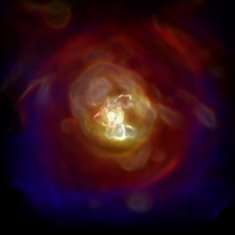
(PhysOrg.com) -- Our Milky Way galaxy only survived because it was already immersed in a large clump of dark matter which trapped gases inside it, scientists led by Durham University's Institute for Computational Cosmology (ICC) found.
The research, to be presented at an international conference today (Wednesday, July 1), also forms a core part of a new ICC movie charting the evolution of the Milky Way to be shown at the Royal Society.
The researchers said that the early Milky Way, which had begun forming stars, held on to the raw gaseous material from which further stars would be made. This material would otherwise have been evaporated by the high temperatures generated by the "ignition" of the Universe about half-a-billion years after the Big Bang.
Tiny galaxies, inside small clumps of dark matter, were blasted away by the heat which reached approximate temperatures of between 20,000 and 100,000 degrees centigrade, the scientists, including experts at Japan's University of Tsukuba, said.
Dark matter is thought to make up 85 per cent of the Universe's mass and is believed to be one of the building blocks of galaxy formation.
Using computer simulations carried out by the international Virgo Consortium (which is led by Durham) the scientists examined why galaxies like the Milky Way have so few companion galaxies or satellites.
Astronomers have found a few dozen small satellites around the Milky Way, but the simulations revealed that hundreds of thousands of small clumps of dark matter should be orbiting our galaxy.
The scientists said the heat from the early stars and black holes rendered this dark matter barren and unable to support the development of satellite star systems.
The findings will be presented to The Unity of the Universe conference to be held at the Institute of Cosmology and Gravitation, at the University of Portsmouth on Wednesday, July 1. The work has been funded by the Science and Technology Facilities Council (STFC) and the Japanese Society for the Promotion of Science.
The simulations also form part of a new ICC movie - called Our Cosmic Origins - which combines ground-breaking simulations with observations of galaxies to track the evolution of the Milky Way over the 13-billion-year history of the Universe.
The movie is part of the ICC's exhibit at The Royal Society's annual Summer Science Exhibition which runs until this Saturday (July 4).
Joint lead investigator Professor Carlos Frenk, Director of the Institute for Computational Cosmology, at Durham University, said: "The validity of the standard model of our Universe hinges on finding a satisfactory explanation for why galaxies like the Milky Way have so few companions.
"The simulations show that hundreds of thousands of small dark matter clumps should be orbiting the Milky Way, but they didn't form galaxies.
"We can demonstrate that it was almost impossible for these potential galaxies to survive the extreme heat generated by the first stars and black holes.
"The heat evaporated gas from the small dark matter clumps, rendering them barren. Only a few dozen front-runners which had a head start on making stars before the Universe ignited managed to survive."
By providing a natural explanation for the origin of galaxies, the simulations support the view that cold dark matter is the best candidate for the mysterious material believed to make up the majority of our Universe, the scientists added.
It is now up to experimental physicists to either find this dark matter directly or to make it in a particle accelerator such as the Large Hadron Collider at CERN.
Professor Frenk, added: "Identifying the dark matter is not only one of the most pressing problems in science today, but also the key to understanding the formation of galaxies."
Joint lead investigator Dr Takashi Okamoto from the University of Tsukuba said: "These are still early days in trying to make realistic galaxies in a computer, but our results are very encouraging."
Source: Durham University (news : web)


Dark Matter/energy = correction factor for bad modeling. With the correct application of dark energy and matter we can arrange correction factors to explain why even though the center of the universe is earth and everything revolves around it rappidly moving clumps of dark matter powered by dark energy create gravitational lensing effects causing light to make it appear we are not the center of the Universe. Furthermore lets add dark holes creating wormholes from one side of our obviously flat earth allowing us to teleport from one side to the other causing the appearance of this "round earth" you speak of.
Some one should alter his funding do have him do something useful like find out how much beer it takes to get a catfish drunk.
How could anyone even be sure that "real" dark matter even enteracts with regular matter through gravity? There could be some other unseen force which doesn't even obey the "inverse square" law of forces, and thus the amount of dark matter needed might actually be the square root of the amount postulated, and etc.
Basicly, they don't know what darkmatter is, don't know how to identify it even if they saw it, and don't know how its force(s) propagate, nor in what strength, nor according to what formula, and CANNOT know that except through direct observation of the particle(s) involved and rigourous study of all possible interactions.
====
I agree with PaulLove in that Dark Matter and Dark Energy, certainly as they are currently known, amount to little more than correction factors for bad theories and bad models.
Allowing for arbitrary variables such as Dark Matter and Dark Energy, one can make a computer model basicly do anything he wants it to do, and consequently support almost any theory he wants them to support (Big Bang, QM, Relativity, etc). He just needs to invent enough arbitrary, unobservable variables to fill in the gaps of his favourite bad theory.
Seen and observed are not quite the same. We have the observed the effects of mass that we cannot see in the both the rotation of galaxies and the movement of galaxies within clusters. The question is not whether some kind of dark matter exists. It is what is made of. Some kind of matter that we have yet to see makes up at least fifty per cent of the mass of galaxies.
Dark Energy is still more than just bit questionable. Dark Matter of some kind is real. Whether it is exotic or not is another question. I don't pretend to know that answer.
Ethelred
Join in or butt out. Even Quantum_Conundrum deserves to know what your problem with the post is. You have yet to make a single post and you are judging posts and giving out ones. How brave.
Ethelred
That is, at least partially, an unfounded assumption.
It may be true to say that "something" exists which we call "Dark Matter," but to say it is even rightly classifed as "matter" is unfounded and "jumping to conclusions".
As I said above, "Dark Matter" may be a misnomer. An "Apparantly gravitational effect" need not be related to "matter" or "mass" at all. Thus, the scientists may be looking for something that simply does not exist, due to a misnomer or unfortunate naming convention.
For example:
Effects attributed to "Dark Matter" may actually be unknown force interactions of "regular matter" which are simply too small to be observed on the "local" level, much as gravity itself is too weak on the "atomic" scale to make much difference compared to charge and nuclear forces.
Effects attributed to "Dark Matter" may simply be the mis-labelled result of some "normal matter" particle, carrier wave interaction, or entanglement interaction which has not yet been discovered.
Simply postulating that it must be "hidden matter" or it must be "hidden mass" that produces "gravity" is unacceptable. There may be nothing "hidden" at all other than some yet to be discovered frequency of electromagnetism, or some relatively miniscule sub-atomic particle that has gone undetected and is in all matter producing a surprisingly large force, and etc(which would seem to make far more sense than "invisible matter").
====
On the other hand, I suppose there COULD be trillions of microscopic black holes spread throughout the galaxy, but then why are we still alive, we should have collided with any number of them by now, having been incinerated by some sort of exotic x-rays or other dire fate, else sucked into it.
And that is the problem with most explainations of "Dark Matter," because if there is all this "hidden mass" everywhere, then the individual stars and planets should have been destroyed, or else, should have more gravity than is observed locally.
It is not an assumption. Spiral galaxies revolve too fast for the visible matter. Not only that the rate doesn't change much as you go from the outside to the center. For this to happen there must be not only more matter but some of the matter has to be outside the disk.
That leaves energy. You don't seem to like that either. Stick with matter as it fits the evidence.
Wrong. It either comes from mass or energy and they are equivalent in the equations.
There isn't any evidence to support that. There is evidence for matter. There is no need to propose a new force when matter already fits the evidence.
You don't quite get it. I even mentioned it. Dark Matter need not be exotic. You seem to think it can only be exotic. To avoid what you think is needed you propose things just as unlikely.
Let me make this clear.
Dark Matter need not be made of unknown particles.
Although weakly interacting particles would be a good fit for the way the rotation of spiral galaxies change with distance from the center. Black holes might fit as well.
Sorry but I am not beholden to what you find acceptable. Nor are the astro-physicists.
You need to cut back on reading Doc E.E. Smith. Electromagnetism has a linear frequency, that is, it only has a single dimension, cycles per unit of time. The energy increases with the rate. We make waves from cycles per minute, for the submarines, right out to hard gamma in the accelerators. Higher frequencies are possible but they are all understood quite well.
No. You might as well suppose that Giant Orbiting Aardvarks are responsible.
I am curios. What is this bizarre need to avoid the idea of Dark Matter by inventing things that even more dubious?
There is no way to get those except in a Big Bang sort of start to the Universe. Most would have evaporated by now. If one were to encounter the Earth it would most likely go right through it unless it was moving pretty slow. Even then most would only occasionally absorb more matter due to its small cross section. A quantum Black Hole has to have a LOT of mass to capture much matter. However I am agreement with you on this. I don't think they exist in any large numbers if at all.
No. It doesn't have to be mini black holes either. It could be a combination of a lot things. Neutrinos don't seem to have enough mass but they must contribute something since they do have mass. There are certainly brown dwarfs we just don't know how many. They probably account for a significant fraction of the Dark Matter. Black Holes exist. Recent evidence has been found that at least some of the global clusters contain them and they aren't in the disk. Which would account for at least some of the unseen matter outside the spiral disk.
You seem to have strange ideas regarding Dark Matter. Even stranger than the fans of WIMPS which are at least possible in some theories.
Ethelred
You too.
Quit lurking and rating.
Join in or stop rating. If you don't contribute you shouldn't be kibitzing from the peanut gallery.(What a giveaway.)
Post something you chicken. Take a chance. It may even make sense. I do recommend typing somewhere outside the comment box and then pasting it into the box.
Ethelred
It still reads like a fantasy novel, but the whole theory of dark matter still intrigues me. It could turn out that "dark matter" is simply the result of some sort of reaction we haven't picked up on yet, and not something that exists to create such reactions.
As for not believing dark matter exists at all because it's invisible, just think about the air in the atmosphere around us that helps us exist. It's not completely visible but we know it's there, the same way fish know water is there (but to us that is more obvious because we can see it). I know that may not make sense to most of you, but when I try to explain the ideas that work in my head it doesn't always come out perfect.
Either way, just take it with a grain of salt and wait for the real proof. But don't dismiss it entirely. Just remember that once upon a time the sun orbited the Earth and there was nothing else in the universe except us sitting on a flat disc at God's doorstep. My love of sci-fi might make me bias :P But the lateral thinking and whacked out theories help keep this fun.
I think space has to be quantized at a fundamental level; it cannot be infinitely continuous to arbitrary resolution, because that implies infinitely complex structure and infinite information content, making any kind of computation or "process", impossible. But that would mean as things get stretched out over immense distances, they would be subject to "pixilation" and our supposedly perfect mathematical formulae would begin to fail.
I rather expect something like this is the case with dark energy/dark matter. After all, it wouldn't be the first time by a long stretch, when the perfect formulae of today are shown to be but imperfect approximations tomorrow.
(And how do gravitons square, again, with Einstein's space-time warpage?)
I have serious problems with that concept myself. The inverse square law seems to me to be inherent in a three dimensional universe. When combined with warping of space by matter the inverse square has been modified. Gravity itself has mass. I don't know if the models being used take this into account as the math becomes very much harder.
As for virtual particles, what little understanding of them I have is that they are a consequence of field theory. The field is everywhere and the virtual particles would, I suppose, arise along the areas of the field that are between the objects. I don't see the need for the virtual particles since the field should do the job on its own. However the Casimer effect and allegedly a few other things point to virtual particles.
The scale would seem to be at the Plank level. We are a long way from that.
So far gravitons are purely a concept. Unless I missed the big headlines in every paper, magazine and web site.
The rotation rates of galaxies are pretty solid. The question is why are they behaving the way they do. More matter that what we can see, some of it dispersed in a sphere, is a good fit for the evidence.
This is not the only cause for people thinking up Dark Matter. It can arise in some super symmetric theories but there is no evidence for them and the energy levels in the accelerators are getting pretty high for them to still not show up.
The other cause for them is obsolete but that doesn't mean that people will give up on them. At one time a lot of people thought the Universe must be closed since the mass of the universe seemed to in or near the right magnitude to close the universe.
The thinking was a bit strange:
The mass of the universe must be within a factor of about 10 for closure. Or would have already begun to either collapse or spread to much lower densities.
For the universe to be that close out of an infinite choices of mass densities it must therefor be magically exactly equal to the point of closure.
That one above was the worst sort of wishful thinking I have seen from people with Phd's in physics.
If you can find this book it covers the ideas pretty thoroughly.
"Cosmic coincidences : dark matter, mankind, and anthropic cosmology"
Your library may have a copy. The main library in Anaheim California does.
by John Gribbin & Martin Rees.
Ethelred
PinkElephant wrote:
'to add to the above, has anyone ever found any experimental evidence whatsoever, for existence of gravitons, so far?'
Gravitons have not been observed yet but they are an obvious consequence of gravity. Changes in gravitational fields will cause ripples or waves to propagate through spacetime, this happens even when you are walking down the street. According to the duality principle, such waves can also be represented as particles, ie. gravitons. There is nothing mysterious about them, the only reason they have not been observed is that the signal is so weak unless you have exceptionally extreme processes happening, like the creation of black holes or the collision of neutron stars.
About gravity in general, you are wrong to say that objects need to know where the other party is. Gravity acts in a 'dumb' way, each object is bending spacetime and any changes in the curvature of spacetime propagates like ripples in the universe moving at the speed of light. Each object is moving according to the spacetime curvature at it's local position. Read general relativity and you will understand, the basic principles are very simple and elegant.
I know this. Ironically, I proved this independently both intuitively and mathematically several years ago before I had ever even heard of the mainstream scientific term "dark matter".
According to Newton's shell theorem, in a uniform shell of matter, the matter outside of a given shell has no net effect on matter inside of the shell, because it is cancelled by other matter outside that layer on the opposite side of the cloud.
Now no true uniform shells exist in nature, but galaxies are close approximates of a "uniform disk". Thus the Shell theory, in principle, should still apply. That is, Dark Matter outside of a galaxy, if approximately uniform, would have little or no net effect on the inner workings of the galaxy.
If "Dark Matter" is indeed matter, it needs to be distributed approximately evenly throughout the galaxy to explain motion(i.e. thereby giving the appearance of a "linear" force.) The reason for this is we need enough mass throughout the galaxy to explain why the outter stars don't fly away, but we can't put too much mass in the core, else the inner stars would all collapse to a black hole(and more than is observed).
I'm not avoiding what I think is needed, quite the contrary. I'm avoiding what I think is not needed, i.e. "mathematical pixie dust".
Also, Einstein's equation does not actually say that "matter is energy and energy is matter". It simply says the two are related and can be converted back and forth according to the formula E=mc^2 for mass m.
Energy and mass are not "the same". Energy is measured in completely different dimensions than mass, i.e. kg*m^2/s^2, whereas mass is simply kg...
Thus it is completely incorrect for you to say that matter and energy are the same. Else Einstein's formula would have been simply "E=M" or "E=am", where "a" would be an arbitrary constant. But he didn't say that, now did he? Nope.
Let me return to the following sentence in your first paragraph:
Again, approximately uniform distribute of undiscovered mass would explain this, and here I am NOT postulating a new force or particle. We discover new planets, asteriods, and comets in our own solar system all the time. They also just had an article on here of someone discovering a, what was it? 13 jupiter masses planet orbitting as star, etc. It may simply be that the average solar system is larger and more massive than estimates have shown, and that there are possibly far more stars and planets than previously known..
vidar lund:
Not necessarily. Even mainstream science currently continues to predict there should be another relatively large planet beyond neptune, which is not explained by Pluto or other so-called dwarf planets. Yet with all our technology, this planet continues to go un-detected. (I am not talking about the UFOlogists notion of a planet inhabited by aliens, I'm talking real physics.) Anyway, the point is, models suggest there "should" be a large planet "somewhere" just outside Neptune's orbit, but it continues not to be detected, literally right under our noses in astronomical terms(literally primarily withing about 320-400 light minutes of the earth or so). When we examine the galaxies, we are talking about radii of 60,000-120,000 light years. We can't find a planet that we KNOW exists in a relatively miniscule section of space in our own back yard, but you claim we would necessarily be able to spot dark bodies at thousands and millions of times farther away? I doubt it.
Brown dwarfs, rogue planets, comets and asteriods, very small, old, dead neutron stars that have totally burned out, etc. These things could be our "dark matter," if distributed approximately evenly, without needing "pixie dust".
That seems reasonable. Though Newton was thinking about solids not rotating gas clouds and stars. The inside of a hollow sphere should have an even gravity field from what I have seen and that is at least as relevant. As long as the mass isn't very concentrated GR wouldn't be needed either.
This would be possible if it doesn't interact much. The question than is why would it collapse into a disk. Maybe gravity is enough to cause the collapse.
I don't see Dark Matter as pixie dust. You don't seem to have got the idea on that. I suspect that exotic matter is not required.
Neither did I. I intentionally used 'equivalent'. In the context I was referring to their both producing gravity. Even gravity produces gravity in GR.
Nor did I. I think that is your problem on this. You think did postulate such. Despite my saying that I didn't.
You really should give me attribution for that. I went over all that myself.
Ethelred
Visible matter isn't distributed uniformly. So a uniform distribution of matter we cannot see would change the expected results.
I can think of a way for WIMPS to be distributed very differently than normal matter. Just came up with it so take it with a peck of salt.
Matter in the solar system has supposedly been kicked out of the area of the planets by orbital perturbations. Some went into the Sun and some into the Oort Cloud. In the galaxy the density of material would be likely to stop normal matter from going very far out. Weakly interacting matter would not be slowed by dust and gas so it would be kicked out further than visible matter.
Of course that would require some kind of WIMP and I have my doubts about that stuff. But black holes may also tend to move out farther. Now that I think more about it I suspect that high density stuff like black holes are pretty certain to move out farther faster than low density material like gas and dust.
Ethelred
GR is extremely accurate on the scales of a solar system. I wouldn't be so sure when it comes to galactic scales: we simply don't have sufficient experimental evidence to conclude that.
Not just barely reacts with normal matter, but barely reacts with anything at all. After all, if it did react with anything at all, we'd be able to detect the thermodynamic losses from those reactions, in the form of heat radiation. And if it reacted with anything at all, losing energy in the process, it would gradually (over billions of years) dissipate its potential energy and migrate toward the galactic center: thus destroying the supposedly uniform distribution being postulated for it.
I find such sheer inertness puzzling and unlikely. Even neutrinos interact enough for us to measure them, and they aren't all that heavy. Mass implies structural complexity, and structural complexity implies lots of interaction modes. This WIMP idea just doesn't smell right to me.
You're assuming that gravity has something fundamentally in common with chromodynamic fields (which is a very elusive wild goose that has been chased without any success by proponents of unified field theory for many decades.) Yes, EM waves and other types of waves are quantized, but nobody has yet demonstrated experimentally that gravity waves are quantized in the same way (indeed, we have yet to detect our first gravity wave, to begin with, even though we think we have indirect evidence in the form of pulsar spin decay.)
The mathematical requirements for perfectly differentiable continuity inherent in General Relativity, clash implacably with any notion of wave-particule duality or quantisation in general. That's one of the major reasons that Quantum Mechanics and General Relativity still cannot be mathematically reconciled, after almost a century of trying by the smartest people in the world.
Gravity seems to be qualitatively different. In GR, it is a warping of space and time. No other "field" has such features: other fields exist within the context of space and the context of time, but have no impact on either of the two. Gravity, on the other hand, is nothing other than a modification of both.
Now you've shifted into the GR model of gravity. Notice how you've abandoned the QM understanding of interaction as virtual particle exchange.
Only just. The huge neutrino spike in from the supernova (1987a? I think is the designation)was a magnificent total of SIX or maybe eight. Out of the trillions or quadrillions that went through the tank. The darn things can go through neutronium with little being captured.
I think you are inferring. Leptons have no complexity that we can see yet. Just a solid particle. Catch is I am pretty sure the WIMPS would have to be heavier than protons at the moment and those are compound particles. I am not thrilled with WIMPS either but who knows. No one yet.
It could be the warping of the basic grain of space if the grain(however you want to deal with it)being on the Plank scale. At that scale we are not going to notice discontinuity.
I have only begun to get a handle on that idea. It only makes sense to me in context of a field. Do you have a clue about that idea in QM? The first time I had an inkling was after seeing a video on the Higgs Boson being something like a phonon in ordinary matter except that it is in the Higgs field. That isn't how it was described, it is how I am seeing it in my head now.
Ethelred
There is something else what makes the standard model ugly: the concept of a beginning of time. Physical theories don't deal with a beginning of time, they deal with the evolution of physical processes in time.
Another big disadvantage is the purely mathematical concept of singularities. Singularities are mathematicel objects, but not physical ones.
Whoever says that the bigbang was a singularity or that black holes are singularities only tries to hide that we simply don't know what happens in certain physical situations.
We don't even know how the atomic nucleus behaves when it contains more than, say, 250 nucleons. How can we know what happens in a neutron star, which is nothing but a giant atomic nucleus?
Still another aspect of the standard model should make all of us very cautious: the obvious religious background of the concept of creation.
These are just some of the reasons why I'm very sceptical with this very contrived standard model.
There are, luckily, concepts which are much more beautiful. They certainly have their drawbacks, especially they are not yet falsifiable. But I'm quite optimistic that one of the string/brane based models will be successful in the long run. Be it the ekpyrotic/cyclic model, be it a model along the randall-suntrum ideas.
Just now, i feel that we are again on the verge of a more compelling explanation of all the observations which are confusing us. Again, as in the days between the Michelson-Morley experiment and Einstein's STR.
Frajo is right.
Rest mass data of the 3,000 types of atoms that comprise all matter in the visible universe offer another solution.
See the Cradle of the Nuclides or "The nuclear cycle that powers the stars: Fusion, gravitational collapse and dissociation" http://tinyurl.com/mat85k
With kind regards,
Oliver K. Manuel
Fast as in not free; fast is not a speed: http://google.com...parisons for the illiterate".
No, black holes are the [infinitely] biggest-ever scientific blunder: http://blogs.disc...eighty/. (See my links at the end. Google Groups search for usenet is dead now.. so put "search" instead of "groups" in the link.
Imaginary time and amplitude are essential in quantum settups and histories.
The shell theorem would work if the shell were 3D in a 3D field; I don't think the 2D rings would.
Dish-galacsies are strewn about at every tilt, its flat accretion ouht of entropy. In a trillion years, many of the dish'es will smash together and become blobs; the background will then be too thin to flatten them again.
Neutrinos aren't heavier than protòns, yet I discoverd they were composite motes. They are hugely weak wherefore of their motes' near-perfect match of quantals and masses. Dark matter is a misnomer; it's clear matter, as much as helium or neutròn is almost clear matter.
By the way, a gravitòn or other quantum is not a mote; it's a wave. (Damn, why does this board miswrite my accented vowels?)
That is not the Standard Model. None of that has anything to do with what is called the Standard Model.
http://en.wikiped...rd_model
That is the Standard Model.
Actually is you that is making is ugly by making it up as you go along.
Please go learn some actual physics or at least go look at what comprises the Standard Model.
Now that is reasonably true. It is possible that a future theory will show how the Universe arose and time began for the Universe but such a theory will have to cover more than the Universe that we can see.
There is way around the problem. As far as we can tell Uncertainty will limit singularities to something that has an actual length. Minimum size of anything in this Universe seems to be the Plank Length.
There are two answers I can give for that.
One, the difficulty with such a complex nucleus is that there are way to many ways for the two different types of particles to interact. So it hard for large values of hard.
Two, a neutron star is much simpler because there are no protons messing things up. Just a bunch of neutrons milling about, unable to escape their own gravitational interactions. Then again even the guys studying what happens aren't sure, as it is a tad hard to study this stuff in the lab, so there is no way to check whether the math matches reality.
This is one of the prime difficulties in physics. The Universe we live in seems to behave according to mathematical principles, which makes it possible to predict things, but its only a SUBSET of all mathematics and there are other valid subsets that do not seem to apply to our Universe. So we have to do experiments to find out which set applies in the real world.
Well quit contriving and use the real thing. Then you will have less problems. There will still be problems, there will just be less.
Thirty years and the math is still broken. That is not a good sign.
Ethelred
Fast is not the same as 'too fast' which is indeed not a speed. It is a comparison and there relative as opposed to absolute.
They fit the evidence and the math.
The link you posted agrees with me. It has nothing implying that Black Holes are a blunder. Maybe one of the comments has something but if so how about you copy a sample so I and others can get a clue about what you think supports you. The article itself is exactly what I am talking about. Thanks.
That makes no sense. Things, of any kind, do not accrete out of entropy. The sentence looks decidedly like something that ELIZA would produce. A random set of words stuck together by a grammar algorithm. I am sorry that English is not your native language but it might help if you used real physics, then then you could use stuff native speakers have already written.
Also if you were to write a lot more you would get more practice. You don't have many posts for the length of time you have been here. Five posts in a year and a half. Write more, if only to improve your writing skills.
That one is even worse. If nothing else the galaxies are moving away from each other so they can't smash together, not even in a trillion years.
So you have the largest accelerator at your disposal and you haven't published the existence of this multi-billion project. Shame on you for keeping such things from the public.
So quit using them. I never use the per cent symbol for just that reason. And in English there is no accent in PROTON so it is a mistake to even try.
Ethelred
You are right, as almost always. Thanks for enlightening my skills in contemporary English. Thus, to advance from mere english words to thoughts, I'd like to rephrase my phrase:
The nowadays dominant cosmological model comprises as key ingredients the bigbang, an expansion called inflation, a kind of matter called dark matter, and a kind of energy called dark energy.
Some days ago, I'd call this model "standard model" when referring to particle physics. In the days to come, I'll instead call it "the standard model of particle physics". Hope this will make everybody happy.
This is a great hint, as it reminds me of a great truth: "Beauty lies in the eyes of the beholder."
Yes, I don't see much beauty in the dominant cosmological model of these days. You seem to see more beauty. I don't have any problem with divergent aesthetic receptions. The model in question doesn't have any quality called "beauty".
Well, I did so more than once. Unfortunately in more languages than english. I wouldn't know this could hurt someone's feelings.
D'accord. And I'd like to add that it is as well possible that a future theory will show that the universe never arose - as the concept of time neither needs nor allows a beginning.
Yes, if quantum mechanics (and the Copenhagen Interpretation) still are valid under these extreme conditions. It's a huge extrapolation of observed data to assume so. And it's a bit onesided to assume that the clashes between Einstein's GTR and QM are due to bugs in GTR only.
It seems to be a bit more complex than that: "...the structure of a proton or neutron is fundamentally modified when it is bound in a nucleus." (See http://www.physor...651.html "NuTeV anomaly helps shed light on physics of the nucleus.")
Yes, that's how it's taught in school. But the term "neutron star" is a bit misleeding as it does not infer that this star is made up of neutrons (udd) only. Instead it describes that there are, due to gravitation, no noncrushed atoms possible. Except on its surface, maybe. (Have not been there yet.) Addition of an electron (lepton, not quark) does not transform a proton (uud) into a neutron. Thus, no, not just a bunch of neutrons.
You should've told Leonardo da Vinci - when he drafted a helicopter.
s/misleeding/misleading/
Extraordinary claims require extraordinary evidence, the claim that our Universe is filled with invisible matter with never before observed properties which is 5 times more abundant then normal matter yet mysteriously absent from Solar System is very extraordinary and it requires much more evidence then excess acceleration of stars on outer rims of galaxies.
Beautiful? In physics beauty is defined as predictive power divided by complexity. Which means string theory is the ugliest monster ever to suck blood from science. String theory is 80% hype 20% mathematics 0% physics, it will become physics when it starts making predictions which can be falsified by experiment (today or in near future).
There are no arguments for or against "beauty". There are personal viewpoints only.
If you define physical beauty, that's ok for you.
I don't define physical beauty for me; I instead call things and thoughts beautiful, when they are a pleasure for me. Thus, my reception of the beauty of string theory does not depend on it's relation to reality. Even if someday it turns out not to be useful to describe what we call reality, it still will be a beautiful concept - for me.
The heat would energize the atoms so that they would in turn radiate energy and as a consequence cool down again.
An alternative would be that it was so hot that matter could not exist - only energy - in which case the energy would immediately set of at the speed of light in all directions.
Now that I can agree with. Not all that fond of parts of it.
It will make it easier to discuss things.
I have a problem at the moment with the that beauty should be involved in physical theories. That has led people down paths that may lead nowhere.
Don't worry about feelings, worry about comprehension. The use of standard definitions tends to improve communications. Occasionally the dictionary definition of words, especially in science, seem to be a bit off the way they are actually used. Plus sometimes the definitions are just plain wrong. That is they make use a description for a word that is open to question.
That is open to debate. Your concept of time may be that way. Not everyone agrees. Nor does it matter what any of our concepts are if they don't fit reality. Perhaps there is a meta-time that would fit a meta-verse. The Big Bang is pretty solid at the moment and in that there is a beginning for time. Hawking seems willing to use imaginary time if need be.
True as far as it goes. However there are rather a large number of neutrinos out there to complete the job. Keep in mind that neutron decay has been observed and the half life measured. Since a neutron can decay into a proton, electron and neutrino I don't see a problem with it going the reverse.
Well his still wouldn't work. No stabilizer.
Ethelred