Salamanders, regenerative wonders, heal like mammals, people
July 1, 2009
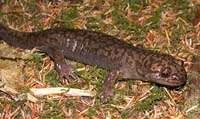
Pacific Giant Salamander (Dicamptodon tenebrosus)

Pacific Giant Salamander (Dicamptodon tenebrosus). Via Wikipedia

The salamander is a superhero of regeneration, able to replace lost limbs, damaged lungs, sliced spinal cord -- even bits of lopped-off brain. But it turns out that remarkable ability isn't so mysterious after all -- suggesting that researchers could learn how to replicate it in people.

Scientists had long credited the diminutive amphibious creature's outsized capabilities to "pluripotent" cells that, like human , have the uncanny ability to morph into whatever appendage, organ or tissue happens to be needed or due for a replacement.

But in a paper set to appear Thursday in the journal Nature, a team of seven researchers, including a University of Florida zoologist, debunks that notion. Based on experiments on genetically modified axolotl salamanders, the researchers show that cells from the salamander's different tissues retain the "memory" of those tissues when they regenerate, contributing with few exceptions only to the same type of tissue from whence they came.

Standard mammal stem cells operate the same way, albeit with far less dramatic results -- they can heal wounds or knit bone together, but not regenerate a limb or rebuild a spinal cord. What's exciting about the new findings is they suggest that harnessing the salamander's regenerative wonders is at least within the realm of possibility for human medical science.

"I think it's more mammal-like than was ever expected," said Malcolm Maden, a professor of biology, member of the UF Genetics Institute, and author of the paper. "It gives you more hope for being able to someday regenerate individual tissues in people."

Also, the salamanders heal perfectly, without any whatsoever, another ability people would like to learn how to mimic, Maden said.

Axolotl salamanders, originally native to only one lake in central Mexico, are evolutionary oddities that become sexually reproducing adults while still in their larval stage. They are useful scientific models for studying because, unlike other salamanders, they can be bred in captivity and have large embryos that are easy to work on.

When an axolotl loses, for example, a leg, a small bump forms over the injury called a blastema. It takes only about three weeks for this blastema to transform into a new, fully functioning replacement leg -- not long considering the animals can live 12 or more years.

The cells within the blastema appear embryonic-like and originate from all tissues around the injury, including the cartilage, skin and muscle. As a result, scientists had long believed these cells were pluripotential -- meaning they came from a variety of sites and could make a variety of things once functioning in their regenerative mode.

Maden and his colleagues at two German institutions tested that assumption using a tool from the transgenic kit: the GFP protein. When produced by genetically modified cells, GFP proteins have the useful quality of glowing livid green under ultraviolet light. This allows researchers to follow the origin, movement and destination of the genetically modified cells.

The researchers experimented on both adult and embryonic salamanders.

With the embryos, the scientists grafted transgenic tissue onto sites already known to develop into certain body parts, then observed how and where the cells organized themselves as the embryo developed. This approach allowed them to see, literally, what tissues the transgenic tissue made. In perhaps the most vivid result, the researchers grafted GFP-modified nerve cells onto the part of the embryo known to develop into the nervous system. Once the creatures developed, ultraviolet light exams of the adults revealed the GFP cells stretched only along nerve pathways -- like glowing green strings throughout the body

With the adults, they took tissue from specific parts or organs from transgenic GFP-producing axolotls, grafted it onto normal axolotls, then cut away a chunk of the grafted tissue to allow regeneration. They could then determine the fate of the grafted green cells in the emerging blastema and replacement tissue.

The researchers' main conclusion: Only 'old' muscle cells make 'new' muscle cells, only old skin cells make new skin cells, only old nerve cells make new nerve cells, and so on. The only hint that the axolotl cells could revamp their function came with skin and cartilage cells, which in some circumstances seemed to swap roles, Maden said.

Maden said the findings will help researchers zero in on why salamander cells are capable of such remarkable regeneration. "If you can understand how they regenerate, then you ought to be able to understand why mammals don't regenerate," he said.

Maden said UF researchers will soon begin raising and experimenting on transgenic axolotls at UF as part of the The Regeneration Project, an effort to treat human brain and other diseases by examining regeneration in , newts, starfish and flatworms.

Source: University of Florida (news : web)

Filter


Move the slider to adjust rank threshold, so that you can hide some of the comments.


Display comments: newest first

Quantum_Conundrum
Jul 01, 2009

Rank: 1 / 5 (4)
I hate this branch of science, in spite of the medical marvels it promises.

This is one of the most dangerous, if not THE most dangerous branches of science in existence.

And of course, even if and when benefits begin to be available to humanity from this research, only the "rich and famous" are going to have access to it.
QubitTamer
Jul 01, 2009

Rank: not rated yet
Well plus the Salamanders too... oh and i suppose the GEICO gecko will have access to it as well as he is now also rich and famous...
poi
Jul 01, 2009

Rank: 4.7 / 5 (3)
And of course, even if and when benefits begin to be available to humanity from this research, only the "rich and famous" are going to have access to it.

initial costs are high. that's why only a few (companies, or even states) have R&D. patents last for i think about 10 years (at least in our jurisdiction). then everyone can have access. the government can even buy off that 10 years and make it available instantly. anymore qualms?
Birger
Jul 02, 2009

Rank: 4.7 / 5 (3)
If people who have become partially disabled can be given back a good and productive life by articifially induced regeneration, I find no fault with it.
Besides, the cost of regenerative nmedicine should be weighed against the cost of caring for disabled, who often cannot work because of their injuries.
Now, if ths kind of regenerative medicine can also be applied to the brains of stroke victims, there will be a stampede of institutes and companies willing to spend money on developing the process. The patients will range from young people that have become paraphlegic, to the elderly who need to exercise the mind and body to slow down the process of ageing, but are disabled by strokes and thus tend to age more rapidly.
dirk_bruere
Jul 02, 2009

Rank: 4.7 / 5 (3)
The argument against developing any technology - "only the rich and famous are going to have access to it". You know - like computers, cars, antibiotics...

BTW, there is also a strain of lab mice that can regenerate:
http://www.wired....09/68962

Quantum_Conundrum
Jul 02, 2009

Rank: 1 / 5 (2)
dirk_bruere:

The real argument against developing trans-genic technology is found in plain sight, in science fiction. Though often exaggerated, many things in science fiction are very much real. Reality is sometimes even worse than the horror/thriller science fiction movie.

Invasive species can already devastate environments.

An escaped lab animal (often mice and other rodents, or flies or roaches,) *ahem*, one of these with transgeneic transgenic regeneration could totally wreck the environment, especially if its able to pass the transgenic trait(s) on to offspring, as some of the japanese experiments have already succeeded in doing.
phystic
Jul 02, 2009

Rank: 5 / 5 (1)
lookin forward to it :-), human regeneration that is. Though that wired article on the mice stated that they passed it on to their offspring.
Koen
Jul 02, 2009

Rank: 3 / 5 (2)
Genetically altered humans with regenerative ability might develop very strange illnesses. How healthy and stable are such genetic mutations? Has Nature missed something the way mammals are?
fhtmguy
Jul 02, 2009

Rank: 5 / 5 (1)
_________________________________________________

And of course, even if and when benefits begin to be available to humanity from this research, only the "rich and famous" are going to have access to it.

_________________________________________________


If you are worried about affording care only available to the rich and famous, then become rich or famous. I'm neither rich nor famous but I wont complain about people that can afford things that I can't. There is no written right to affordable "limb regeneration" or did I miss that in the new health care legislation that hasn't been totally written, nobody has totally read and the Dems have voted totally yes too. Go figure?
frajo
Jul 03, 2009

Rank: 1 / 5 (1)
... an effort to treat human brain and other diseases ...


I like that phrasing :)
fixer
Jul 05, 2009

Rank: not rated yet
It beats dying young.
PinkElephant
Jul 06, 2009

Rank: not rated yet
Hm, perfect regeneration vs. genetically enhanced autoimmune disease (at least in those MRL mice.) I think I'd rather avoid getting injured, than saddle myself with lupus...

I agree with Koen: I'll get a lot more excited about this research when it demonstrates no negative side-effects over life-long trials. And does so on chimps, rather than mice or salamanders... (In other words, not in my lifetime.)
Ethelred
Aug 08, 2009

Rank: not rated yet
initial costs are high. that's why only a few (companies, or even states) have R&D. patents last for i think about 10 years (at least in our jurisdiction).


Odd jurisdiction. In most countries its 20 years these days. I think it used to be 18 in the US but was changed to match international standards. In any case the standard is now 20.

Ethelred
Rank 5 /5 (25 votes)
Relevant PhysicsForums posts
  • Science behind the bore feeling?
    created5 hours ago
  • Homo Sapien vs. Chimpanzee - Divergence Timeline
    created10 hours ago
  • a single mRNA strand is attached to sevaral ribosomes?
    createdFeb 08, 2012
  • Oestrogen and FSH
    createdFeb 07, 2012
  • Linear Blood Vessel Network Examples in Animals or Plants
    createdFeb 07, 2012
  • Neuroscientists: What is a Principal Cell Layer?
    createdFeb 06, 2012
  • More from Physics Forums - Biology

More news stories

Ocean warming causes elephant seals to dive deeper

Global warming is having an effect on the dive behaviour and search for food of southern elephant seals. Researchers from the Alfred Wegener Institute for Polar and Marine Research in the Helmholtz Association cooperating ...

Biology / Ecology

created 11 minutes ago | popularity not rated yet | comments 0

Fresh city tomatoes, any time

Why not produce lettuce, beans and tomatoes where most of the consumers are to be found: in the city? The flat roofs of many buildings are well-suited for growing vegetables. Rooftop greenhouses can also make ...

Biology / Other

created 19 minutes ago | popularity not rated yet | comments 0

Deciding to go left or right: Researchers use device to determine that lower animals can navigate too

For decades, scientists have associated binary decision making — opting to go left or right — with higher-ranking animals, including humans. A team of Harvard researchers, however, is rewriting that ...

Biology / Plants & Animals

created 2 hours ago | popularity not rated yet | comments 2 | with audio podcast

Life in Antarctic lake? It's everywhere else

If scientists find microbes in a frigid lake two miles beneath the thick ice of Antarctica, it will illustrate once again that somehow life finds a way to survive in the strangest and harshest places.

Biology / Plants & Animals

created 6 hours ago | popularity 3 / 5 (4) | comments 0

Can indigenous insects be used against the light brown apple moth?

The light brown apple moth (LBAM), Epiphyas postvittana (Walker), an invasive insect from Australia, was found in California in 2006. The LBAM feeds on apples, pears, stonefruits, citrus, grapes, berries and many other plants ...

Biology / Ecology

created 1 hour ago | popularity not rated yet | comments 0


Apple to debut 'iPad 3' in March: report

Apple will unveil a new version of its market-ruling iPad table computer in March, according to a report in Dow Jones-owned technology blog All Things D.

Model analyzes shape-memory alloys for use in earthquake-resistant structures

Recent earthquake damage has exposed the vulnerability of existing structures to strong ground movement. At the Georgia Institute of Technology, researchers are analyzing shape-memory alloys for their potential ...

Facebook sees slowing growth

Few experts were surprised when Facebook disclosed in its recent IPO filing that its user growth had slowed in the U.S. and Canada. But a deeper look at Facebook's user numbers shows its growth is also slowing ...

New Kindle Touch is an impressive e-reader

When it comes to reading digital books, tablets are all the rage. But there's a lot to like about simple e-readers, which over the past year have become both a lot cheaper and a lot less clunky.

Digital photos could put kids at risk

A study published in the International Journal of Electronic Security and Digital Forensics this month suggests that parents and carers could be putting children at risk if they upload digital photos that are automatically "geota ...

New battery could lead to cheaper, more efficient solar energy

A joint research project between the University of Southampton and lithium battery technology company REAPsystems has found that a new type of battery has the potential to improve the efficiency and reduce the cost of solar ...