A Super-Efficient Particle Accelerator
July 1, 2009
A Super-Efficient Particle Accelerator

Enlarge

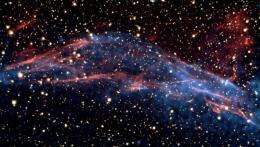
This image of data from NASA's Chandra X-ray Observatory and the European Southern Observatory's Very Large Telescope shows a part of the roughly circular supernova remnant known as RCW 86.

This remnant is the remains of an exploded star, which may have been observed on Earth in 185 AD by Chinese astronomers. By studying this remnant, a team of astronomers was able to understand new details about the role of remnants as the Milky Way's super-efficient particle accelerators.

The team shows that the shock wave visible in this area is very efficient at accelerating particles and the energy used in this process matches the number of cosmic rays observed on Earth.

The VLT data (colored red in the composite) was used to measure the temperature of the gas right behind the shock wave created by the stellar explosion. Using X-ray images from Chandra (blue), taken three years apart, the researchers were also able to determine the speed of the shock wave to be between one and three percent of the speed of light. The temperature found by these latest results is much lower than expected, given the measured shock wave's velocity. The researchers conclude that the missing energy goes into accelerating the .

Image credits: Optical: ESO/E. Helder; X-ray: NASA/CXC/Univ. of Utrecht/J.Vink et al.

Provided by NASA

4.5 /5 (4 votes)  

Filter


Move the slider to adjust rank threshold, so that you can hide some of the comments.


Display comments: newest first

omatumr
Jul 02, 2009

Rank: 1 / 5 (1)
ACCELERATED BY MAGNETIC FIELD OF NEUTRON STAR?

The magnetic field of a neutron star may accelerate protons away from a supernova remnant.

This may also be the mechanism that maintains mass separation in the Sun by generating a carrier gas of protons moving upward from the solar core ["Superfluidity in the solar interior: Implications for solar eruptions and climate," Journal of Fusion Energy 21 (2002) 193-198; http://arxiv.org/...501441v1 ].

With kind regards,
Oliver K. Manuel
http://www.omatumr.com
Rank 4.5 /5 (4 votes)
Related Stories
Relevant PhysicsForums posts
  • Scale of the Universe
    created5 hours ago
  • Titan's lack of impact craters
    createdFeb 09, 2012
  • Real pictures of black hole eating a star?
    createdFeb 08, 2012
  • Hypothetical way to travel faster than light, but not technically exceed lightspeed
    createdFeb 06, 2012
  • How do scientists monitor the Sun's activity?
    createdFeb 05, 2012
  • Search patterns in observational studies
    createdFeb 05, 2012
  • More from Physics Forums - General Astronomy

More news stories

Humans may have helped the decline of African rainforests 3000 years ago

(PhysOrg.com) -- Large areas of rainforests in Central Africa mysteriously disappeared over three thousand years ago, to be replaced by savannas. The prevailing theory has been that the cause was a change ...

Space & Earth / Environment

created 16 hours ago | popularity 4.2 / 5 (9) | comments 11 | with audio podcast report

Could Venus be shifting gear?

(PhysOrg.com) -- ESA’s Venus Express spacecraft has discovered that our cloud-covered neighbour spins a little slower than previously measured. Peering through the dense atmosphere in the infrared, the ...

Space & Earth / Space Exploration

created 12 hours ago | popularity 5 / 5 (7) | comments 7 | with audio podcast

NASA sees wide-eyed cyclone Jasmine

Cyclone Jasmine's eye has opened wider on NASA satellite imagery, as it moves through the Southern Pacific Ocean.

Space & Earth / Earth Sciences

created 4 hours ago | popularity 2 / 5 (1) | comments 1

NASA sees Giovanna reach cyclone strength, threaten Madagascar

Tropical Storm 12S built up steam and became a cyclone on February 10, 2012 as NASA's Terra satellite passed overhead. Residents of east-central Madagascar should prepare for this cyclone to make landfall ...

Space & Earth / Earth Sciences

created 4 hours ago | popularity not rated yet | comments 0

Mars Science Laboratory computer issue resolved

(PhysOrg.com) -- Engineers have found the root cause of a computer reset that occurred two months ago on NASA's Mars Science Laboratory and have determined how to correct it.

Space & Earth / Space Exploration

created 13 hours ago | popularity 4.7 / 5 (6) | comments 3 | with audio podcast


Google users warned of threat to smartphone wallets

Users of Google smartphone wallets were being warned on Friday that there is a way to crack pass codes intended to thwart thieves from going on illicit shopping sprees.

Anonymous knocks CIA website offline (Update)

The website of the Central Intelligence Agency was inaccessible on Friday after the hacker group Anonymous claimed to have knocked it offline.

Complex wiring of the nervous system may rely on a just a handful of genes and proteins

Researchers at the Salk Institute have discovered a startling feature of early brain development that helps to explain how complex neuron wiring patterns are programmed using just a handful of critical genes. ...

New error-correcting codes guarantee the fastest possible rate of data transmission

Error-correcting codes are one of the triumphs of the digital age. They’re a way of encoding information so that it can be transmitted across a communication channel — such as an optical fiber o ...

The power of estrogen -- male snakes attract other males

A new study has shown that boosting the estrogen levels of male garter snakes causes them to secrete the same pheromones that females use to attract suitors, and turned the males into just about the sexiest ...

Putting the squeeze on planets outside our solar system

(PhysOrg.com) -- Using high-powered lasers, scientists at Lawrence Livermore National Laboratory and collaborators discovered that molten magnesium silicate undergoes a phase change in the liquid state, abruptly ...