Here's one I made earlier: Chimps learn from watching videos
July 1, 2009
Here's one I made earlier: Chimps learn from watching videos

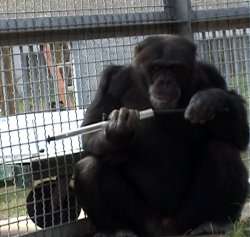
A still from the demonstration video used to teach chimpanzees to construct a tool. Credit: E Price

(PhysOrg.com) -- Lots of species have been discovered to use simple tools. Some birds use twigs to pull grubs out of their hiding places, and chimpanzees will strip leaves from branches to fish for termites - but is making a tool from separate parts simply a stretch too far for a non-human species?

An international team of researchers led by Elizabeth Price and Professor Andrew Whiten at the University of St Andrews have found that this is not the case as they discovered that can learn to make a tool long enough to capture out-of-reach food.

In their paper published today (Wednesday July 1st), Price and Whiten proved that chimps could learn and apply the skill by watching a video of a chimpanzee they had earlier trained to demonstrate the construction process.

Chimpanzees at a University of Texas primate centre were presented with an out of reach grape. Some were then shown a video of another chimpanzee expertly slotting one stick into another to create a rake, and then using the tool to obtain the food.

Others were shown videos with less information, for example, a chimpanzee using a readymade tool. The researchers found that chimpanzees who watched the full video demonstration were able to copy what they saw and make the tools themselves.

In a follow up test, the grapes were sometimes put within reach, making the use of a longer tool unnecessary. The chimpanzees that had learned the skill by watching the full video persisted in making the rake, which in the new scenario was more awkward to use.

However, a few individual chimpanzees who had not seen the full demonstration but still managed to make a tool, did not do so when the grape was close enough to reach without help.

Lead researcher Elizabeth Price commented, "These results are important not only because they provide the first evidence that chimpanzees can socially learn how to construct tools, but also because they suggest that can have a potent effect on how an individual approaches related problems later."

These surprising results suggest that learning from others - or 'social learning' - can lead to a less flexible approach to novel situations. The researchers are now planning to discover the extent to which our own species is vulnerable to a similar effect.

Ms Price continued, "Social learning plays a major role in the spread of complex technologies in humans, and the extent to which behaviour is faithfully replicated may tell us much about the cultural abilities of other species such as chimpanzees. Our results show that in some situations, social learning can have powerful effects in chimpanzees. If captive chimpanzees are cognitively savvy enough to innovate and socially learn complex tool construction to solve problems, the lack of such behaviour in the wild is unlikely to result simply from cognitive limitations."

The research has been published electronically in Proceedings of the Royal Society B today (Wednesday 1st July).

Provided by University of St Andrews

4.3 /5 (3 votes)  

Rank 4.3 /5 (3 votes)
Relevant PhysicsForums posts
  • Mitosis
    created1 hour ago
  • Stem cell question.
    created3 hours ago
  • Protease cleavage
    created9 hours ago
  • Pertubance in a model
    created16 hours ago
  • Cancer drugs and Alzheimer's, Oh my!
    createdFeb 09, 2012
  • Squishing cells
    createdFeb 09, 2012
  • More from Physics Forums - Biology

More news stories

The power of estrogen -- male snakes attract other males

A new study has shown that boosting the estrogen levels of male garter snakes causes them to secrete the same pheromones that females use to attract suitors, and turned the males into just about the sexiest ...

Biology / Plants & Animals

created 14 hours ago | popularity 4.8 / 5 (6) | comments 1 | with audio podcast

Grass to gas: Researchers' genome map speeds biofuel development

Researchers at the University of Georgia have taken a major step in the ongoing effort to find sources of cleaner, renewable energy by mapping the genomes of two originator cells of Miscanthus x giganteus, a large perenn ...

Biology / Biotechnology

created 11 hours ago | popularity 3.8 / 5 (5) | comments 0 | with audio podcast

Experts reveal how plants don't get sunburn

(PhysOrg.com) -- Experts at the University of Glasgow have discovered how plants survive the harmful rays of the sun.

Biology / Cell & Microbiology

created 14 hours ago | popularity 4.8 / 5 (5) | comments 0 | with audio podcast

Miami battling invasion of giant African snails

No one knows how they got there. But an invasion of African giant snails has southern Florida in a panic over potential crop damage, disease and general yuckiness surrounding the slimy gastropods.

Biology / Ecology

created 18 hours ago | popularity 4 / 5 (1) | comments 4

Protein libraries in a snap

(PhysOrg.com) -- A Rice University undergraduate will depart with not only a degree but also a possible patent for his invention of an efficient way to create protein libraries, an important component of biomolecular ...

Biology / Cell & Microbiology

created 17 hours ago | popularity 4.8 / 5 (4) | comments 0 | with audio podcast


Google users warned of threat to smartphone wallets

Users of Google smartphone wallets were being warned on Friday that there is a way to crack pass codes intended to thwart thieves from going on illicit shopping sprees.

Anonymous knocks CIA website offline (Update)

The website of the Central Intelligence Agency was inaccessible on Friday after the hacker group Anonymous claimed to have knocked it offline.

New error-correcting codes guarantee the fastest possible rate of data transmission

Error-correcting codes are one of the triumphs of the digital age. They’re a way of encoding information so that it can be transmitted across a communication channel — such as an optical fiber o ...

Complex wiring of the nervous system may rely on a just a handful of genes and proteins

Researchers at the Salk Institute have discovered a startling feature of early brain development that helps to explain how complex neuron wiring patterns are programmed using just a handful of critical genes. ...

Humans may have helped the decline of African rainforests 3000 years ago

(PhysOrg.com) -- Large areas of rainforests in Central Africa mysteriously disappeared over three thousand years ago, to be replaced by savannas. The prevailing theory has been that the cause was a change ...

New power source discovered

(PhysOrg.com) -- Researchers at the Massachusetts Institute of Technology (MIT) and RMIT University have made a breakthrough in energy storage and power generation.