Blood stem cell growth factor reverses memory decline in mice
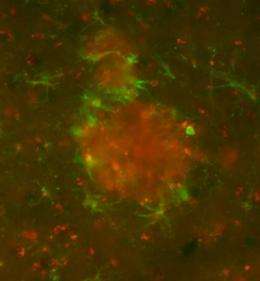
A human growth factor that stimulates blood stem cells to proliferate in the bone marrow reverses memory impairment in mice genetically altered to develop Alzheimer's disease, researchers at the University of South Florida and James A. Haley Hospital found. The granulocyte-colony stimulating factor (GCSF) significantly reduced levels of the brain-clogging protein beta amyloid deposited in excess in the brains of the Alzheimer's mice, increased the production of new neurons and promoted nerve cell connections.
The findings are reported online in Neuroscience and are scheduled to appear in the journal's print edition in August.
GCSF is a blood stem cell growth factor or hormone routinely administered to cancer patients whose blood stem cells and white blood cells have been depleted following chemotherapy or radiation. GCSF stimulates the bone marrow to produce more white blood cells needed to fight infection. It is also used to boost the numbers of stem cells circulating in the blood of donors before the cells are harvested for bone marrow transplants. Advanced clinical trials are now investigating the effectiveness of GCSF to treat stroke, and the compound was safe and well tolerated in early clinical studies of ischemic stroke patients.
"GCSF has been used and studied clinically for a long time, but we're the first group to apply it to Alzheimer's disease," said USF neuroscientist Juan Sanchez-Ramos, MD, PhD, the study's lead author. "This growth factor could potentially provide a powerful new therapy for Alzheimer's disease - one that may actually reverse disease, not just alleviate symptoms like currently available drugs."
The researchers showed that injections under the skin of filgrastim (Neupogen®) -- one of three commercially available GCSF compounds -- mobilized blood stem cells in the bone marrow and neural stem cells within the brain and both of these actions led to improved memory and learning behavior in the Alzheimer's mice. "The beauty in this less invasive approach is that it obviates the need for neurosurgery to transplant stem cells into the brain," Dr. Sanchez-Ramos said.
Based on the promising findings in mice, the Alzheimer's Drug Discovery Foundation is funding a pilot clinical trial at USF's Byrd Alzheimer's Center. The randomized, controlled trial, led by Dr. Sanchez-Ramos and Dr. Ashok Raj, will test the safety and effectiveness of filgrastim in 12 patients with mild to moderate Alzheimer's disease
The researchers worked with 52 elderly mice, equivalent to the human ages of 60 to 80 years. About half (24) were mice genetically altered to develop symptoms mimicking Alzheimer's disease by the time they reach 5-months old. The others (28 normal, or non-Alzheimer's, mice) were not. The researchers confirmed through a series of tests that the Alzheimer's mice were memory impaired before beginning the experiments.
Some mice were treated for three weeks with injections of the GCSF compound filgrastim. At the end of study, the Alzheimer's mice treated with GCSF demonstrated clearly improved memory, performing as well on behavioral tests as their non-Alzheimer's counterparts. The Alzheimer's mice administered saline injections instead of GCSF continued to perform poorly. GCSF treatment did not boost the already excellent memory performance demonstrated by the non-Alzheimer's mice tested before the study began.
Further experiments showed that the size and extent of beta amyloid deposited in the brains of the Alzheimer's mice was significantly less in those treated with GCSF. Depending on their ages, mice treated with GCSF had a 36 to 42-percent reduction in beta amyloid, the protein considered a major culprit in the development of Alzheimer's disease.
GCSF reduced the burden of beta amyloid deposited in the brains of the Alzheimer's mice by several means, the researchers found. One was by recruiting reinforcements to clear beta amyloid accumulating abnormally in the brain. The growth factor prodded bone-marrow derived microglia outside the brain to join forces with the brain's already-activated microglia in eliminating the Alzheimer's protein from the brain. Microglia are brain cells that act as the central nervous system's main form of immune defense. Like molecular "Pac-men," they rush to the defense of damaged or inflamed areas to gobble up toxic substances.
The growth factor also appeared to increase the production of new neurons in the area of the brain (hippocampus) associated with memory decline in Alzheimer's disease and to form new neural connections.
"The concept of using GCSF to harness bone marrow-derived cells for Alzheimer's therapy is exciting and the findings in mice are promising, but we still need to prove that this works in humans," said Dr. Raj, a physician researcher at the Byrd Alzheimer's Center at USF Health.
Source: University of South Florida Health


