Secrets revealed about how disease-causing DNA mutations occur
A team of Penn State scientists has shed light on the processes that lead to certain human DNA mutations that are implicated in hundreds of inherited diseases such as tuberous sclerosis and neurofibromatosis type 1. The results one day could influence the way couples who seek to have children receive genetic counseling. The team, led by Kateryna Makova, an associate professor of biology, also includes Erika Kvikstad, a graduate student in the Department of Biology, and Francesca Chiaromonte, an associate professor of statistics. Their findings will be published in the July 2009 issue of the journal Genome Research.
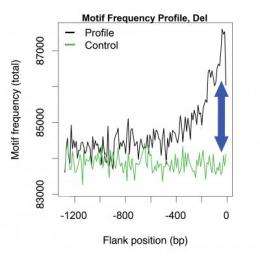
The scientists examined insertions and deletions -- mutations in which small fragments of DNA are either added or subtracted from the genome -- and they found patterns in the DNA sequences immediately surrounding the mutations. "The patterns in the DNA sequences that surround insertions and deletions suggest mechanisms that may have generated the insertions and deletions," said Chiaromonte. According to the researchers, the study is the first to detect patterns in the DNA sequences adjacent to insertions and deletions of DNA fragments at the genome-wide scale.
The team also found striking differences between insertions and deletions. For example, they found that recognition sites for the enzyme topoisomerase, which is responsible for winding and unwinding DNA, were more prevalent near deletions than near insertions. "We were surprised to find that the patterns of DNA sequences surrounding insertions versus deletions are unique because scientists previously have lumped the two types of mutations together," said Kvikstad.
Scientists also previously had believed that insertions and deletions are formed mostly by errors taking place during DNA replication, but the team found that the mutations also can form by mechanisms related to recombination. "What's striking is that most insertions and deletions are thought to occur by replication errors and, while this is a primary source generating the mutations, we discovered that recombination also is very important," said Kvikstad.
For one of the first times in a genome-wide study, the team used a statistical method, called wavelet analysis, which allows scientists to look at variability in a sample at multiple scales simultaneously. For example, JPEG image files, which preserve an image's different qualities regardless of whether the image is made smaller or larger, use a similar wavelet-like method. According to Chiaromonte, "When you run a wavelet analysis you are characterizing the signals simultaneously at many scales. In our case, the signal was the composition of the DNA sequences surrounding insertions and deletions. To be able to look at these sequences with a multi-scale approach was really important for our ability to find interesting features."
Using the wavelet analysis, the team confirmed that scale is important in detecting patterns of DNA sequences adjacent to insertions and deletions. For example, they were able to detect an increased number of DNA sequences responsible for pausing DNA polymerase, an enzyme involved in DNA replication, at the finest scales (10 to 20 DNA base pairs), but not at larger scales.
Both replication and recombination errors can lead to disease-causing mutations in humans. According to the researchers, if we know that certain diseases are more likely to be caused by recombination than by replication errors, doctors can provide better advice to couples who want to have children. "For example, there is a difference among males and females in the number of replication rounds that their germline cells undergo. Males undergo more rounds of DNA replication than females and the number of replication rounds increases with a male's age. If we know that a disease is due to a replication error rather than a recombination error, doctors can provide better genetic counseling to couples," said Makova.
Source: Pennsylvania State University (news : web)


