Newly discovered gene regulates balance of 'bad' cholesterol
July 2, 2009
Newly discovered gene regulates balance of 'bad' cholesterol

IDOL

In an article in Science, Noam Zelcer from the LACDR (The Netherlands) describes a previously unknown mechanism for regulating the amount of LDL cholesterol. This offers opportunities for supplementing and improving the effect of so-called statins: medicines that remove 'bad' cholesterol from the bloodstream. 

Cholesterol is not water-soluble. In order to be transported in the blood, it therefore forms fat globules, called lipoproteins, together with other fats. The two most familiar are known as HDL (high density lipoprotein) or ‘good’ , and LDL () or ‘bad' cholesterol. Too much LDL in the blood can contribute to the development of cardiovascular diseases.

A group of substances, known as statins, is often used as a medication to reduce the LDL level in the blood. They achieve this by on the one hand blocking the production of cholesterol and on the other hand by raising the number of receptors for LDL on the cells of the liver. This allows the cells to absorb more LDL from the blood, so that the blood becomes 'cleaner'. Statins are currently the most frequently sold medicines. However, they are not perfect.

The development of statins is based on the cell's natural mechanisms for regulating the cholesterol balance. All cells have the ability to make, absorb or excrete cholesterol. And all cells have to treat cholesterol with care: too much cholesterol in the cell is toxic, but too little is also not good. Cholesterol is needed for such purposes as forming membranes. Cells can 'sense' the amount of cholesterol and regulate the level by pumping it away if there is too much. If they want to obtain cholesterol from outside, they raise the level of the LDL receptor. This receptor binds to 'free ranging' LDL and absorbs it into the cell, where the fat globule is broken down into its different components, including cholesterol itself.

Noam Zelcer, now part of the Leiden/Amsterdam Center for Drug Research (LACDR), together with Peter Tontonoz and other former colleagues at the University of California in Los Angeles, has discovered a previously unknown mechanism that explains how cells regulate cholesterol levels. On the website of the journal Science (Science Express 11 June), he describes a mechanism that influences the number of LDL receptors.

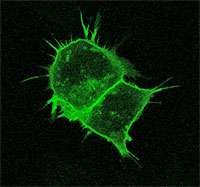
If active IDOL is present in the cell, the number and positioning of the LDL receptors alters dramatically.

Zelcer identified a gene that influences the breakdown of these receptors. 'The gene works like a traffic controller,' he explains. 'As soon as there is too much cholesterol in the cell, it sends the LDL receptors to the lysosome, the waste processing centre of the cell. They are broken down there, so that the cell absorbs less cholesterol and the balance is restored.'

Zelcer named the cell IDOL, which stands for Inducible Degrader Of the LDLR. This cell repairs the internal balance. But the same degradation mechanism that maintains the internal balance could well be a factor that prevents statins from working optimally: namely allowing LDL to be removed from the blood by cells. Zelcer: ‘There are indications that this could be the case, so we have studied what happens if we switch off the IDOL.' Raised receptor level They managed to do this successfully, both in mice cells and in human cells in a test tube. As soon as the researchers inactived the IDOL, or reduced the amount, the level of the LDL receptor rose, so that the cell was able to absorb more LDL cholesterol. Zelcer is now researching wh ether influencing IDOL might lead to a new cholesterol-reducing therapy that complements the working of statins.

Source: Universiteit Leiden


Rank 5 /5 (1 vote)
Related Stories
Relevant PhysicsForums posts
  • Is Everyday Technology Killing Us?
    createdFeb 08, 2012
  • Exercise and weight loss
    createdFeb 08, 2012
  • Why do we have head aches? Our brains can't feel anything.
    createdFeb 07, 2012
  • "The end of diseases" by David Agus, interview from Daily Show with Jon Stewart
    createdFeb 04, 2012
  • Oncolytic adenovirus
    createdFeb 04, 2012
  • Nutrition label stuffs and diets
    createdFeb 02, 2012
  • More from Physics Forums - Medical Sciences

More news stories

Study suggests girls can 'rewire' brains to ward off depression

(Medical Xpress) -- What if you could teach your brain to respond differently to things that make you feel sad, down or stressed out? What if doing that helped ward off depression?

Medicine & Health / Psychology & Psychiatry

created 9 minutes ago | popularity not rated yet | comments 0

UNC investigator issues call to action for schizophrenia research

(Medical Xpress) -- Much of medical research is aimed at figuring out what role a single gene or molecule plays in the development of disease.

Medicine & Health / Psychology & Psychiatry

created 4 minutes ago | popularity not rated yet | comments 0

What does love look like?

What does love look like? A dozen roses delivered on an ordinary weekday? Breakfast in bed? Or just a knowing glance between lovers?

Medicine & Health / Psychology & Psychiatry

created 3 minutes ago | popularity not rated yet | comments 0

High school students test best with 7 hours' rest

(Medical Xpress) -- Whether or not you know any high school students that actually get nine hours of sleep each night, that’s what federal guidelines currently prescribe.

Medicine & Health / Health

created 40 minutes ago | popularity not rated yet | comments 0

Using economic evaluations for drug reimbursement decisions - what have we achieved?

Researchers at the University of York perform evaluations of the clinical and cost-effectiveness of drugs for the National Institute for Health and Clinical Excellence (NICE).

Medicine & Health / Health

created 37 minutes ago | popularity not rated yet | comments 0


New error-correcting codes guarantee the fastest possible rate of data transmission

Error-correcting codes are one of the triumphs of the digital age. They’re a way of encoding information so that it can be transmitted across a communication channel — such as an optical fiber o ...

A frank discussion of the power law and linking correlation to causation

(PhysOrg.com) -- Michael Stumpf a mathematics professor at Imperial College in London, and Mason Porter a lecturer at Oxford have teamed together to write and publish a perspective piece in Science regarding the in ...

Mars Science Laboratory computer issue resolved

(PhysOrg.com) -- Engineers have found the root cause of a computer reset that occurred two months ago on NASA's Mars Science Laboratory and have determined how to correct it.

Advanced power-grid model finds low-cost, low-carbon future in West

(PhysOrg.com) -- The least expensive way for the Western U.S. to reduce greenhouse gas emissions enough to help prevent the worst consequences of global warming is to replace coal with renewable and other ...

Small modular reactor design could be a 'SUPERSTAR'

(PhysOrg.com) -- Though most of today's nuclear reactors are cooled by water, we've long known that there are alternatives; in fact, the world's first nuclear-powered electricity in 1951 came from a reactor ...

The question of life in the ancient world

There’s a general feeling that we don’t get the Greeks – ancient or modern. Many, including heads of state like Angela Merkel, visibly shake their head in exasperation, rightly or wrongly, at ...