Printable batteries

July 2, 2009 Printable batteries

Enlarge

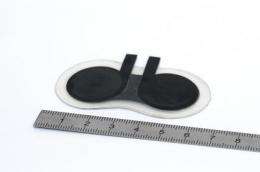
The small, thin battery comes out of the printer and can be applied to flexible substrates. Credit: Fraunhofer ENAS

For a long time, batteries were bulky and heavy. Now, a new cutting-edge battery is revolutionizing the field. It is thinner than a millimeter, lighter than a gram, and can be produced cost-effectively through a printing process.

In the past, it was necessary to race to the bank for every money transfer and every bank statement. Today, bank transactions can be easily carried out at home. Now where is that piece of paper again with the TAN numbers? In the future you can spare yourself the search for the number. Simply touch your EC card and a small integrated display shows the TAN number to be used. Just type in the number and off you go. This is made possible by a printable battery that can be produced cost-effectively on a large scale.

It was developed by a research team led by Prof. Dr. Reinhard Baumann of the Fraunhofer Research Institution for Electronic Nano Systems ENAS in Chemnitz together with colleagues from TU Chemnitz and Menippos GmbH. "Our goal is to be able to mass produce the batteries at a price of single digit cent range each," states Dr. Andreas Willert, group manager at ENAS.

The characteristics of the battery differ significantly from those of conventional batteries. The printable version weighs less than one gram on the scales, is not even one millimeter thick and can therefore be integrated into bank cards, for example. The battery contains no mercury and is in this respect environmentally friendly. Its voltage is 1.5 V, which lies within the normal range.

By placing several batteries in a row, voltages of 3 V, 4.5 V and 6 V can also be achieved. The new type of battery is composed of different layers: a and a manganese , among others. Zinc and manganese react with one another and produce electricity. However, the anode and the cathode layer dissipate gradually during this chemical process. Therefore, the is suitable for applications which have a limited life span or a limited power requirement, for instance greeting cards.

The batteries are printed using a silk-screen printing method similar to that used for t-shirts and signs. A kind of rubber lip presses the printing paste through a screen onto the substrate. A template covers the areas that are not to be printed on. Through this process it is possible to apply comparatively large quantities of printing paste, and the individual layers are slightly thicker than a hair. The researchers have already produced the batteries on a laboratory scale. At the end of this year, the first products could possibly be finished.

Source: Fraunhofer-Gesellschaft (news : web)


Rate this story - 4.8 /5 (13 votes)

Rank Filter

Move the slider to adjust rank threshold, so that you can hide some of the comments.


Display comments: newest first

  • Ricochet - Jul 02, 2009
    • Rank: not rated yet
    Ok, so how much energy do they store?
  • Soylent - Jul 02, 2009
    • Rank: not rated yet
    Ok, so how much energy do they store?


    That's not the main point. These kinds of batteries are not for cars, laptops or other high-power applications. They're for small, thin, low power, single-use applications(not rechargeable). The main points are price, size and waste stream.
  • showme - Jul 03, 2009
    • Rank: not rated yet
    WTF is a TAN number?
  • Soylent - Jul 05, 2009
    • Rank: not rated yet
    WTF is a TAN number?


    It's a Tax deduction and collection Account Number as 2 seconds of google will tell.

July 2, 2009 all stories

Comments: 4

4.8 /5 (13 votes)

  • hide
  • Related Stories

  • Scientists Working Toward Better Batteries
    created Mar 09, 2006 | popularity not rated yet | comments 0
  • ZPower claims its silver-zinc batteries last 40% longer than lithium-ion
    created Oct 08, 2008 | popularity not rated yet | comments 0
  • Nanoball Batteries Could Charge Electric Cars in 5 Minutes
    created Mar 12, 2009 | popularity not rated yet | comments 0
  • Battery Wrapped in Solar Cells Recharges in the Sun
    created Mar 02, 2009 | popularity not rated yet | comments 0
  • Flower-shaped nanoparticles may lead to better batteries for portable electronics
    created Sep 15, 2008 | popularity not rated yet | comments 0


  • hide
  • Relevant PhysicsForums posts

  • Beam Equations
    created 1hour ago
  • Starting Hydraulics!.. Recommendations?
    created 4 hours ago
  • Looking for Equation that can describe both scenarios
    created 7 hours ago
  • Emergency Thermal Expansion question(Mech. Materials)
    created 17 hours ago
  • More from Physics Forums - General Engineering

Other News

Researchers to test renewable-energy system at local treatment plant

Researchers to test renewable-energy system at local treatment plant

Technology / Energy

created 2 hours ago | popularity not rated yet | comments 0 | with audio podcast

A successful University of Nevada, Reno renewable energy research project is moving from the lab to the real world in a demonstration-scale system to turn wastewater sludge into electricity.


Palm's sales slump as its new phones struggle (AP)

Palm's phone sales slump and its stock dives

Technology / Business

created 2 hours ago | popularity not rated yet | comments 0

(AP) -- Palm Inc. reported sales figures Thursday that showed it's having a difficult time getting consumers to pay attention to its phones in a market dominated by iPhones and BlackBerrys. The company's ...


Scanner scans a 200 page book in one minute (w/ Video)

Scanner scans a 200 page book in one minute (w/ Video)

Technology / Engineering

created 10 hours ago | popularity 4.6 / 5 (7) | comments 4 | with audio podcast report

(PhysOrg.com) -- Japanese researchers are developing a super-fast scanner that will be able to scan a book of about 200 pages in a minute without any need to break up or flatten the book.


New welding discovery could radically improve manufacturing practices

New welding discovery could radically improve manufacturing practices

Technology / Engineering

created 3 hours ago | popularity 4 / 5 (2) | comments 0

(PhysOrg.com) -- A new welding technique for manufacturing horizontal and inclined structures discovered by Cranfield University could radically improve weld-based manufacturing practices, without the need ...


Mobile learning with iPhone now possible

Technology / Software

created 1hour ago | popularity not rated yet | comments 1

Developing countries often lack the appropriate infrastructure and trained personnel to enable lifelong learning or continuing education. Although broadband Internet is on the rise, it still requires a big funds investment. ...