Ferns took to the trees and thrived
July 2, 2009 By Karl Leif Bates Ferns took to the trees and thrived

Enlarge

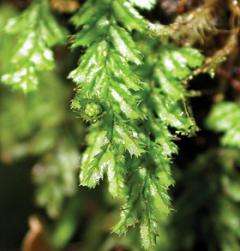
Hymenophyllum jamesonii, an epiphytic fern of neotropical rain forests, has berry-like clusters of sporangia where reproductive spores are produced. | Courtesy of Eric Schuettpelz

(PhysOrg.com) -- As flowering plants like giant trees quickly rose to dominate plant communities during the Cretaceous period, the ferns that had preceded them hardly saw it as a disappointment.

In fact, they flourished. While modern tropical rain forests were becoming established, ferns climbed aboard, and experienced a flowering of their own species diversity.

"The canopy is there and -- boom -- diversification," said Duke University researcher Eric Schuettpelz, who is completing a post-doctoral fellowship in biology with associate professor Kathleen Pryer.

By integrating genomic data from 400 living fern species with information from the fossil record, Schuettpelz and Pryer constructed a new time-calibrated family tree for ferns. Their study appears on the cover of the July 7 .

Though ancient, it appears that ferns really came into their own during a very hot, very wet period that peaked about 10 million years after the Cretaceous/Tertiary boundary 65 million years ago.

Two key innovations may have led to the ferns' success in the face of the new competition from , Schuettpelz said. Some ferns developed the ability to make a living on light that was more toward the red end of spectrum -- shade, in other words. And, around this time, some ferns also developed the ability to live on trees, sometimes without soil, as epiphytes.

By storing water, developing thicker skin, or being more tolerant to drying out, the epiphytic ferns could now perch on a trunk, limb, or twig and live quite happily more than 100 feet off the forest floor, where moisture, temperature, and sunlight are very different indeed.

Whereas the fossil record seemed to suggest that ferns experienced three distinct pulses of species diversification, the Duke team's analysis shows that there was a fourth, roughly corresponding with the development of epiphytism.

So, as rain forests developed and tropical trees and vines clawed past each other to reach heavenward, they took the ferns up along with them. Thousands of new fern species evolved to take advantage of all the new niches being created in the canopy.

"In some ways I guess, the epiphytes escaped the battle on the ground," Schuettpelz said.

Today, epiphytes comprise about 30 percent of the more than 9,000 living fern species. But this isn't the only plant group that includes epiphytes. This fall, as a post-doctoral fellow at the National Evolutionary Synthesis Center (NESCent), Schuettpelz will begin to look for parallel patterns of diversification in epiphytic flowering plants like bromeliads and orchids.

Source: Duke University (news : web)


print this article email this article download pdf blog this article bookmark this article     Stumble it Digg this share on Facebook retweet share on Reddit add to delicious
Rate this story - 4.8 /5 (5 votes)


July 2, 2009 all stories

Comments: 0

4.8 /5 (5 votes)
  • Stumble this up

  • Digg this

  • share this

  • hide
  • Related Stories

  • Rapid burst of flowering plants set stage for other species
    created Feb 09, 2009 | popularity not rated yet | comments 0
  • Scientists find unexpected key to flowering plants' diversity
    created Jul 28, 2008 | popularity not rated yet | comments 0
  • Flowering plants evolved very quickly into 5 groups
    created Nov 26, 2007 | popularity not rated yet | comments 0
  • Two studies on bee evolution reveal surprises
    created Dec 09, 2006 | popularity not rated yet | comments 0
  • Invading trees put rainforests at risk
    created Mar 03, 2008 | popularity not rated yet | comments 0


  • hide
  • Relevant PhysicsForums posts

  • Questions about diffusion
    created 2 hours ago
  • Human Leukocyte Antigen (HLA) typing
    created 8 hours ago
  • Breeding program
    created Nov 20, 2009
  • How does a concentration gradient provide energy?
    created Nov 20, 2009
  • More from Physics Forums - Biology

Other News

The Monarchs' annual migration ritual has yet to be scientifically explained

Tree-eating bugs threaten Monarch butterfly in Mexico

Biology / Ecology

created 9 hours ago | popularity 4 / 5 (1) | comments 0

The mysterious Monarch butterfly, which migrates en masse annually between Canada and Mexico, is now facing a new peril: another insect thriving in Western Mexican forests.


Bigger not necessarily better, when it comes to brains

Bigger not necessarily better, when it comes to brains

Biology / Plants & Animals

created Nov 17, 2009 | popularity 4.5 / 5 (17) | comments 11

(PhysOrg.com) -- Tiny insects could be as intelligent as much bigger animals, despite only having a brain the size of a pinhead, say scientists at Queen Mary, University of London.


Extinct goat Myotragus balearicus

Extinct goat was cold-blooded

Biology / Plants & Animals

created Nov 18, 2009 | popularity 4.9 / 5 (33) | comments 10

(PhysOrg.com) -- An extinct goat that lived on a barren Mediterranean island survived for millions of years by reducing in size and by becoming cold-blooded, which has never before been discovered in mammals.


Right-handed chimpanzees provide clues to the origin of human language

Biology / Plants & Animals

created Nov 16, 2009 | popularity 3 / 5 (1) | comments 7

Most of the linguistic functions in humans are controlled by the left cerebral hemisphere. A study of captive chimpanzees at the Yerkes National Primate Research Center (Atlanta, Georgia), reported in the January 2010 issue ...


The creature was found at a depth of 161 metres

Japanese researchers film rare baby fish 'fossil'

Biology / Plants & Animals

created Nov 17, 2009 | popularity 4.7 / 5 (7) | comments 4

Japanese marine researchers said Tuesday they had found and successfully filmed a young coelacanth -- a rare type of fish known as "a living fossil" -- in deep water off Indonesia.