All in sight: Scientists test infrared system for the protection of whales
July 2, 2009
All in sight: Scientists test infrared system for the protection of whales

Enlarge

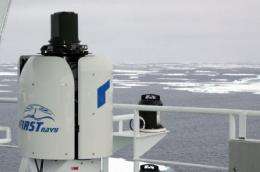
The FIRST Navy thermal imager is installed in Polarstern’s crow’s nest at a height of about 28 m above water on a highly stabilized platform (white basis). The sensor head (green) rotates at 5 revolutions per second. In the crow’s nest the wind often blows at gale force strength due to the ship’s superstructure while the temperature plummets to minus 30° C, presenting highest demands to the system. Credit: Photo: Lars Kindermann, Alfred Wegener Institute

A new measurement system for the detection of whales is used for the first time on board of the research vessel Polarstern. Whales are usually difficult to spot. On the one hand, they spend the greater part of their life under water. On the other hand, only a small part of their body can be seen when they surface, and this can even hardly be distinguished from the surrounding water.

Visual sightings by marine mammal observers are therefore usually based on observations of the spout, the condensing and quite warm breathing cloud. It rises, depending on the whale species and wind conditions, between one metre and ten metres over the and remains visible for only a few seconds. A thermal imaging camera specifically optimized for this purpose now uses the heat of this spout. It is employed for the first time during the current expedition of RV Polarstern.

The underlying measurement method, infrared thermography, registers both at day and night the heat radiation originating from each body. It depicts it on a computer screen as a black and white picture, thus making it visible for humans: the brighter a spot, the warmer it is. The warm spout of a whale clearly stands out against the background of the cold North Atlantic or .

All in sight: Scientists test infrared system for the protection of whales
Enlarge

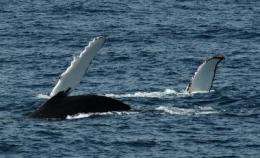
These are two humpback whales visiting Polarstern while the ship was on station. Credit: Photo: Alfred Wegener Institute

Infrared thermography is already in use with great success, for example to examine the heat insulation of buildings. However, the ship-based detection of on sea presents new challenges: the camera must have "all-round visibility", it is subject to the constant movement of the ship and the spout is only briefly visible, possibly at a great distance. This poses high demands on the camera's optics: similar to animal photography, highest resolution telephoto lenses are necessary. When mounted to the ship, however, the camera would, due to the ship's motion, only point into the sky for much of the time.

A new thermal imager developed by Rheinmetall Defence Electronics, Bremen, Germany overcomes these challenges. The system, called FIRST Navy, was installed during Polarstern's last port call on a highly stabilized platform in the ship's crow's nest at a height of about 28 metres. The system generates five thermographic all-round images per second with a resolution of 7200 x 563 pixels of about 4 megapixels each. The stabilization compensates the ship's movements with the effect that the upper edge of the image is always aligned with the horizon and the surrounding water surface does not move out of the picture. The system produces about a terabyte of data each day.

Researchers from the Alfred Wegener Institute for Polar and Marine Research in the Helmholtz Association currently develop software to evaluate this data volume automatically.

"We are very happy that the hardware of the system works successfully on board of Polarstern. The software is designed to search the stream of pictures for whale spout", explains Dr. Olaf Boebel, head of the research group Oceanic Acoustics at the Alfred Wegener Institute. He is in charge of the research project MAPS ( Perimeter Surveillance) which runs since early 2009. The aim is to transmit direction and distance of a whale sighting together with the respective video sequences to the ship's command in real-time. Ships equipped with such a system can, for the protection of the whales, respond by evasive manoeuvres or interrupt seismic measurements, as appropriate. Furthermore, the system can directly support research projects concerning whale population in the scarcely researched Antarctic regions. Further application possibilities regarding ship security (evasion of collisions with growlers) and sea ice research (ice coverage at small-scales) are important, not least with regard to the diminishing Arctic ice cover.

Source: Helmholtz Association of German Research Centres (news : web)


Rank 4 /5 (1 vote)
Related Stories
Relevant PhysicsForums posts
  • Calling function with no input argument
    created4 hours ago
  • Force free body diagram problem on gym equipment
    created5 hours ago
  • Empirical data regarding shower heads and water
    created13 hours ago
  • feed hold button on CNC lathe
    createdFeb 09, 2012
  • RFAC in Fortran
    createdFeb 09, 2012
  • dynamics 2/32
    createdFeb 08, 2012
  • More from Physics Forums - General Engineering

More news stories

New error-correcting codes guarantee the fastest possible rate of data transmission

Error-correcting codes are one of the triumphs of the digital age. They’re a way of encoding information so that it can be transmitted across a communication channel — such as an optical fiber o ...

Technology / Computer Sciences

created 8 hours ago | popularity 5 / 5 (3) | comments 4 | with audio podcast

Small modular reactor design could be a 'SUPERSTAR'

(PhysOrg.com) -- Though most of today's nuclear reactors are cooled by water, we've long known that there are alternatives; in fact, the world's first nuclear-powered electricity in 1951 came from a reactor ...

Technology / Energy & Green Tech

created 7 hours ago | popularity 4.2 / 5 (10) | comments 17 | with audio podcast

Advanced power-grid model finds low-cost, low-carbon future in West

(PhysOrg.com) -- The least expensive way for the Western U.S. to reduce greenhouse gas emissions enough to help prevent the worst consequences of global warming is to replace coal with renewable and other ...

Technology / Energy & Green Tech

created 7 hours ago | popularity 5 / 5 (2) | comments 7 | with audio podcast

New power source discovered

(PhysOrg.com) -- Researchers at the Massachusetts Institute of Technology (MIT) and RMIT University have made a breakthrough in energy storage and power generation.

Technology / Energy & Green Tech

created 7 hours ago | popularity 5 / 5 (7) | comments 3 | with audio podcast

Netflix light on flicks as viewers soak up TV shows

Like most fresh faces that arrive in Hollywood, Netflix wanted to be a movie star. But now it's learning what many in Tinseltown have known for decades: Movies are sexy, but the real money is in television.

Technology / Business

created 5 hours ago | popularity not rated yet | comments 1


Complex wiring of the nervous system may rely on a just a handful of genes and proteins

Researchers at the Salk Institute have discovered a startling feature of early brain development that helps to explain how complex neuron wiring patterns are programmed using just a handful of critical genes. ...

Human cognitive performance suffers following natural disasters, researchers find

Not surprisingly, victims of a natural disaster can experience stress and anxiety, but a new study indicates that it might also cause them to make more errors - some serious - in their daily lives. In their upcoming Human Fa ...

The power of estrogen -- male snakes attract other males

A new study has shown that boosting the estrogen levels of male garter snakes causes them to secrete the same pheromones that females use to attract suitors, and turned the males into just about the sexiest ...

Both maternal and paternal age linked to autism

Older maternal and paternal age are jointly associated with having a child with autism, according to a recently published study led by researchers at The University of Texas Health Science Center at Houston (UTHealth).

Putting the squeeze on planets outside our solar system

(PhysOrg.com) -- Using high-powered lasers, scientists at Lawrence Livermore National Laboratory and collaborators discovered that molten magnesium silicate undergoes a phase change in the liquid state, abruptly ...

Curry spice component may help slow prostate tumor growth

Curcumin, an active component of the Indian curry spice turmeric, may help slow down tumor growth in castration-resistant prostate cancer patients on androgen deprivation therapy (ADT), a study from researchers ...