Fermi Telescope reveals a population of radio-quiet gamma-ray pulsars
July 2, 2009 Fermi Telescope reveals a population of radio-quiet gamma-ray pulsars

Enlarge

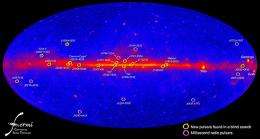
This all-sky map shows the positions of 16 new pulsars (yellow) and eight millisecond pulsars (magenta) studied using Fermi's LAT. Credit: NASA/DOE/Fermi LAT Collaboration

(PhysOrg.com) -- A new class of pulsars detected by NASA's Fermi Gamma-ray Space Telescope is solving the mystery of previously unidentified gamma-ray sources and helping scientists understand the mechanisms behind pulsar emissions.

A study to be published by an international team of scientists in the July 2 edition of Science Express describes 16 pulsars discovered by Fermi based on their pulsed emissions of high-energy . A pulsar is a rapidly spinning neutron star, the dense core left behind after a . Most of the 1,800 known pulsars were found through their periodic radio emissions.

"These are the first pulsars ever detected by gamma rays alone, and already we've found 16," said coauthor Robert Johnson, professor of physics at the University of California, Santa Cruz. "The existence of a large population of radio-quiet pulsars was suspected prior to this, but until Fermi was launched, only one radio-quiet pulsar was known, and it was first detected in x-rays."

Johnson and other physicists at UCSC's Santa Cruz Institute for Particle Physics (SCIPP) identified the gamma-ray pulsars using computational techniques they developed to comb through data from Fermi's Large Area Telescope (LAT). Marcus Ziegler, a postdoctoral researcher at SCIPP and corresponding author of the paper, said detection of gamma-ray pulsations from a typical source requires weeks or months of data from the LAT.

"From the faintest pulsar we studied, the LAT sees only two gamma-ray photons a day," Ziegler said.

Of the 16 gamma-ray pulsars found by Fermi, 13 are associated with unidentified gamma-ray sources detected previously by the EGRET instrument on the Compton Gamma-ray Observatory. EGRET detected nearly 300 gamma-ray point sources, but was unable to detect pulsations from those sources, most of which have remained unidentified, said Pablo Saz Parkinson, also a SCIPP postdoctoral researcher and corresponding author of the paper.

"It's been a longstanding question what could be powering those unidentified sources, and the new Fermi results tell us that a lot of them are pulsars," Saz Parkinson said. "These findings are also giving us important clues about the mechanism of pulsar emissions."

A pulsar emits narrow beams of radio waves from the magnetic poles of the neutron star, and the beams sweep around like a lighthouse beacon because the magnetic poles are not aligned with the star's spin axis. If the radio beam misses the Earth, the pulsar cannot be detected by radio telescopes. Fermi's ability to detect so many radio-quiet gamma-ray pulsars indicates that the gamma-rays are emitted in a beam that is wider and more fan-like than the radio beam.

"This favors models in which the gamma rays are emitted from the outer magnetosphere of the pulsar, as opposed to the polar cap much closer to the surface of the star," Saz Parkinson said.

The very intense magnetic and electric fields of a pulsar accelerate charged particles to nearly the speed of light, and these particles are ultimately responsible for the gamma-ray emissions.

Because the rotation of the star powers the emissions, isolated pulsars slow down as they age and lose energy. But a binary companion star can feed material to a and spin it up to a rotation rate of 100 to 1,000 times a second. These are called millisecond pulsars, and Fermi scientists detected gamma-ray pulsations from eight millisecond pulsars that were previously discovered at radio wavelengths. Those results are reported in a second study also published in the July 2 edition of Science Express.

"Fermi has truly unprecedented power for discovering and studying gamma-ray pulsars," said Paul Ray of the Naval Research Laboratory in Washington. "Since the demise of the Compton Gamma Ray Observatory a decade ago, we've wondered about the nature of unidentified gamma-ray sources it detected in our galaxy. These studies from Fermi lift the veil on many of them."

Source: University of California - Santa Cruz (news : web)


print this article email this article download pdf blog this article bookmark this article     Stumble it Digg this share on Facebook retweet share on Reddit add to delicious
Rate this story - 4.9 /5 (10 votes)

Rank Filter

Move the slider to adjust rank threshold, so that you can hide some of the comments.


Display comments: newest first

  • omatumr - Jul 03, 2009
    • Rank: 1 / 5 (2)
    THE ORIGIN AND ACCELERATION OF PROTONS FROM PULSARS??

    Those working with NASA's Fermi Gamma-ray Space Telescope have addressed one part of a cosmic puzzle:

    "The very intense magnetic and electric fields of a pulsar accelerate charged particles to nearly the speed of light, and these particles are ultimately responsible for the gamma-ray emissions."

    The rest of the story: Repulsive interactions between neutrons cause neutron-emission from pulsars. Then neutrons quickly decay to protons and electrons.

    See Journal of Fusion Energy 21 (2002) 193-198
    http://arxiv.org/.../0501441

    With kind regards
    Oliver K. Manuel
  • yyz - Jul 11, 2009
    • Rank: not rated yet
    Other science news sites reported that Fermi received on average of 2 gamma-ray photons a day from these pulsars, making the statistical verification of these pulsars extraordinary!

July 2, 2009 all stories

Comments: 2

4.9 /5 (10 votes)
  • Stumble this up

  • Digg this

  • share this

  • hide
  • Related Stories

  • Fermi telescope unveils a dozen new pulsars
    created Jan 06, 2009 | popularity not rated yet | comments 0
  • First gamma-ray-only pulsar observation opens new window on stellar evolution
    created Oct 16, 2008 | popularity not rated yet | comments 0
  • Pulsar Racing Through Space Reveals Comet-Like Trail
    created Dec 16, 2005 | popularity not rated yet | comments 0
  • New technique improves estimates of pulsar ages
    created Jun 09, 2009 | popularity not rated yet | comments 0
  • GLAST: The Challenge of Too Much New Data
    created May 22, 2007 | popularity not rated yet | comments 0


  • hide
  • Relevant PhysicsForums posts

  • Supernova vs. Nova?
    created 5 hours ago
  • Supernova's Gamma Rays and Comets
    created Nov 06, 2009
  • Our Moon
    created Nov 06, 2009
  • Question about a Carl Zeiss lens
    created Nov 05, 2009
  • Origin of planets
    created Nov 05, 2009
  • Q?
    created Nov 02, 2009
  • More from Physics Forums - General Astronomy

Other News

Seattle team wins $900,000 in Space Elevator Games (AP)

Seattle team wins $900,000 in Space Elevator Games

Space & Earth / Space Exploration

created 8 hours ago | popularity 5 / 5 (5) | comments 4

(AP) -- A Seattle team has collected a $900,000 prize in a NASA-backed competition to develop the concept of an elevator to space - an idea spurred by science fiction novels.


Russian rocket to launch from French Guiana in 2010

Space & Earth / Space Exploration

created 8 hours ago | popularity 5 / 5 (1) | comments 0

A Russian rocket will next year for the first time blast off from a European launch pad in South America, officials said Saturday, as the first rockets headed for the site on board a ship.


Success in 'space elevator' competition (AP)

Success in 'space elevator' competition (Update 3)

Space & Earth / Space Exploration

created Nov 05, 2009 | popularity 4.3 / 5 (31) | comments 50

(AP) -- A robot powered by a ground-based laser beam climbed a long cable dangling from a helicopter on Wednesday to qualify for prize money in a $2 million competition to test the potential reality of the ...


Space hotel taking bookings for 2012 opening

Space hotel taking bookings for 2012 opening

Space & Earth / Space Exploration

created Nov 05, 2009 | popularity 4.5 / 5 (18) | comments 11

(PhysOrg.com) -- The first orbiting space hotel is on track to open for its first customers in 2012, but hurry, as bookings are filling fast.


'Dropouts' pinpoint earliest galaxies

'Dropouts' pinpoint earliest galaxies

Space & Earth / Astronomy

created Nov 06, 2009 | popularity 4 / 5 (8) | comments 10

Astronomers, conducting the broadest survey to date of galaxies from about 800 million years after the Big Bang, have found 22 early galaxies and confirmed the age of one by its characteristic hydrogen signature ...