VLBA locates superenergetic bursts near giant black hole
July 2, 2009
VLBA locates superenergetic bursts near giant black hole

Enlarge

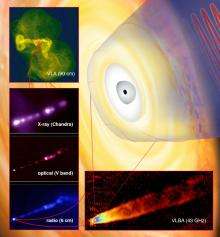
Peering Deeper Into the Core of M87: At top left, a VLA image of the galaxy shows the radio-emitting jets at a scale of about 200,000 light-years. Subsequent zooms progress closer into the galaxy's core, where the supermassive black hole resides. In the artist's conception (background). the black hole illustrated at the center is about twice the size of our Solar System, a tiny fraction of the size of the galaxy, but holding some six billion times the mass of the Sun. CREDIT: Bill Saxton, NRAO/AUI/NSF

(PhysOrg.com) -- Using a worldwide combination of diverse telescopes, astronomers have discovered that a giant galaxy's bursts of very high energy gamma rays are coming from a region very close to the supermassive black hole at its core. The discovery provides important new information about the mysterious workings of the powerful "engines" in the centers of innumerable galaxies throughout the Universe.

The galaxy M87, 50 million light-years from Earth, harbors at its center a black hole more than six billion times more massive than the Sun. are concentrations of matter so dense that not even light can escape their gravitational pull. The black hole is believed to draw material from its surroundings -- material that, as it falls toward the black hole, forms a tightly-rotating disk.

The scientists reported their findings in the July 2 online edition of the journal Science.

Processes near this "," powered by the immense gravitational energy of the black hole, propel energetic material outward for thousands of light-years. This produces the "jets" seen emerging from many galaxies. In 1998, astronomers found that M87 also was emitting flares of gamma rays a trillion times more energetic than visible light.

However, the telescopes that discovered these bursts of very high energy gamma rays could not determine exactly where in the galaxy they originated. In 2007 and 2008, the astronomers using these gamma-ray telescopes combined forces with a team using the National Science Foundation's continent-wide Very Long Baseline Array (VLBA), a radio telescope with extremely high resolving power, or ability to see fine detail.

"Combining the gamma-ray observations with the supersharp radio 'vision' of the VLBA allowed us to see that the gamma rays are coming from a region very near the black hole itself," said Craig Walker, of the National Radio Astronomy Observatory (NRAO).

"Pinning down this location addresses what was an open question and provides important clues for understanding how such highly energetic emissions are produced in the jets of active galaxies," said Matthias Beilicke, of Washington University in St. Louis, MO.
Pinpointing origin of gamma rays from a supermassive black hole
Enlarge

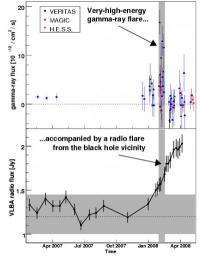
The chart below describes results of the study "Radio Imaging of the Very-High-Energy Gamma-Ray Emission Region in the Central Engine of a Radio Galaxy," which appears in the July 2 Science Express. The upper panel shows the very-high-energy gamma-ray emission from the radio galaxy M87 during 2007-2008 measured with the VERITAS, H.E.S.S and MAGIC experiments. The regular gaps in the light curve correspond to phases of full moon during which no observations were possible. The vertical gray box indicates the time period of the strong flaring activity. The lower panel shows the radio flux as measured with the Very Long Baseline Array, which detects radio waves with high spatial precision, from a region very close to the supermassive black hole in M87. Credit: The VERITAS Collaboration, the VLBA 43 GHz M 87 Monitoring Team, the H.E.S.S. Collaboration, and the MAGIC Collaboration.

The gamma-ray flares from the galaxy were monitored by systems of large telescopes designed to detect faint flashes of blue light that result when gamma rays enter the Earth's atmosphere. Data from sensitive cameras in these systems can allow astronomers to infer the energy of the gamma rays and the direction from which they came. Their directional information, however, is not precise enough to narrow down the gamma-ray-emitting region within the galaxy.

The VLBA offered a millionfold improvement in resolving power, allowing the scientists to determine that the gamma rays are coming from the immediate vicinity of the black hole. Though gamma rays are the most energetic form of electromagnetic radiation and radio waves the least energetic, both often arise from the same regions. This was shown clearly when M87's most energetic gamma-ray flares were accompanied by the largest flare of radio waves seen from that galaxy by the VLBA.

The radio flare began at about the time of the gamma-ray flares, but continued to increase in brightness for at least two months. "This tells us that energetic material burst out very close to the black hole, causing the gamma rays to be emitted and the radio flare to begin. As that material traveled down the jet, expanding and losing energy, the gamma-ray emission ceased, but the radio continued to increase in brightness," Walker explained. "The VLBA showed us with great precision where the radio emission came from, so we know the gamma rays came from closer in toward the black hole," he added.

M87 is the largest galaxy in the Virgo Cluster of galaxies, at the center of a supercluster of galaxies that includes the Local Group, of which our own Milky Way is a member. The black hole in M87 has an "event horizon," from which matter cannot escape, roughly twice the size of our Solar System, or a tiny fraction of the size of the entire galaxy. The new measurements indicate that the are coming from an area no larger than 50 times the size of the event horizon.

The telescope systems that detected the gamma-ray flares are the VERITAS array in Arizona, the H.E.S.S. system in Namibia, Africa, and the MAGIC system on La Palma in the Canary Islands.

Source: National Radio Astronomy Observatory (news : web)

4.9 /5 (8 votes)  

Filter


Move the slider to adjust rank threshold, so that you can hide some of the comments.


Display comments: newest first

omatumr
Jul 03, 2009

Rank: 1 / 5 (2)
ENERGY SOURCE OF GIANT BLACK HOLE?

If neutron stars are the dead nuclear embers of massive stars, and black holes are produced by further collapse and release of energy, . . .

Then what causes super-energetic bursts?

With kind regards,
Oliver K. Manuel
http://www.omatumr.com
yyz
Jul 11, 2009

Rank: not rated yet
A preprint paper discussing the H.E.S.S., VERITAS, MAGIC and radio observations was recently published here: http://arxiv.org/...65v1.pdf .
yyz
Jul 14, 2009

Rank: not rated yet
Oliver K. Manuel asks in his post 'ENERGY SOURCE OF GIANT BLACK HOLE?', "what causes super-energetic bursts?". May I suggest that a super-sized accretion disc and twisted and contorted magnetic field lines along the polar jets seem a reasonable source. In this instance, the VHE gamma-rays seem to originate VERY close to the SMBH and are probably not related to the jet, leaving irregularities in the massive accretion disk or near polar emission from the SMBH as possible sites for VHE radiation production. Refer to the paper I linked to above for details.
Rank 4.9 /5 (8 votes)
Relevant PhysicsForums posts
  • Titan's lack of impact craters
    created12 hours ago
  • Real pictures of black hole eating a star?
    createdFeb 08, 2012
  • Hypothetical way to travel faster than light, but not technically exceed lightspeed
    createdFeb 06, 2012
  • How do scientists monitor the Sun's activity?
    createdFeb 05, 2012
  • Search patterns in observational studies
    createdFeb 05, 2012
  • Derivation of Pogson's law
    createdFeb 03, 2012
  • More from Physics Forums - General Astronomy

More news stories

Deconstructing a mystery: What caused Snowmaggedon?

In the quiet after the storms, streets and cars had all but disappeared under piles of snow. The U.S. Postal Service suspended service for the first time in 30 years. Snow plows struggled to push the evidence ...

Space & Earth / Earth Sciences

created 7 hours ago | popularity 4.7 / 5 (3) | comments 1 | with audio podcast

Ocean microbe communities changing, but long-term environmental impact is unclear

As oceans warm due to climate change, water layers will mix less and affect the microbes and plankton that pump carbon out of the atmosphere – but researchers say it's still unclear whether these processes ...

Space & Earth / Earth Sciences

created 9 hours ago | popularity 5 / 5 (2) | comments 2 | with audio podcast

Researchers create 3-D laser maps that show how earthquake changes landscape

Geologists have a new tool to study how earthquakes change the landscape down to a few inches, and it's giving them insight into how earthquake faults behave. In the Feb. 10 issue of the journal Science, a team ...

Space & Earth / Earth Sciences

created 9 hours ago | popularity 5 / 5 (4) | comments 0 | with audio podcast

New views show old NASA Mars landers

(PhysOrg.com) -- The High Resolution Imaging Science Experiment (HiRISE) camera on NASA's Mars Reconnaissance Orbiter recorded a scene on Jan. 29, 2012, that includes the first color image from orbit showing ...

Space & Earth / Space Exploration

created 15 hours ago | popularity 4.9 / 5 (7) | comments 5 | with audio podcast

Black holes and star formation

(PhysOrg.com) -- It has long been recognized that galaxy mergers or even close interactions can play a vital role in shaping the morphology of galaxies. One way they can do so, it is thought, is by triggering ...

Space & Earth / Astronomy

created 14 hours ago | popularity 4 / 5 (6) | comments 3 | with audio podcast


'Dark plasmons' transmit energy

Microscopic channels of gold nanoparticles have the ability to transmit electromagnetic energy that starts as light and propagates via "dark plasmons," according to researchers at Rice University.

Hydrogen from acidic water: Researchers develop potential low cost alternative to platinum for splitting water

A technique for creating a new molecule that structurally and chemically replicates the active part of the widely used industrial catalyst molybdenite has been developed by researchers with the Lawrence Berkeley ...

FDA-approved drug rapidly clears amyloid from the brain, reverses Alzheimer's symptoms in mice

Neuroscientists at Case Western Reserve University School of Medicine have made a dramatic breakthrough in their efforts to find a cure for Alzheimer's disease. The researchers' findings, published in the journal Science, show t ...

Ultraviolet protection molecule in plants yields its secrets

Lying around in the sun all day is hazardous not just for humans but also for plants, which have no means of escape. Ultraviolet (UV) radiation from the sun can damage proteins and DNA inside cells, leading ...

Anyone can learn to be more inventive, cognitive researcher says

There will always be a wild and unpredictable quality to creativity and invention, says Anthony McCaffrey, a cognitive psychology researcher at the University of Massachusetts Amherst, because an "Aha moment" is rare and ...

Cell biologists describes mechanism by which some people may be more susceptible to colon cancer

An international research team led by cell biologists at the University of California, Riverside has uncovered a new insight into colon cancer, the third leading cause of cancer-related deaths in the United ...