Many characteristics of Mars, including ice, are similar to Earth
July 2, 2009 Mars

Enlarge

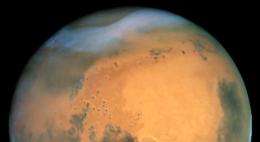
Mars, as seen by the Hubble Space Telescope. Image credit: NASA

Mars gets as far as 250 million miles away, but many parts of it closely resemble places on Earth, including its landscape, history of water, soil and even its weather, says a Texas A&M University researcher in the current issue of "Science" magazine.

Mark Lemmon, a professor of atmospheric sciences who has been involved with missions for years, says last year's Phoenix Mars Lander mission keeps revealing secrets about the planet, answering some questions but raising other big ones. He is one of several authors detailing the Phoenix discoveries.

"Phoenix landed in a place that has access to Martian ice, which is exciting by itself," Lemmon says of the Mars probe, which landed May 25, 2008. The mission goals were to investigate the suitability of Mars for past or present life, but Phoenix was incapable of detecting life itself.

"Phoenix was designed to verify and investigate subsurface ice, and it found it almost instantly," he explains. The entire area where it landed has water ice just a few inches under the . The area is cold now, but it has been warmer in the past."

NASA's charge to researchers on the mission has been simple: "Follow the water," meaning examine all aspects of water - or ice - on Mars. No water in a liquid state has been found yet, Lemmon says, but there is new evidence that Mars had liquid water billions of years ago.

Using its robotic arm, the Mars Lander was able to scoop up dirt, which was mixed with ice, and analyze it, Lemmon says.

"Where it landed is a barren place that resembles the dry valleys of Antarctica," he adds. "The area has mounds and troughs, and just like in Antarctic valleys, there is no liquid water but plenty of ice.

"Some of these patches are fairly pure. Others have the mixed with soil containing energy sources and nutrients that could be used if there were life."

Lemmon says the soil has perchlorate, a form of chlorine that is considered hazardous, but certain types of bacteria are able to live on it here.

"The interesting thing is, the soil has a potential energy source and oxygen source for life on Mars," he notes.

Traces of calcite were also found, which shows a presence of at some time in the past, Lemmon notes.

Phoenix also found weather patterns similar to those on Earth, including cold fronts that bring in gusty winds and sub-freezing temperatures.

Another bonus: Phoenix saw small Martian snowflakes, which leads the team to believe that snowfall on Mars was once a common occurrence.

"To sum it up, we found a place on Mars that is similar to cold, dry environments on Earth, and those environments are capable of supporting life," Lemmon explains.

"There are numerous signs of a history of water on Mars. The snowflakes indicate to us that there are weather patterns on Mars similar to those on . Phoenix has given us valuable insights into Martian weather and soil, and it gives us clues as to how we should proceed with future investigations of Mars."

Source: Texas A&M University


print this article email this article download pdf blog this article bookmark this article     Stumble it Digg this share on Facebook retweet share on Reddit add to delicious
Rate this story - 4.5 /5 (4 votes)

Rank Filter

Move the slider to adjust rank threshold, so that you can hide some of the comments.


Display comments: newest first

  • deatopmg - Jul 03, 2009
    • Rank: 1 / 5 (1)
    "There are numerous signs of a history of water on Mars. The snowflakes indicate to us that there are weather patterns on Mars similar to those on Earth. Phoenix has given us valuable insights into Martian weather and soil, and it gives us clues as to how we should proceed with future investigations of Mars."
    Yes, it does - the equatorial region at low elevations w/ a duplicate of the successful Viking life detection experiment plus a GC/MS or LC/MS. But release to the paying public of ALL Mars photos in as received RAW format (not the severely degraded jpg images) from MSSS would likely be enough to identify liquid water and possible life. And that would only cost us a minuscule fraction of another mission.
  • omatumr - Jul 07, 2009
    • Rank: not rated yet
    ANOTHER SIMILARITY OF EARTH AND MARS

    The xenon/krypton ratio in air is much lower than that in meteorites.

    In 1968 we showed that selective adsorption of xenon on fine grained sediments likely reduced the xenon/krypton ratio for the gases that remained in air by about a factor of ~10 [R. A. Canalas, E. C. Alexander, Jr. and O. K. Manuel, "Terrestrial abundance of noble gases," J. Geophys. Res. 73 (1968) 3331-3334].

    Recent studies have shown that the xenon/krypton ratio on Mars is similar to that in air. This suggests the possibility of selective adsorption of xenon on fine-grained Martian sediments too.

    With kind regards,
    Oliver K. Manuel
    http://www.omatumr.com/

July 2, 2009 all stories

Comments: 2

4.5 /5 (4 votes)
  • Stumble this up

  • Digg this

  • share this

  • hide
  • Related Stories

  • Phoenix Heads for Mars
    created Aug 04, 2007 | popularity not rated yet | comments 0
  • Phoenix Scrapes to Icy Soil in Wonderland
    created Jun 30, 2008 | popularity not rated yet | comments 0
  • Phoenix Lander Prepares for Microscopy, Wet Chemistry on Mars
    created Jun 24, 2008 | popularity not rated yet | comments 0
  • Report: Images from Mars lander show liquid water
    created Mar 11, 2009 | popularity not rated yet | comments 0
  • Simulations predicted Mars lander would hit sub-surface
    created Jun 02, 2008 | popularity not rated yet | comments 0


  • hide
  • Relevant PhysicsForums posts

  • Above or Below the Line of Nodes
    created 32 minutes ago
  • Supernova vs. Nova?
    created 6 hours ago
  • Supernova's Gamma Rays and Comets
    created Nov 06, 2009
  • Our Moon
    created Nov 06, 2009
  • More from Physics Forums - General Astronomy

Other News

Seattle team wins $900,000 in Space Elevator Games (AP)

Seattle team wins $900,000 in Space Elevator Games

Space & Earth / Space Exploration

created 9 hours ago | popularity 5 / 5 (5) | comments 4

(AP) -- A Seattle team has collected a $900,000 prize in a NASA-backed competition to develop the concept of an elevator to space - an idea spurred by science fiction novels.


Russian rocket to launch from French Guiana in 2010

Space & Earth / Space Exploration

created 9 hours ago | popularity 5 / 5 (1) | comments 0

A Russian rocket will next year for the first time blast off from a European launch pad in South America, officials said Saturday, as the first rockets headed for the site on board a ship.


Success in 'space elevator' competition (AP)

Success in 'space elevator' competition (Update 3)

Space & Earth / Space Exploration

created Nov 05, 2009 | popularity 4.3 / 5 (31) | comments 50

(AP) -- A robot powered by a ground-based laser beam climbed a long cable dangling from a helicopter on Wednesday to qualify for prize money in a $2 million competition to test the potential reality of the ...


Space hotel taking bookings for 2012 opening

Space hotel taking bookings for 2012 opening

Space & Earth / Space Exploration

created Nov 05, 2009 | popularity 4.5 / 5 (18) | comments 11

(PhysOrg.com) -- The first orbiting space hotel is on track to open for its first customers in 2012, but hurry, as bookings are filling fast.


'Dropouts' pinpoint earliest galaxies

'Dropouts' pinpoint earliest galaxies

Space & Earth / Astronomy

created Nov 06, 2009 | popularity 4 / 5 (8) | comments 10

Astronomers, conducting the broadest survey to date of galaxies from about 800 million years after the Big Bang, have found 22 early galaxies and confirmed the age of one by its characteristic hydrogen signature ...