New type of El Nino could mean more hurricanes make landfall
July 2, 2009 New type of El Nino could mean more hurricanes make landfall

Enlarge

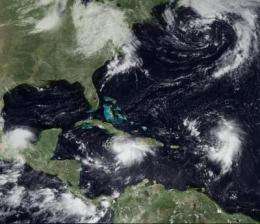
The 2008 hurricane season was one of the most active on record. In this image, taken on August 28, 2008, three storms can be seen in various stages: Fay, Gustav and Hannah. Credit: National Oceanic and Atmospheric Administration

El Niņo years typically result in fewer hurricanes forming in the Atlantic Ocean. But a new study suggests that the form of El Niņo may be changing potentially causing not only a greater number of hurricanes than in average years, but also a greater chance of hurricanes making landfall, according to climatologists at the Georgia Institute of Technology. The study appears in the July 3, 2009, edition of the journal Science.

"Normally, El Niņo results in diminished hurricanes in the Atlantic, but this new type is resulting in a greater number of hurricanes with greater frequency and more potential to make landfall," said Peter Webster, professor at Georgia Tech's School of Earth and Atmospheric Sciences.

That's because this new type of El Niņo, known as El Niņo Modoki (from the Japanese meaning "similar, but different"), forms in the Central Pacific, rather than the Eastern Pacific as the typical El Niņo event does. Warming in the Central Pacific is associated with a higher storm frequency and a greater potential for making landfall along the Gulf coast and the coast of Central America.

Even though the oceanic circulation pattern of warm water known as El Niņo forms in the Pacific, it affects the circulation patterns across the globe, changing the number of hurricanes in the Atlantic. This regular type of El Niņo (from the Spanish meaning "little boy" or "Christ child") is more difficult to forecast, with predictions of the December circulation pattern not coming until May. At first glance, that may seem like plenty of time. However, the summer before El Niņo occurs, the storm patterns change, meaning that predictions of El Niņo come only one month before the start of season in June. But El Niņo Modoki follows a different prediction pattern.

"This new type of El Niņo is more predictable," said Webster. "We're not sure why, but this could mean that we get greater warning of hurricanes, probably by a number of months."

As to why the form of El Niņo is changing to El Niņo Modoki, that's not entirely clear yet, said Webster.

"This could be part of a natural oscillation of El Niņo," he said. "Or it could be El Niņo's response to a warming atmosphere. There are hints that the trade winds of the Pacific have become weaker with time and this may lead to the warming occurring further to the west. We need more data before we know for sure."

In the study, Webster, along with Earth and Atmospheric Sciences Chair Judy Curry and research scientist Hye-Mi Kim used satellite data along with historical tropical records and climate models.

The research team is currently looking at La Niņa, the cooling of the surface waters in the Eastern and Central Pacific.

"In the past, La Nina has been associated with a greater than average number of North Atlantic hurricanes and La Nina seems to be changing its structure as well," said Webster. "We're vitally interested in understanding why El Niņo-La Niņa has changed. To determine this we need to run a series of numerical experiments with climate models."

Source: Georgia Institute of Technology


print this article email this article download pdf blog this article bookmark this article     Stumble it Digg this share on Facebook retweet share on Reddit add to delicious
Rate this story - 3.3 /5 (20 votes)

Rank Filter

Move the slider to adjust rank threshold, so that you can hide some of the comments.


Display comments: newest first

  • mikiwud - Jul 03, 2009
    • Rank: 2.3 / 5 (3)
    Once upon a time there was a Big Bad Troll.......
  • Mercury_01 - Jul 03, 2009
    • Rank: 1 / 5 (1)
    I AM EL NINO, ALSO KNOWN AS "THE NINO"!!!!!!!!!
  • Doug_Huffman - Jul 03, 2009
    • Rank: not rated yet
    Modoki is almost exactly, similar but different, a solecism.
  • deatopmg - Jul 03, 2009
    • Rank: 3.7 / 5 (3)
    Run those models!!!! but it's still: garbage in, garbage out.

    Headline could have been just as accurate by reading: New type of El Nino could mean less hurricanes make landfall

    This is Chicken Licken and Henny Penny journalism.
  • birdbrainz - Jul 03, 2009
    • Rank: 5 / 5 (2)
    This is ridiculous. Doesn't "similar" imply a difference? Another thing: what's with the mixing of languages? What's next? Wiki Wiki El Nino Modoki au poivre mit Hackfleisch?
  • thermodynamics - Jul 04, 2009
    • Rank: 5 / 5 (1)
    Good grief. This article sets forth a testable hypothesis. That is what science is supposed to do. They say they are going to make a prediction and then we will be able to see if it is right. This is how science is supposed to be done. Make a prediction. Test it. If it is right, test it again, and again, and again. If it is wrong discard it and move on. Who cares what they call it? Doesn't anyone reading this have a science background? They do not accuse AGW. They are not telling anyone to run for their lives. They are simply making a prediction and we get to see it either work or not. Give it a rest!
  • mikiwud - Jul 04, 2009
    • Rank: 1 / 5 (1)
    Test it. If it is right, test it again, and again, and again. If it is wrong discard it and move on.

    Or, do as the IPCC etc does with AGW, when it's shown to be wrong, ignore the evidence and attack the messenger? Blow it out of all proportion with MSM headlines when new and never admit when it's wrong, just let it slide.
  • thermodynamics - Jul 04, 2009
    • Rank: not rated yet
    Mikiwud: I was discussing this particular article. It has nothing to do with IPCC and AGW. Are you so fixated that you are not able to look objectively at anything that has the word "climate" in it?"
  • Nik_2213 - Jul 05, 2009
    • Rank: not rated yet
    FWIW, this naming protocol has a splendid historical precedent: Measles vs German Measles...

    And, it is good Science: "Look, we reckon there's a pattern emerging, with ElNinos which start in Central Pacific spawning bigger storms than the Eastern Pacific variety."

    Now they've made their prediction, lots of people will dig through old logs, check historical records etc. Only takes one proven no-show to falsify the prediction as it stands. Of course, bets are off if year was screwy due volcano ash etc..
  • dachpyarvile - Jul 05, 2009
    • Rank: 1 / 5 (1)
    Climate scientists branded Winter 2008 as the coldest winter of the 21st century. We also had worse storms and hurricances in the same year. Correlation?

    Why then would we want to reduce CO2 emissions if we have the resources to warm the atmosphere and keep it relatively stable?

    Oh, wait! We had increases in CO2 levels ppm but the climate still cooled! Never mind... :)
  • mo411 - Jul 06, 2009
    • Rank: 1 / 5 (1)
    Perhaps it is time to give the climatologists another hint... it's the sun, we all remember that bright thing with very few spots on it recently... yah, the perturbations collectively between it, us and our nearest neighbors are in cycles and say what was that about worming and cooling trends, oh yah another cycle of something "scientist" can not fathom. I guess too many have remained oblivious to the two-nonillion kilogram (that's 2 x 10 to the 30th kilogram) bright thing seen during the day every day...

    Yes the scientific method is to come up with a hypothesis and then try to prove it. The trick is to articulate it a bloody hypothesis and NOT something one destroys an economy over...
  • Velanarris - Jul 08, 2009
    • Rank: not rated yet
    The 2008 season was not out of the ordinary for the Atlantic basin.

    Not in the least.

July 2, 2009 all stories

Comments: 12

3.3 /5 (20 votes)
  • Stumble this up

  • Digg this

  • share this

  • hide
  • Related Stories

  • Forecasters say El Nino may be developing
    created Jun 08, 2009 | popularity not rated yet | comments 0
  • El Nino may calm 2006 hurricane season
    created Sep 07, 2006 | popularity not rated yet | comments 0
  • El Nino To Affect Weather In Colorado And Western U.S.
    created Dec 01, 2006 | popularity not rated yet | comments 0
  • Warm temps, El Nino delay lakes' freezing
    created Jan 12, 2007 | popularity not rated yet | comments 0
  • U.N. meteorologist predicts cooler summer
    created Apr 04, 2008 | popularity not rated yet | comments 0


  • hide
  • Relevant PhysicsForums posts

  • The Origin of the term 'fossil' fuels
    created Nov 05, 2009
  • co2
    created Nov 03, 2009
  • Early Earths Sulfidic Ocean Conditions
    created Oct 30, 2009
  • vegetation
    created Oct 29, 2009
  • More from Physics Forums - Earth

Other News

Seattle team wins $900,000 in Space Elevator Games (AP)

Seattle team wins $900,000 in Space Elevator Games

Space & Earth / Space Exploration

created 8 hours ago | popularity 5 / 5 (5) | comments 4

(AP) -- A Seattle team has collected a $900,000 prize in a NASA-backed competition to develop the concept of an elevator to space - an idea spurred by science fiction novels.


Russian rocket to launch from French Guiana in 2010

Space & Earth / Space Exploration

created 8 hours ago | popularity 5 / 5 (1) | comments 0

A Russian rocket will next year for the first time blast off from a European launch pad in South America, officials said Saturday, as the first rockets headed for the site on board a ship.


Success in 'space elevator' competition (AP)

Success in 'space elevator' competition (Update 3)

Space & Earth / Space Exploration

created Nov 05, 2009 | popularity 4.3 / 5 (31) | comments 50

(AP) -- A robot powered by a ground-based laser beam climbed a long cable dangling from a helicopter on Wednesday to qualify for prize money in a $2 million competition to test the potential reality of the ...


Space hotel taking bookings for 2012 opening

Space hotel taking bookings for 2012 opening

Space & Earth / Space Exploration

created Nov 05, 2009 | popularity 4.5 / 5 (18) | comments 11

(PhysOrg.com) -- The first orbiting space hotel is on track to open for its first customers in 2012, but hurry, as bookings are filling fast.


'Dropouts' pinpoint earliest galaxies

'Dropouts' pinpoint earliest galaxies

Space & Earth / Astronomy

created Nov 06, 2009 | popularity 4 / 5 (8) | comments 10

Astronomers, conducting the broadest survey to date of galaxies from about 800 million years after the Big Bang, have found 22 early galaxies and confirmed the age of one by its characteristic hydrogen signature ...