Mars data published in Science this week
Four papers in the journal Science this week offer new details about the history of water on Mars, gleaned from the 2008 NASA Phoenix Mars Mission that was operated from The University of Arizona.
Peter H. Smith, a scientist with the UA Lunar and Planetary Laboratory and the mission's principal investigator, is the first author of "H2O at the Phoenix Landing Site" in Science. There are 35 co-authors from six countries on the paper. Smith and his group of scientists and students used the lander to investigate the role of water and ice on Mars, as well as the changing weather patterns.
The popular mission launched in early August 2007. In May, 2008, early 10 months later, its landing trajectory was spectacularly captured by the HiRISE camera onboard the Mars Reconnaissance Orbiter.
For the next five months, the UA Science Operations Center clattered with researchers gearing themselves to follow the Martian diurnal phases, which are about 40 minutes longer than day and night on Earth and enough to throw off human sleep schedules in short order.
The landing site was an ejecta field. A comet or asteroid that crashed into the surface melted the ice below creating a sheet of dust and water that flowed across a shallow valley. Smith said that event also covered any large rocks that could have interfered with the ability of the Phoenix to safely land.
Smith and his group found patterns in the ground near the lander, multi-sided shapes about three to ten meters in size. The shapes are created when the surface contracts and the ice cracks. Sand fills in the cracks before the ice expands and buckles the surface to make the distinctive patterns.
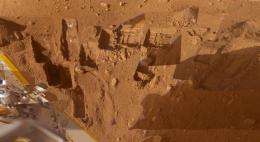
Smith used the Phoenix lander's robotic arm to dig a series of trenches to expose subsurface ice and found that the ice in the centers of the polygons was fairly shallow, only a couple of inches deep.
"But in the troughs in between, we went down as much as eight inches and never did find the ice underneath. We weren't able to dig further down because the robot arm was hitting against the side of the lander. It was not known ahead of time that there would be changes in the depth of the ice," he said.
"We wanted to know the origin of the ice," Smith said. "It could have been the remnant of a larger polar ice cap that shrank; could have been a frozen ocean; could have been a snowfall frozen into the ground," he said.
"The most likely theory is that water vapor from the atmosphere slowly diffused into the surface and froze at the level where the temperature matches the frost point. We expected that was probably the source of the ice, but some of what we found was surprising."
One of the surprises was finding perchlorate.
"Perchlorate was not predicted at this landing site and nobody had it on their list of likely chemicals. There was a very high concentration of it, higher than the salts we might have expected like sodium chloride (table salt). As an oxidized state of chlorine, it has interesting properties including a strong affinity for water. On Earth, microbes use it as a chemical energy source."
During the mission, Mars moved from summer to winter, giving Smith and others an unprecedented look at the planet's changing weather patterns, including frost and snow.
"Frost was predicted, but snowfall was quite a welcome surprise," Smith said. "In summer there was a lot of dust in the atmosphere. As we neared fall, the dust cleared, and all of a sudden there were water ice clouds forming at about 4 km (2.5 mi.) above the surface. We could see the clouds scud by, moving through the camera field, and once we saw snow coming out of the bottom of a cloud. It was very exciting to watch the daily weather changes. No one has ever had this experience."
Smith said there are clues that thin films of water modified the soil chemistry. Unlike Earth, Mars has an unstable spin axis, which currently is tilted at about 25 degrees from vertical. Perhaps five millions years ago, he said, it was tilted much more, which would have exposed the north pole to larger amounts of sunlight creating warmer, wetter conditions during summer.
"During that previous climate, you would expect huge increase in the amounts of water vapor coming off the polar cap. If the cap goes unstable, you can have as much as three hundred times as much water in the atmosphere," Smith said.
It would have been enough for snowdrifts. On hot summer days, melting snow could have formed thin films of water.
Not enough for a lake or a river, but he said this could have been a time when damp soil provided a growth period for any microbes that learned to survive those long periods of dryness.
"Who knows? Evolution is a powerful force. If life ever started on Mars, there are niches where still it could survive."
Source: University of Arizona (news : web)


