A question of height: Learning from reintroduction of once extinct butterfly in Britain
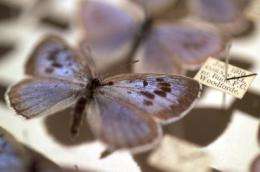
Intelligent countryside management could improve the survival chances of animal and plant species threatened by climate change. The creation of small heat-shielded habitats and better links between habitats would counteract a moderate temperature increase and give threatened species more time to adapt better and/or to migrate to cooler regions.
This is the conclusion drawn by scientists at the Helmholtz Centre for Environmental Research (UFZ) from a British study on saving the Large Blue butterfly (Maculinea arion). This butterfly became extinct in Britain in 1979 and was reintroduced there 25 years ago. Since then, the butterfly's reintroduction is seen as a model for the conservation of endangered insects.
A form of countryside management that creates cooler microclimatic conditions, for example through taller grass in today's meadows, should mitigate the effects of global warming in the short and medium term, say the researchers, writing in the current issue of Science. This is, however, not a long-term solution - just a stop-gap for the next few decades.
The Large Blue butterfly (Maculinea arion) is rather rare throughout many European countries. It is found in meadows and pastures where thyme grows because the caterpillars eat only this plant or its close relative, wild marjoram (Origanum vulgare). The butterfly's survival depends on a large number of factors - as it belongs to the genus Maculinea.
This means that it is dependent not only on a specific food plant for the caterpillars, but also on a particular species of ant. The caterpillars trick the ants into carrying them into their nest where they feed on the ants' brood through the winter. However, this trick works only on one very specific type of ant - only Myrmica sabuleti is tricked by the scent of the caterpillars' of the Large Blue. Other ants see through the disguise and remove any caterpillars that have been carried into their nest. During the decline of the Large Blue in Britain, M. sabuleti ants were crowded out by a competing species of ant, M. scabrinoides, which copes better with lower soil temperatures.
"A change in the height of the grass by one or two centimetres can result in a two or three degree temperature change in the ants' brood chambers just below the surface," explains Prof. Jeremy A. Thomas of Oxford University. The biologist spent decades studying the complicated interplay and his findings have now been published in the same issue of Science - in a publication to which the Helmholtz scientists refer.
The soil temperature dropped because the meadows on which the butterflies and ants had lived together for so long were grazed less, and because an epidemic among the wild rabbits, which used to keep the grass short, caused their numbers to plummet. A change in land use had thrown the sensitive interplay between the species off balance. By the time this was realised, it was already too late for the Large Blue in Britain. Once the precise reasons for the disappearance of the butterfly populations became known, scientists kept a lookout for suitable donor populations in other European countries so that the butterfly could be reintroduced.
Eventually, butterflies were brought in from Sweden and the meadows were kept short in line with the scientific findings. It was this that turned the reintroduction of the Large Blue into a success story. There are now more butterflies of this highly endangered species living in the UK than there were when records began in the 1950s. "The fact that it was possible to stop and reverse the decline could make this a model for many other insect conservation projects," hopes Jeremy Thomas.
His fellow scientists from the UFZ go a step further in a second article published in Science. The problem with the Large Blue butterfly was that the longer grass made the soil cooler. However, climate change will pose the opposite problem, and many species could simply find it too hot. "We could counter this by simply letting the grass grow longer. Then the microclimate at soil level would remain constant," suggests Dr Josef Settele of the UFZ, one of the two authors of the article. "This may sound trivial, but it is a very simple example of how modified countryside management can cushion against climate changes to give many species a breathing space to adapt or to migrate." Settele coordinates a number of large research projects investigating risks to biodiversity.
In order to recognise environmental changes like these in good time, researchers are now relying on more intensive environmental monitoring. This includes a butterfly monitoring programme in which thousands of volunteers in countries like the UK, the Netherlands and Germany count and record butterflies using the same method.
The Europe-wide butterfly-monitoring programme is being coordinated by Butterfly Conservation Europe (BCE, www.bc-europe.org). In Germany the Helmholtz Centre for Environmental Research (UFZ) has taken on the coordination of the German butterfly-monitoring programme (Tagfalter-Monitoring Deutschland, TMD). "Systematic records, like the ones kept for the Large Blue in England, show the potential offered by data that has been recorded systematically over the long term. The first four years of the German butterfly-monitoring programme have been very successful. The active participation of around 600 volunteers makes us optimistic that we will be able to make many more statements about a large number of species and large areas in a few years' time," says Elisabeth Kühn, co-author of the UFZ's contribution to Science. In the long term, the TMD data will form an important basis for realistic modelling, e.g. to show the impacts of climate and land use change on butterfly communities. This will provide an opportunity to make forecasts.
The Large Blue butterfly has been included in the European Grassland Butterfly Indicator, which provides information about the ecological status of meadows and pastures by recording typical butterflies. If monitoring can be firmly established as an early-warning system in the long term, there will be a greater chance of preventing species and populations from disappearing entirely, following the British example - ideally before they die out and have to be reintroduced. The UFZ authors therefore highlight the significance of the British study for insect conservation in general: many specialist species, which are frequently endangered, can be conserved only with the help of good ecological data and countryside management which has been derived from it - usually at landscape level.
Publications:
Josef Settele and Elisabeth Kühn (2009):
Insect Conservation.
Science 325, 41-42.
J. A. Thomas, D. J. Simcox, and R. T. Clarke (2009):
Successful Conservation of a Threatened Maculinea Butterfly.
Science 325, xx-xx
Science Express Reports. DOI: 10.1126/science.1175726
dx.doi.org/10.1126/science.1175726
Dover, J., Settele, J. (2009):
The influences of landscape structure on butterfly distribution and movement: a review
Journal of Insect Conservation 13 (1), 3-27
dx.doi.org/10.1007/s10841-008-9135-8
Settele, J., Kudrna, O., Harpke, A., Kühn, I., van Swaay, C., Verovnik, R., Warren, M., Wiemers, M., Hanspach, J., Hickler, T., Kühn, E., van Halder, I., Veling, K., Vliegenthart, A., Wynhoff, I., Schweiger, O. (2008):
Climatic risk atlas of European butterflies
Biorisk 1
Pensoft, Sofia, 710 S.
pensoftonline.net/biorisk/inde … ournal/issue/current
Kühn, E., Feldmann, R., Harpke, A., Hirneisen, N., Musche, M., Leopold, P., Settele, J. (2008):
Getting the public involved into butterfly conservation - lessons learned from a new monitoring scheme in Germany
Isr.J.Ecol.Evol. 54 (1), 89-103
dx.doi.org/10.1560/IJEE.54.1.89
Thomas, J. A., Settele, J. (2004):
Evolutionary biology: Butterfly mimics of ants
Nature 432 (7015), 283-284
dx.doi.org/10.1038/432283a
Source: Helmholtz Association of German Research Centres (news : web)


