Second Life data offers window into how trends spread
July 2, 2009
Second Life data offers window into how trends spread

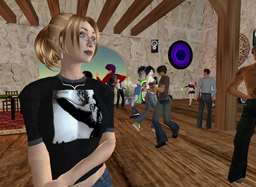
Avatars in Second Life hang out in a dance club. Dance moves are one type of gesture researchers from the University of Michigan studied in their exploration of how gestures propagate from friend to friend through the online community. Couresy of Linden Lab

(PhysOrg.com) -- Do friends wear the same style of shoe or see the same movies because they have similar tastes, which is why they became friends in the first place? Or once a friendship is established, do individuals influence each other to adopt like behaviors?

Social scientists don't know for sure. They're still trying to understand the role social influence plays in the spreading of trends because the doesn't keep track of how people acquire new items or preferences.

But the does. Researchers from the University of Michigan have taken advantage of this unique information to study how "gestures" make their way through this online community. Gestures are code snippets that Second Life avatars must acquire in order to make motions such as dancing, waving or chanting.

Roughly half of the gestures the researchers studied made their way through the virtual world friend by friend.

"We could have found that most everyone goes to the store to buy gestures, but it turns out about 50 percent of gesture transfers are between people who have declared themselves friends. The social networks played a major role in the distribution of these assets," said Lada Adamic, an assistant professor in the School of Information and the Department of Electrical Engineering and Computer Science.

Adamic is an author of a paper on the research that graduate student Eytan Bakshy will present on July 7 at the Association for Computer Machinery's Conference on Electronic Conference in Stanford, Calif. Bakshy is a doctoral student in the School of Information.

"There's been a high correspondence between the real world and virtual worlds," Adamic said. "We're not saying this is exactly how people share in the real world, but we believe it does have some relevance."

This study is one of the first to model social influence in a virtual world because of the rarity of having access to information about how information, assets or ideas propagate. In Second Life, the previous owner of a gesture is listed.

The researchers also found that the gestures that spread from friend to friend were not distributed as broadly as ones that were distributed outside of the social network, such as those acquired in stores or as give-aways.

And they discovered that the early adopters of gestures who are among the first 5-10 percent to acquire new assets are not the same as the influencers, who tend to distribute them most broadly. This aligns with what social scientists have found.

"In our study, we sought to develop a more rigorous understanding of social processes that underlies many cultural and economic phenomena," Bakshy said. "While some of our findings may seem quite intuitive, what I find most exciting is that we were actually able to test some rather controversial and competing hypotheses about the role of social networks in influence."

The researchers examined 130 days worth of gesture transfers in late 2008 and early 2009. They looked at 100,229 users and 106,499 gestures. They obtained the data from Linden Lab, the maker of Second Life. Personally-identifying information had been removed.

More information: The paper is called, "Social Influence and the Diffusion of User-Created Content." It can be found at http://www-persona … du/~ladamic/

Source: University of Michigan (news : web)

Filter


Move the slider to adjust rank threshold, so that you can hide some of the comments.


Display comments: newest first

Nan2
Jul 03, 2009

Rank: not rated yet
I note there is no definition to the correspondence to the real world. One might also define which gestures were shared rather than bought and for what reason....I bet I can GUESS the correct answer to that one! ugh. This study is creepy and perhaps naive.

Social networks using a group that may have social inadequacies in real life may produce bad results, ya think?
Rank not rated yet
Related Stories
Relevant PhysicsForums posts

More news stories

2.1 million viewers live stream Super Bowl online

(AP) -- The first live stream of the Super Bowl drew 2.1 million unique viewers, NBC said Thursday.

Technology / Internet

created 55 minutes ago | popularity not rated yet | comments 1

Japan electronic giants eye chip merger: reports

Three of Japan's biggest electronics companies are to join forces in a chip-making venture, according to reports, days after a swathe of dire results from a sector struggling to compete globally.

Technology / Business

created 33 minutes ago | popularity not rated yet | comments 0

Hundreds of gamers flock to Brazil tech fest

Hundreds of geeks and gamers braved Sao Paulo's torrid heat Tuesday to play online video games at the fifth edition of Brazil's Campus Party, an annual, week-long technology fest.

Technology / Software

created 13 minutes ago | popularity not rated yet | comments 0

Baseball legend fields fantasy world video game

Electronic Arts has released a much-anticipated "Kingdoms of Amalur: Reckoning" video game created by an all-star team put together by World Series champion pitcher Curt Schilling.

Technology / Software

created 50 minutes ago | popularity not rated yet | comments 0

Samsung says to sell 25 mln 'smart TVs' this year

South Korea's Samsung Electronics said on Wednesday it plans to sell more than 25 million "smart TVs" this year as it tries to capture the emerging Internet TV market eyed by competitors including Apple.

Technology / Business

created 3 minutes ago | popularity not rated yet | comments 0


Scared of a younger rival? Not for some male songbirds

When mature male white-crowned sparrows duel to win a mate or a nesting territory, a young bird just doesn't get much respect.

Tiny primate 'talks' in ultrasound

One of the world's smallest primates, the Philippine tarsier, communicates in a range of ultrasound inaudible to predator and prey alike, according to a study published on Wednesday.

Preventing bacteria from falling in with the wrong crowd could help stop gum disease

Stripping some mouth bacteria of their access key to gangs of other pathogenic oral bacteria could help prevent gum disease and tooth loss. The study, published in the journal Microbiology suggests that t ...

New study sheds light on genetics of rice metabolism

A large-scale study analyzing metabolic compounds in rice grains conducted by researchers at the RIKEN Plant Science Center (PSC) and their collaborators has identified 131 rice metabolites and clarified the ...

Study examines role of bilingualism in children's development

A new study on children who are raised bilingual examined the effects on children's development of growing up speaking two languages. The study found that different factors were responsible for the language- and non-language-related ...

Getting caffeine fix as easy as taking deep breath

(AP) -- Move over, coffee and Red Bull. A Harvard professor thinks the next big thing will be people inhaling their caffeine from a lipstick-sized tube. Critics say the novel product is not without its risks.