Australian scientists hail triple dinosaur find
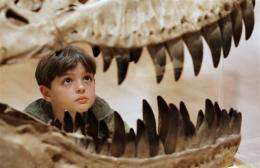
July 3, 2009 by Talek Harris Will Murphy, 7, inspects the teeth of a Theropod dinosaur

Enlarge

Will Murphy, 7, inspects the teeth of a Theropod dinosaur at an exhibition at the Melbourne Museum, 2008. Australian scientists hailed the country's most significant dinosaur discovery in decades on Friday after three new species were unearthed in a Queensland billabong.

Australian scientists hailed the country's most significant dinosaur discovery in decades on Friday after three new species were unearthed in a Queensland billabong.

The flesh-eating theropod -- dubbed Australia's answer to the "Jurassic Park" velociraptors -- and two sauropods had lain in a 98 million-year-old geological deposit until a recent archaeological dig.

Scientists said the three, named Banjo, Matilda and Clancy in honour of Australia's most famous song, "Waltzing Matilda", opened up an exciting new front in the world of dinosaur research.

"Wow! This is amazing stuff," said John Long, head of sciences at Museum Victoria.

"I would regard the paper by Scott Hocknull and his team as one of the most significant papers ever published on Australian to date."

Queensland Museum researcher Hocknull and his team found the fossils in the billabong, or small lake, near the Outback town of Winton, where poet Banjo Paterson is said to have written "Waltzing Matilda" in 1885.

The team used bulldozers to carve through the site's unyielding topsoil before digging with hand tools in the thick clay beneath, back-breaking work which yielded Australia's first major dinosaur discovery since 1981.

Hocknull compared the , from the family, to the velociraptors made famous in 1993's "Jurassic Park", only "many times bigger and more terrifying".

"He could run down most prey with ease over open ground. His most distinguishing feature was three large slashing claws on each hand," Hucknull said.

"Unlike some theropods that have small arms, Banjo was different. His arms were a primary weapon. He?s Australia's answer to velociraptor but many times bigger and more terrifying.

The plant-eating Matilda and Clancy belong to the giant titanosaur family, the biggest creatures ever to walk the earth.

"These discoveries are a major breakthrough in the scientific understanding of prehistoric life in Australia," said state premier Anna Bligh, as she announced the find in Winton.

Scientists said Australia's continent-sized Outback could hold untold treasures for palaeontogists.

"When we think of dinosaurs we think North America, Europe, South America, Africa, not Australia," said Rod Wells, of Flinders University.

"Australia is the exciting new frontier in vertebrate palaeontology, a continent as large as North America awaiting exploration."

Hocknull also held out hope that more discoveries were waiting for his team near Winton.

"Many hundreds more fossils from this dig await preparation and there is much more material left to excavate," Hocknull said.

(c) 2009 AFP


print this article email this article download pdf blog this article bookmark this article     Stumble it Digg this share on Facebook retweet share on Reddit add to delicious
Rate this story - 4.5 /5 (15 votes)

Rank Filter

Move the slider to adjust rank threshold, so that you can hide some of the comments.


Display comments: newest first

  • gopher65 - Jul 03, 2009
    • Rank: 4 / 5 (1)
    "Australia is the exciting new frontier in vertebrate palaeontology, a continent as large as North America awaiting exploration."

    Australia: 7,686,850 km^2
    North America: 24,709,000 km^2

    Yup, those are *totally* the same size. I can barely tell the difference! What's frightening is that that guy is an Associate Professor at Flinders. Ah well. Could be worse. He could have been a geologist.

July 3, 2009 all stories

Comments: 1

4.5 /5 (15 votes)
  • Stumble this up

  • Digg this

  • share this

  • hide
  • Related Stories

  • Aussie museum displays huge dinosaur bones
    created Jul 20, 2005 | popularity not rated yet | comments 0
  • Researchers find an Australian dinosaur with South American heritage
    created Jun 11, 2008 | popularity not rated yet | comments 0
  • Paleontologist reports discovery of carnivorous dinosaur tracks in Australia
    created Oct 19, 2007 | popularity not rated yet | comments 0
  • Only second Jurassic dinosaur ever found in Antarctica
    created Dec 10, 2007 | popularity not rated yet | comments 0
  • America's smallest dinosaur uncovered
    created Sep 23, 2008 | popularity not rated yet | comments 0


  • hide
  • Relevant PhysicsForums posts

  • Breeding program
    created 10 hours ago
  • How does a concentration gradient provide energy?
    created 14 hours ago
  • Eyesight and Neural Damage from Electronics
    created Nov 19, 2009
  • Quick question about the Golgi Apparatus?
    created Nov 19, 2009
  • More from Physics Forums - Biology

Other News

Researcher says text proves Shroud of Turin real (AP)

Researcher says text proves Shroud of Turin real

Other Sciences / Archaeology & Fossils

created 11 hours ago | popularity 1.8 / 5 (14) | comments 16

(AP) -- A Vatican researcher claims a nearly invisible text on the Shroud of Turin proves the authenticity of the artifact revered as Jesus' burial cloth. The claim made in a new book by historian Barbara ...


Three of a kind

Three of a kind: Revealing language’s universal essence

Other Sciences / Social Sciences

created 15 hours ago | popularity 3.7 / 5 (7) | comments 6

(PhysOrg.com) -- On the surface, English, Japanese, and Kinande, a member of the Bantu family of languages spoken in the Democratic Republic of Congo, have little in common. It is not just that the vocabularies ...


Active hearing process in mosquitoes

Active hearing process in mosquitoes

Other Sciences / Mathematics

created 21 hours ago | popularity not rated yet | comments 0

A mathematical model has explained some of the remarkable features of mosquito hearing. In particular, the male can hear the faintest beats of the female's wings and yet is not deafened by loud noises.


Glorious Dawn: Sagan, Hawking Sing (w/ Video)

Other Sciences / Other

created Nov 12, 2009 | popularity 4.6 / 5 (17) | comments 8

Astronomer and long time science advocate Carl Sagan once said that he was "not very good at singing songs." But on Nov. 9 in Washington D.C., his voice could be heard singing about the wonders of universe -- 13 years after ...


U. of Neb. board votes down stem-cell rule changes (Update)

Other Sciences / Other

created 19 hours ago | popularity not rated yet | comments 0

(AP) -- The University of Nebraska's governing board on Friday voted down a proposal to restrict the school's rules governing embryonic stem-cell research beyond what the federal government allows.