Rare sheep could be key to better diagnostic tests in developing world, study
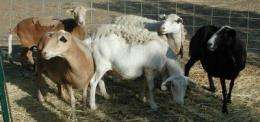
The newest revolution in microbiology testing walks on four legs and says "baa."
It's the hair sheep, a less-hirsute version of the familiar woolly barnyard resident. A new study from the Stanford University School of Medicine, which is to be published July 3 in PLoS ONE, finds that not only are these ruminants low-maintenance and parasite-resistant, they're also perfect blood donors for the microbiology tests necessary to diagnose infectious disease in the developing world.
Identifying microbes from a patient's urine or sputum requires growing those microbes in culture dishes filled with gelatinous agar and a small amount of blood. The blood provides nutrients to the growing bugs and also provides clues as to the microbes' identities: Microbiologists can rule out or identify certain strains of bacteria based on how the organisms interact with the blood cells in culture.
In the developed world, microbiologists use sheep or horse blood. But in many parts of the developing world, horses are prohibitively expensive, and regular sheep, with their constant need for shearing and tendency to get infections, are difficult to keep alive. Importing animal blood isn't feasible either, as shipping is costly and often unreliable.
Many labs in the developing world use human blood, often donated by lab technicians themselves. But diagnostic tests aren't standardized for human blood, said Ellen Yeh, MD, a resident in pathology at Stanford and first author on the paper. "You don't get the same test results when you use human blood versus sheep blood," she said. In addition, the use of human donors increases technicians' risk of infection with blood-borne diseases.
Ellen Jo Baron, PhD, professor of pathology at the medical school and senior author on the paper, wanted to do better. She's a veteran of overseas microbiology, having trained lab technicians from Botswana to Cambodia for more than a decade.
"Up until the time I saw a hair sheep — which I first saw in Botswana — I had no idea there was even such a thing," said Baron, who is associate director of Stanford's clinical microbiology lab, interim director of the clinical virology lab, and associate chair of pathology for faculty development. She wasted no time in learning about the animals, finding that they resist parasites, don't need to be sheared, and do well in the tropical climes prevalent in much of the developing world.
But no one had tested whether their blood was equivalent to horse or sheep blood. So, calling in a favor from a colleague with a hobby farm near Walnut Creek, Calif., Baron and her colleagues collected blood from hair sheep — the animals are remarkably mellow about the donations, she said — and created test cultures using the blood. Then, they ran a series of common diagnostic tests.
"It worked for every single thing," Baron said.
The researchers also found that they could collect the blood in donation bags, much like those human donors might see at the Red Cross. That's a big advantage over the defibrination process the developed world uses. To defibrinate blood, technicians must shake the samples in a glass jar filled with hundreds of tiny glass beads constantly during and after the donation. That's fine in a lab with machines to do the shaking and autoclaves to sterilize all of those beads, but it's an enormous burden in labs without that equipment. Fortunately, Baron found, hair sheep blood collected in donation bags performed the same as defibrinated blood.
"It's very important," said Bruce Hanna, PhD, professor of pathology and microbiology at the New York University School of Medicine, who was not involved in the study. "This paper found an alternative that is able to be produced in Africa and provides identical results to the standardized products that are used in this country."
Michele Barry, MD, senior associate dean for global health at Stanford medical school, added: "Diagnosis of bacterial diseases and antibiotic sensitivity in low resource settings is often infeasible due to cost, access to diagnostics or manpower. Ellen Jo Baron and colleagues have uniquely decided to combine veterinary health science and human blood banking to develop a blood agar from hair sheep as medium to grow bacteria. This sheep is a low-maintenance animal adopted for hot climates. The technology, which they are modeling in Botswana, is an example of a practical 'can do' innovation in microbiology that will save lives in the tropics at low cost by quickly identifying bacteria to tailor cost-effective antibiotic use — a precious commodity overseas."
Now, said Baron and Yeh, the only hurdle is getting the sheep to the labs that need them. Two veterinary labs in Botswana already provide hair sheep blood to local labs based on Baron's initial results. Baron is now lobbying the charity Heifer International to add hair sheep to its catalogue so microbiologists can donate and send the animals to the developing world. After all, she said, the sheep can provide milk and meat — and that's on top of their role as donors of blood that, in her words, "works perfectly for every microbiology test that a laboratory would need to do."
Source: Stanford University Medical Center (news : web)


