Caffeine reverses memory impairment in Alzheimer's mice
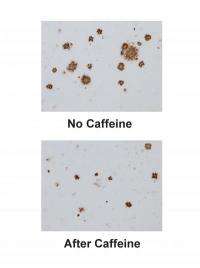
Coffee drinkers may have another reason to pour that extra cup. When aged mice bred to develop symptoms of Alzheimer's disease were given caffeine - the equivalent of five cups of coffee a day - their memory impairment was reversed, report University of South Florida researchers at the Florida Alzheimer's Disease Research Center.
Back-to-back studies published online today in the Journal of Alzheimer's Disease, show caffeine significantly decreased abnormal levels of the protein linked to Alzheimer's disease, both in the brains and in the blood of mice exhibiting symptoms of the disease. Both studies build upon previous research by the Florida ADRC group showing that caffeine in early adulthood prevented the onset of memory problems in mice bred to develop Alzheimer's symptoms in old age.
"The new findings provide evidence that caffeine could be a viable 'treatment' for established Alzheimer's disease, and not simply a protective strategy," said lead author Gary Arendash, PhD, a USF neuroscientist with the Florida ADRC. "That's important because caffeine is a safe drug for most people, it easily enters the brain, and it appears to directly affect the disease process."
Based on these promising findings in mice, researchers at the Florida ADRC and Byrd Alzheimer's Center at USF hope to begin human trials to evaluate whether caffeine can benefit people with mild cognitive impairment or early Alzheimer's disease, said Huntington Potter, PhD, director of the Florida ADRC and an investigator for the caffeine studies. The research group has already determined that caffeine administered to elderly non-demented humans quickly affects their blood levels of β-amyloid, just as it did in the Alzheimer's mice.
"These are some of the most promising Alzheimer's mouse experiments ever done showing that caffeine rapidly reduces beta amyloid protein in the blood, an effect that is mirrored in the brain, and this reduction is linked to cognitive benefit," Potter said. "Our goal is to obtain the funding needed to translate the therapeutic discoveries in mice into well-designed clinical trials."
Arendash and his colleagues became interested in caffeine's potential for treating Alzheimer's several years ago, after a Portuguese study reported that people with Alzheimer's had consumed less caffeine over the last 20 years than people without the neurodegenerative disease. Since then, several uncontrolled clinical studies have reported moderate caffeine consumption may protect against memory decline during normal aging. The highly controlled studies using Alzheimer's mice allowed researchers to isolate the effects of caffeine on memory from other lifestyle factors such as diet and exercise, Arendash said.
The just-published Florida ADRC study included 55 mice genetically altered to develop memory problems mimicking Alzheimer's disease as they aged. After behavioral tests confirmed the mice were exhibiting signs of memory impairment at age 18 to 19 months - about age 70 in human years - the researchers gave half the mice caffeine in their drinking water. The other half got plain water. The Alzheimer's mice received the equivalent of five 8-oz. cups of regular coffee a day. That's the same amount of caffeine - 500 milligrams -- as contained in two cups of specialty coffees like Starbucks, or 14 cups of tea, or 20 soft drinks.
At the end of the two-month study, the caffeinated mice performed much better on tests measuring their memory and thinking skills. In fact, their memories were identical to normal aged mice without dementia. The Alzheimer's mice drinking plain water continued to do poorly on the tests.
In addition, the brains of the caffeinated mice showed nearly a 50-percent reduction in levels of beta amyloid, a substance forming the sticky clumps of plaques that are a hallmark of Alzheimer's disease. Other experiments by the same investigators indicate that caffeine appears to restore memory by reducing both enzymes needed to produce beta amyloid. The researchers also suggest that caffeine suppresses inflammatory changes in the brain that lead to an overabundance of beta amyloid.
Since caffeine improved the memory of mice with pre-existing Alzheimer's, the researchers were curious to know if it might further boost the memory of non-demented (normal) mice administered caffeine from young adulthood through old age. It did not. Control mice given regular drinking water throughout their lives performed as well on behavioral tests in old age as normal mice who received long-term caffeine treatment, Arendash said. "This suggests that caffeine will not increase memory performance above normal levels. Rather, it appears to benefit those destined to develop Alzheimer's disease."
The researchers do not know if an amount lower than the 500 mg. daily caffeine intake received by the Alzheimer's mice would be effective, Arendash said. For most individuals, however, this moderate level of caffeine intake poses no adverse health effects, according to both the National Research Council and the National Academy of Sciences. Nonetheless, Arendash said, individuals with high blood pressure or those who are pregnant should limit their daily caffeine intake.
If larger, more rigorous clinical studies confirm that caffeine staves off Alzheimer's in humans, as it does in mice, this benefit would be substantial, Arendash said. Alzheimer's disease attacks nearly half of Americans age 85 and older, and Alzheimer's and other dementias triple healthcare costs for those age 65 and older, according to the Alzheimer's Association.
More information:
1. Caffeine Reverses Cognitive Impairment and Decreases Brain Amyloid-β Levels in Aged Alzheimer's Disease Mice; Gary W Arendash, Takashi Mori, Chuanhai Cao, Malgorzata Mamcarz, Melissa Runfeldt, Alexander Dickson, Kavon Rezai-Zadeh, Jun Tan, Bruce A Citron, Xiaoyang Lin, Valentina Echeverria, and Huntington Potter; Journal of Alzheimer's Disease, Volume 17:3 (July 2009). www.j-alz.com
2. Caffeine Suppresses Amyloid-β Levels in Plasma and Brain of Alzheimer's Disease Transgenic Mice; Chuanhai Cao, John R Cirrito, Xiaoyang Lin, Lilly Wang, Deborah K Verges, Alexander Dickson, Malgorzata Mamcarz, Chi Zhang, Takashi Mori, Gary W Arendash, David M Holzman, and Huntington Potter; Journal of Alzheimer's Disease, Volume 17:3 (July 2009).
Source: University of South Florida Health


