Nano Measurement in the 3rd Dimension
July 6, 2009 Nano Measurement in the 3rd Dimension

Enlarge

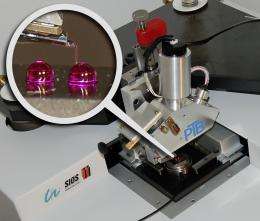
The micro probe used in the micro-nano CMM measures the form and the spacing of two reference spheres with diameters of two millimetres each. The figure shows a survey of the system and the proportions of measuring probe and measurement object in detail. (Image: PTB)

From the motion sensor to the computer chip - in many products of daily life components are used whose functioning is based on smallest structures of the size of thousandths - or even millionths - of millimetres. These micro and nano structures must be manufactured and assembled with the highest precision so that in the end, the overall system will function smoothly.

Thereby, details are important - and therefore scientists at the Physikalisch-Technische Bundesanstalt (PTB, Germany) have developed a metrological scanning probe microscope into a micro and nano coordinate measuring instrument. This now allows dimensional quantities with nanometer resolution also to be measured on three-dimensional objects in an extraordinarily large measurement range of 25 mm x 25 mm x 5 mm. The new device is already extensively being used at PTB - to a large part for calibration orders from industry and research.

Often, such small dimensions can be grasped only when they are transferred to everyday life. If we assume, for example, that someone lost a cube of sugar within an area of 25 square kilometres - the new micro and nano coordinate measuring instrument would not only be able to find it, but it would also be able to determine its exact position and shape. This does not only apply to plane surfaces, but also to three-dimensional landscapes, for example if the cube of sugar were stuck to a steep wall.

As increasingly, components with structures in the micro- and nanometer range are being used in industry, dimensional metrology on such structures is becoming increasingly important. To meet the increasing requirements for 3D measurements of micro and nano structures, 3D measuring probes newly developed at PTB were incorporated in a metrological scanning probe microscope based on a commercial nano-positioning system with integrated laser displacement sensors of the company SIOS Messtechnik GmbH. The new functionalities given by the measuring probe and the software extend the scanning probe microscope to a metrological micro/nano coordinate measuring machine (CMM) which also allows 3D measurements conforming to standards to be performed on micro and nano structures.

International intercomparisons on step-height standards and lattice structures have shown that the measuring system is worldwide one of the most precise of its kind. For step heights, measurement uncertainties in the subnanometer range - and for measurements of the mean structure spacing on extensive lattice standards even in the range of 10 picometers - have been achieved and confirmed in comparison with optical diffraction measurements.

The new measuring instrument is available for dimensional precision measurements with nm resolution on 3D micro and nano structures such as micro gears, micro balls, hardness indenters and nano lattice standards as well as for comparisons of measures; moreover, it serves as a platform for research and development tasks. It is an important link between nano, micro and macro coordinate metrology.

Source: Physikalisch-Technische Bundesanstalt (PTB)


print this article email this article download pdf blog this article bookmark this article     Stumble it Digg this share on Facebook retweet share on Reddit add to delicious
Rate this story - 4.3 /5 (3 votes)


July 6, 2009 all stories

Comments: 0

4.3 /5 (3 votes)
  • Stumble this up

  • Digg this

  • share this

  • hide
  • Related Stories

  • Scaling Friction Down to the Nano/Micro Realm
    created May 28, 2004 | popularity not rated yet | comments 0
  • Error message! How mobile phones distort measurements
    created Sep 17, 2008 | popularity not rated yet | comments 0
  • Nano drops from the one-way pack
    created Sep 15, 2004 | popularity not rated yet | comments 0
  • Equivalence principle in space test
    created May 11, 2009 | popularity not rated yet | comments 0
  • Shadow Technique Improves Measurement of Micro Holes
    created Jun 02, 2005 | popularity not rated yet | comments 0


  • hide
  • Relevant PhysicsForums posts

  • coefficient of Friction
    created 2 hours ago
  • how can I collect power from a magnetic field?
    created 3 hours ago
  • Definite phase?
    created 5 hours ago
  • What is time?
    created 9 hours ago
  • More from Physics Forums - General Physics

Other News

New Digital 'Electronics' Concept May Continue Moore's Law

New Digital 'Electronics' Concept May Continue Moore's Law

Nanotechnology / Nanophysics

created Nov 05, 2009 | popularity 4.6 / 5 (50) | comments 8

(PhysOrg.com) -- Computers of the future could be operating not on electrons, but on tiny waves traveling through an electron "fluid," if a new proposal is successful. The new circuit design, recently introduced ...


Nanoparticles for gene therapy improve

Nanoparticles for gene therapy improve

Nanotechnology / Bio & Medicine

created Nov 06, 2009 | popularity 5 / 5 (4) | comments 3

(PhysOrg.com) -- About five years ago, Professor Janet Sawicki at the Lankenau Institute in Pennsylvania read an article about nanoparticles developed by MIT's Robert Langer for gene therapy, the insertion ...


Breakthrough in industrial-scale nanotube processing

Breakthrough in industrial-scale nanotube processing

Nanotechnology / Nanomaterials

created Nov 02, 2009 | popularity 4.9 / 5 (20) | comments 3

(PhysOrg.com) -- Rice University scientists today unveiled a method for the industrial-scale processing of pure carbon-nanotube fibers that could lead to revolutionary advances in materials science, power ...


Scientists witness nature's complexity unfold in self-assembling quasicrystals

Scientists witness nature's complexity unfold in self-assembling quasicrystals

Nanotechnology / Nanomaterials

created Oct 31, 2009 | popularity 4.9 / 5 (16) | comments 3

(PhysOrg.com) -- Just a few decades ago, scientists believed that all ordered matter consists of self-repeating building blocks -- atoms, ions or molecules. In this view, the ordinary solids of everyday life ...


Nanoparticles may cause DNA damage across a cellular barrier

Nanoparticles may cause DNA damage across a cellular barrier

Nanotechnology / Bio & Medicine

created Nov 05, 2009 | popularity 4.3 / 5 (9) | comments 1

(PhysOrg.com) -- Scientists have shown in the laboratory that metal nanoparticles damaged the DNA in cells on the other side of a cellular barrier. The research, by the University of Bristol, is published ...